
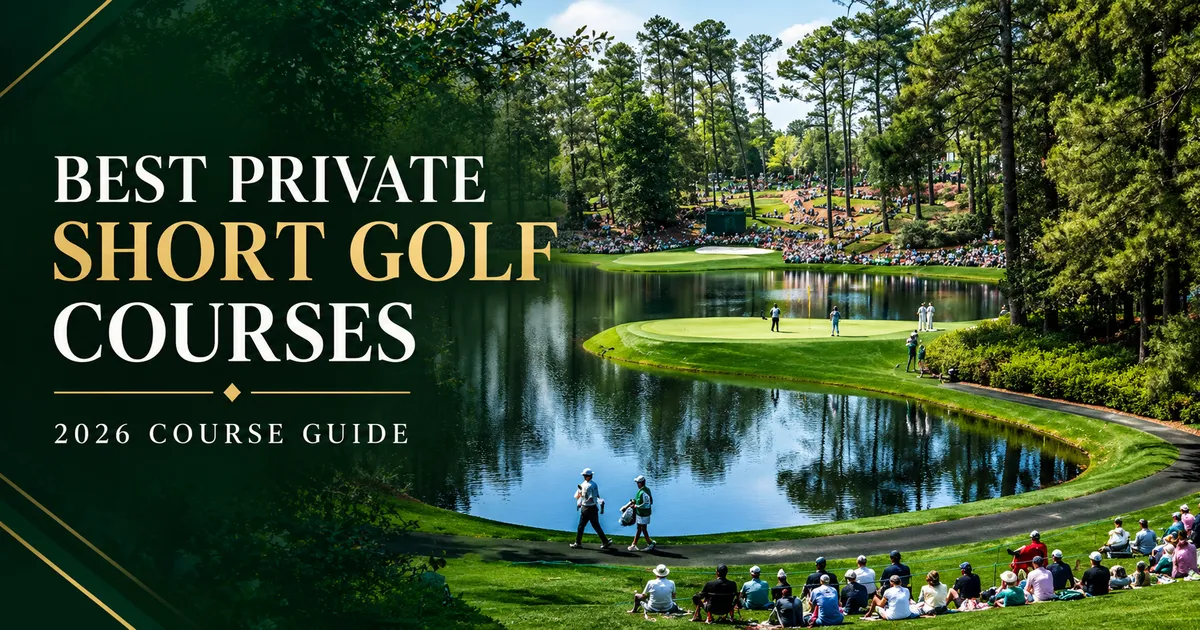
Golfweek has released its 2026 ranking of America’s top 25 private par-3, short and non-traditional golf courses, highlighting a category of golf architecture that continues to gain attention from leading designers, club operators and players.
Published on October 23, the latest Golfweek’s Best list examines private layouts that offer something different from traditional championship-length courses.
These facilities range from compact par-3 layouts to unconventional courses featuring unusual hole counts, shorter playing distances and designs intended to encourage creativity.
The ranking arrives as short-course golf becomes an increasingly important part of the experience offered by private clubs and major resorts.
Why Short Golf Courses Are Becoming More Important
Golf courses do not necessarily need 18 holes or a conventional par of 72 to provide a memorable playing experience.
Short courses often emphasize approach shots, putting, recovery skills and strategic decisions rather than maximum driving distance.
Their compact designs can also provide opportunities for social golf, casual competitions and shorter rounds.
For private clubs, a short course may complement a full-length championship layout by creating an alternative for members who have limited time or want to practice different parts of their games.
These facilities can also make golf more approachable for juniors, beginners and families, depending on the club’s access policies and how its course is operated.
The category is not entirely new.
Several historically significant private golf clubs have maintained shorter layouts for decades.
However, increased investment in short-course architecture has brought renewed attention to their value.
How Golfweek Evaluates Short and Non-Traditional Courses
Golfweek first introduced a dedicated ranking for short and non-traditional layouts in 2023.
The publication divided the category into separate private and public-access lists in 2024.
Rather than applying exactly the same assessment structure used for traditional courses, Golfweek asks its evaluators to provide an overall score based on the design and playing experience.
Those assessments are combined into an average rating.
Courses must receive at least 10 evaluations to qualify.
The approach recognizes that a nine-hole par-3 course should not necessarily be assessed using precisely the same expectations as a full-length championship venue.
Short courses can offer different architectural qualities, including unusual green complexes, distinctive bunker arrangements and multiple strategic shot options.
The latest private ranking focuses on facilities where access is generally limited to members and their authorized guests.
Golfweek publishes a separate list for layouts available to the wider public.
Pine Valley Demonstrates the Appeal of a Short Course
One of America’s most famous private short-course experiences is the Tom Fazio-designed layout at Pine Valley Golf Club in New Jersey.
The course opened in 1992 and features 10 holes designed to recreate some of the memorable approach-shot challenges found on the club’s renowned championship course.
Developed with club chairman Ernie Ransome, the project was intended to complement the original Pine Valley experience rather than compete with it.
Eight of its 10 holes draw inspiration from approach shots on the main course, while the remaining two are original designs.
The layout placed first in Golfweek’s 2025 private short-course ranking, illustrating the recognition it had received before the newest edition.
Its design demonstrates how a compact course can preserve complex strategic demands without requiring the length of a traditional championship layout.
For recreational golfers, the architectural lesson is particularly interesting: approach-shot difficulty depends on far more than distance alone.
Green contours, bunkers, elevation changes and surrounding terrain can create challenging decisions even when a hole requires only one full shot.
Augusta National’s Par-3 Course Combines History and Tradition
Another celebrated example of short-course architecture is Augusta National Golf Club’s nine-hole Par 3 Course.
Designed by George Cobb, the course opened in 1958 and became closely associated with the annual Masters Par 3 Contest.
The competition gives Masters participants an opportunity to play a more relaxed event before the tournament begins.
Families and children frequently participate as caddies, making the occasion one of the most recognizable traditions in championship golf.
The course itself has undergone significant changes over time.
Ahead of the 2023 Masters, Augusta National completed an extensive project involving changes to the routing, greens and surrounding landscape.
The renovations improved the experience for both golfers and spectators.
The Par 3 Course placed third in Golfweek’s 2025 private short-course ranking.
Its continuing importance illustrates the lasting appeal of a compact layout connected to one of the sport’s most historic institutions.
Philadelphia Cricket Club Shows That Short Courses Can Have Major Championship History
Not all short courses were originally designed as recreational additions to larger golf facilities.
The St. Martins Course at Philadelphia Cricket Club offers a different example.
Golf was introduced at the club in 1895, when its original nine-hole layout was established.
The property subsequently expanded to 18 holes and hosted the U.S. Open championships in 1907 and 1910.
Today, St. Martins operates as a nine-hole course.
Its history demonstrates that some layouts now classified as short or non-traditional once played a substantial role in American championship golf.
The course ranked second on Golfweek’s 2025 private list.
St. Martins also illustrates why the category extends beyond exclusively par-3 golf.
Its combination of par-3, par-4 and par-5 holes creates a different experience from purpose-built pitch-and-putt facilities.
The course retains historical significance despite no longer operating as a standard 18-hole championship venue.
Modern Private Clubs Are Investing in Short-Course Design
While historic courses attract attention, newer short-course developments reflect changing expectations among club members.
Oakwood Country Club in Kansas City, Missouri, provides one example.
Its nine-hole short course, designed with involvement from Todd Clark and Ron Whitten, opened in 2023.
The course rose to fourth place in Golfweek’s 2025 private ranking after placing 12th the previous year.
That earlier movement showed how a recently developed layout could establish a strong reputation among Golfweek’s evaluators.
Hamilton Farm Golf Club in New Jersey represents another approach.
Its Hickory Course features 18 par-3 holes, providing a longer series of short-game challenges than the more common nine-hole format.
Designed by Michael Hurdzan and Dana Fry, the course demonstrates that short-course golf can also offer a complete 18-hole experience.
Together, these examples show the variety of formats available to private clubs.
A successful short course may feature six, nine, 10, 12 or 18 holes, depending on its intended role and the land available.
Private and Public Short Courses Offer Different Experiences
One important distinction in Golfweek’s 2026 coverage is the separation of private clubs from public-access golf.
Private short courses are generally intended for members and authorized guests.
They may form part of a broader club experience that includes championship golf, practice facilities and other recreational amenities.
Public-access short courses, by contrast, may be available through regular reservations, resort stays or daily-fee arrangements.
Golfweek’s 2026 public-access ranking places Bandon Preserve at Bandon Dunes Golf Resort in Oregon first, followed by Golden Gate Park Golf Course in San Francisco and The Sandbox at Sand Valley in Wisconsin.
Those courses are evaluated in a separate category from the private facilities.
The distinction matters for golfers planning trips because a high ranking does not automatically mean a course is available to book.
Readers should confirm the course’s access arrangements before making travel plans.
What Makes a Great Short Golf Course?
The most interesting short-course designs demonstrate that quality golf architecture is not determined solely by yardage.
A demanding par-3 may require precise distance control, thoughtful club selection and the ability to negotiate a difficult green complex.
The absence of long drives can also place greater emphasis on the parts of the game that frequently determine scores.
However, short courses can serve different purposes.
Some are designed as serious tests of approach-shot skill, while others prioritize recreation, social interaction and accessibility.
Golfweek’s ranking recognizes this variety by evaluating the overall experience rather than relying exclusively on conventional championship-course characteristics.
That flexibility helps explain why historic venues and newer developments can appear within the same category.
What the 2026 Rankings Mean for Golf Architecture
Golfweek’s continued publication of dedicated short-course rankings reflects the growing recognition of these layouts as important golf facilities in their own right.
For designers, they create opportunities to experiment with green complexes, bunker placement and unusual routing decisions.
For private clubs, they provide alternatives to full-length golf and can broaden the variety of experiences available to members.
For players, they demonstrate that shorter golf can still be creative, challenging and rewarding.
The most significant lesson is that a course does not need to be long to provide architectural interest.
Whether inspired by historic approach shots, designed for family-oriented golf or created as a challenging par-3 experience, short courses have an increasingly visible place in American golf.
Final Thoughts
Golfweek’s Best 2026 private short-course ranking brings renewed attention to a part of the golf industry that continues to evolve.
Layouts such as Pine Valley’s Short Course, Augusta National’s Par 3 Course and Philadelphia Cricket Club’s historic St. Martins demonstrate the architectural and cultural importance of shorter golf.
Modern facilities such as Oakwood’s short course and Hamilton Farm’s Hickory Course provide further examples of the different experiences these layouts can offer.
The full 2026 list should be consulted for the current positions and ratings, rather than relying on earlier rankings.
But the broader significance is already evident: private short courses are no longer simply secondary facilities. Many have become distinctive golf destinations within their clubs, combining strategic design, history and an alternative way to enjoy the game.
Source: Golfweek’s Best 2026 ranking of private par-3, short and non-traditional golf courses, published October 23, 2026. Historical ranking information is identified as 2025 data.