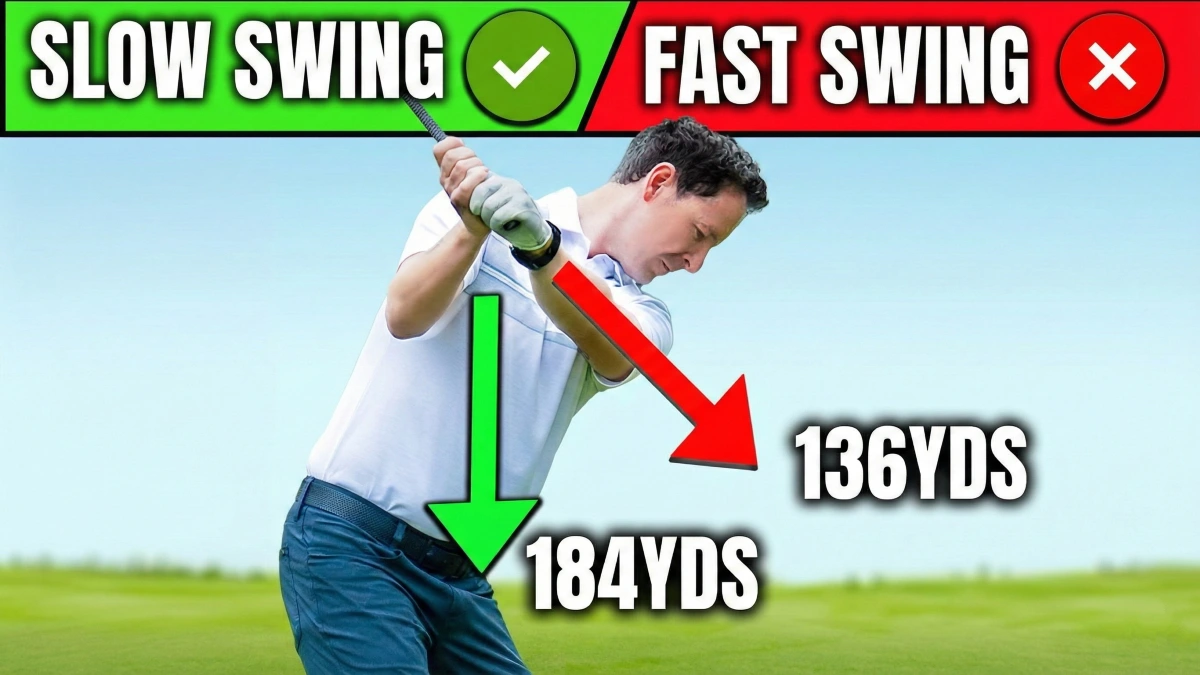
Why You Can’t Hit Your Irons As Far As You Should – STOP THIS!
Meet Sam. He is in his 50s, physically strong, and works harder than anyone else on the driving range. But when Danny Maude saw him, Sam was miserable. He was sweating and swinging with 100% maximum effort. Yet, his club head speed was stuck at a low 70mph. The ball was going nowhere. He topped shots. He hit the ground behind the ball.
Does this sound like your Saturday morning? You buy new clubs and watch videos, but the harder you swing, the shorter the ball goes. This is the tension trap. Most golfers believe that distance comes from muscle. They grip the club tight and force the shot. This creates rigid tension. It ruins contact and kills speed.
But there is a fix. It does not require more gym time. It requires doing less. In under one hour, Sam went from a strained 70mph to an effortless 93mph. He gained over 20mph of ball speed by learning to let go. This guide shows exactly how he did it.
The Swing Tuner
The Swing Tuner
Adjust the mechanics for maximum distance.
100y
200y
300y
🏌️
1. Grip
Rigid/Tight
Loose/Heavy
2. Path
Forced
Hinged
3. Power
Arms Only
Body Turn
4. Rhythm
Rushed
Da-Da-Da
0 YDS
Topped Shot
Advice goes here.
The “Tension Trap”: Why Harder Swings Go Shorter
Credit: DepositPhotos
Your brain plays a trick on you. It thinks that to hit the ball far, you must tense your muscles. But in golf, tense muscles are slow muscles.
Think of a whip versus a stick. If you swing a rigid stick, it moves at one speed. If you swing a whip, the handle moves slowly, but the end snaps at incredible speed. This is “Effortless Power.” When Sam tried to hit the ball hard, he turned his arms into a stick. He had “Powerless Effort.”
The Science of Speed Biomechanics experts call this the Kinematic Sequence. Energy should transfer from your body to your arms and finally to the club. When you are tight, you block this energy transfer.
Sam’s Starting Point: 70mph club speed with maximum physical exertion.
Sam’s Result: 93mph club speed with 80% feeling of effort.
You must stop forcing the club. You need to let it swing.
Step 1: Feeling the “Heavy” Clubhead (The Towel Drill)
To get speed, the club head must travel fast. But most golfers force the handle and forget the head. You need to feel the weight of the club head swinging itself.
The Towel Drill This is the fastest way to feel the proper “snap” or lag.
Grab a standard golf towel.
Hold one end and swing it over your trail shoulder.
Let the towel drop and swing through to the finish.
Listen for the sound. You want a “whip” or “snap” sound at the bottom of the swing.
If you are rigid, the towel will not snap. It will just drag through the air.
Transition to the Club Once you feel the towel snap, pick up a 7 iron. Hold it out in front of you. Feel the heavy weight of the head. Swing it back and let that heavy weight drop. Do not pull it down. Let gravity help you.
Try This: Go to the range. Swing a towel for 2 minutes. Then hit a ball. Try to recreate that same “heavy drop” feeling with the iron. You want the club to feel like a weight on a string.
Step 2: Structure Without Stiffness (The Hinge Technique)
You need a loose swing, but you also need direction. If you are too loose, the ball could go anywhere. We need structure without adding tension.
The goal is to guide the swing, not force it. Focus on where the club points at two specific times.
The Two Checkpoints
Backswing: Hinge the club up so it points over your trail shoulder. Do not lift your arms high. Just fold your trail elbow naturally.
Follow Through: Let the momentum carry the club so it hinges over your lead shoulder.
This creates a defined path. You swing from shoulder to shoulder. The middle part happens automatically if you stay relaxed.
Key Insight: Don’t try to place the club in the perfect slot. Just think “Trail Shoulder” on the way back and “Lead Shoulder” on the way through. Let the heavy weight of the club find the path between those two points.
Step 3: Unlock Body Momentum (The Basket Drill)
Many golfers are told to “keep their head down” or “stay still.” This is distance killing advice. If you freeze your body, your arms have to do all the work.
You must give yourself permission to move. Look at long drive champions. They move their feet. They turn their hips. They use the ground.
Design 490: The Heavy Object Drill
The Heavy Object Drill
Add Significant Weight
Pick up a range basket filled with balls or a heavy shopping bag to feel true momentum.
Pendulum Swing
Swing the object back and forth at hip height. Let the weight dictate the rhythm.
Foot Awareness
Notice your feet. To support the weight, they will naturally shift pressure correctly without you thinking.
The Heavy Object Drill
Pick up a range basket filled with balls or a heavy shopping bag.
Swing it back and forth at hip height.
Notice your feet.
To swing something heavy, your body naturally reacts. Your weight shifts to the right. Then you push off the ground to swing it left. You don’t have to think about “weight transfer.” It happens because the object is heavy.
Apply it to the Iron Feel that same momentum with your club. Let your heels lift slightly. Let your knees move. Use the momentum of your body to throw the club head toward the target.
Try This: Swing two clubs at once. The extra weight forces your big muscles to engage. You cannot swing two clubs with just your hands. This wakes up your body’s natural power sources.
Step 4: The “Da-Da-Da” Rhythm Hack
You have the drills. Now you need to take it to the course. The problem is that technical thoughts destroy performance. If you stand over the ball thinking about your elbows, you will get tense again.
We need a distraction for your brain. This technique comes from The Inner Game of Golf by W. Timothy Gallwey. It keeps your tempo smooth.
The Verbal Cue Say these sounds out loud or in your head during the swing:
Say “Da” when the club reaches the top of the backswing.
Say “Da” when the club hits the ball.
Say “Da” when the swing finishes.
Why This Works You are not trying to make the swing happen. You are just observing when those three points happen. This quiets the mind. It stops you from rushing down from the top. It prevents the “death grip” panic.
Try This: On your next round, use the “Da-Da-Da” rhythm for your practice swing. Then step up and do it for the real shot. If you mess up the shot but keep the rhythm, that is a win. The distance will follow.
The 4-Step Swing Reset
Goal
Drill
The “Feel” Cue
1. Speed
Towel Drill
“Heavy Drop” Wait for the snap at the bottom; don’t force the handle.
2. Structure
Shoulder Hinge
“Shoulder to Shoulder” Point club over trail shoulder lead shoulder.
3. Power
Heavy Swing
“Active Feet” Swing a basket/two clubs; let body & heels move naturally.
4. Rhythm
“Da-Da-Da”
“3-Point Tempo” Say “Da” at Top, Impact, and Finish to stop rushing.
Conclusion
Sam did not need new muscles to hit the ball further. He needed to stop fighting his own swing. By removing the tension, he gained 23mph of club head speed. That is the difference between a short iron and a long drive.
It starts with the Towel Drill. Feel the snap. Then give yourself permission to move your body. Finally, use the rhythm hack to keep your mind quiet.
Stop trying to hit the ball hard. Start letting the heavy weight of the club do the work.