
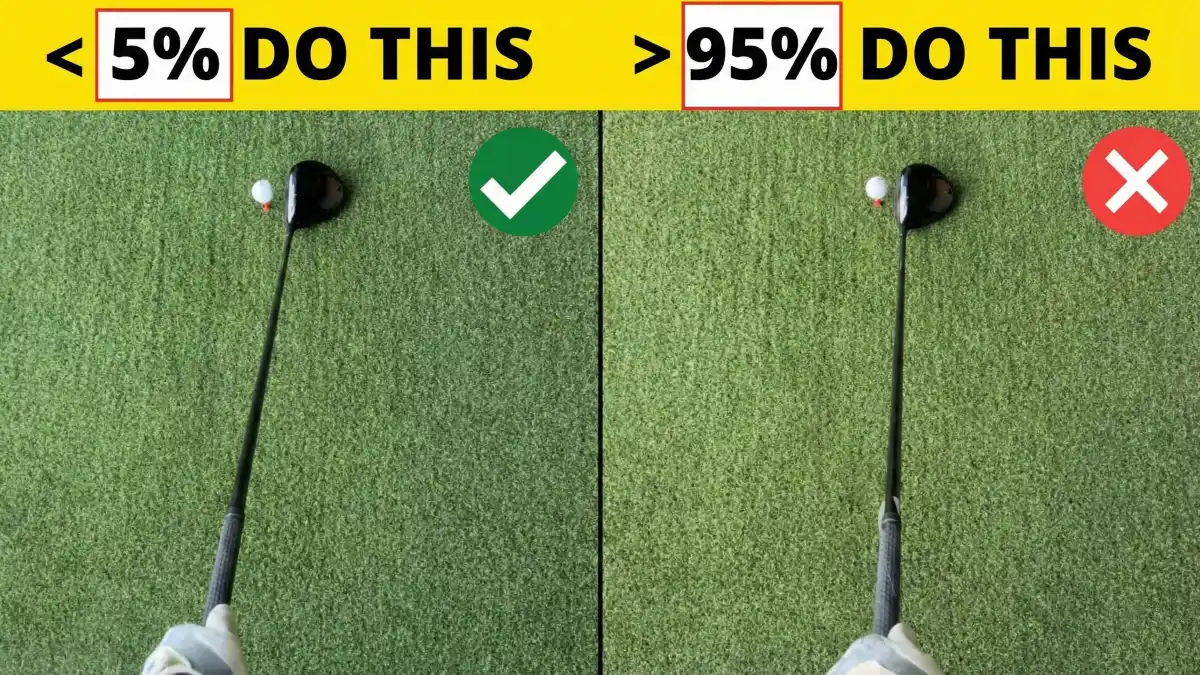
You’re flushing your 7-iron, but your driver feels weak, erratic, and short.
Naturally, you try to fix this by swinging harder. But the driver is cruel, the more muscle you apply, the less distance you achieve. Instead of bombing it, you fall into what instructor Russell Heritage calls the “Effort Trap” a steep “spin out” that kills power and sprays the ball offline.
His student, Lynn, was stuck exactly here. She was stripping her irons but bunting her drives, working harder than anyone else on the range for zero return on that energy. There is nothing more exhausting than swinging out of your shoes only to watch the ball land shorter than your playing partner’s easy warm-up swing.
The fix isn’t arm speed, it’s a specific interaction between your hips and head position. By using ground force to keep your head behind the ball, you can stop the spin-out and unlock effortless power.
The Root Cause: Turning “Into” vs. “Over” the Leg

Great drives are constructed before the downswing even begins. If energy is not loaded correctly, there is nothing to release into the ball. A common fault observed in amateurs is the loss of hip depth. Players often slide their hips laterally or turn “over” their trail leg. This can be likened to a car spinning its tires on ice there is a lot of motion, but no traction.
To rectify this, the golfer must turn into the trail leg (the right leg for right-handed golfers).
The Power Coil
-
Maintain Flex
Keep your trail leg flexed throughout the backswing. Do not let it straighten out completely.
-
Turn Into Resistance
Feel your pelvis turn into the resistance of your stable leg, creating torque.
-
Glute Activation
You should feel a strong, distinct activation in your trail glute as it loads the energy.
How to feel the correct load:
- Keep the trail leg flexed; do not let it straighten out completely.
- Feel the pelvis turn into that resistance.
- There should be a strong activation in the trail glute.
In the case of the student, Lynn, there was no resistance; she was simply spinning. Because she failed to utilize the ground, she was forced to lunge forward to initiate the downswing, effectively killing her power. When a player turns into the leg, they create a platform that feels like a coiled spring.
This loads energy into the ground. Biomechanics data indicates that elite long drivers generate force by pushing into the ground, not merely spinning horizontally. This Ground Reaction Force (GRF) is essentially free speed. If the player sways or slides, that tension is lost. Maintaining the flex and turning into the leg creates the necessary power source.
The Downswing Trigger: Pulling the Lead Side Back

The transition is where many amateurs ruin their load. Coiled at the top, the desire to hit the ball hard often leads to “firing” the right shoulder and right hip directly at the ball. This is a swing killer.
When the right side fires forward, two detrimental things occur:
- Steepness: The club is pushed outside the line and descends on a steep, chopping angle.
- Loss of Width: The hands get too close to the body, leaving no room to generate speed.
The correct movement is the opposite. Rather than pushing the right side, the golfer should focus on pulling the lead side back. For a right-handed golfer, this means clearing the left hip back and away from the ball.
Physically, pulling the left hip back creates massive space. This allows the hands to drop into the “slot” naturally, maintaining the width of the swing arc. A wide arc translates to more speed at the bottom.
Firing the right side throws energy away early, whereas pulling the lead hip back whips the club through the zone. This motion is crucial for shallowing the club and achieving clean hip clearance.
The “Head Move” That Unlocks Power

Central to this method is the specific head movement, but the trick lies in the fact that it is not performed with the neck. The hips dictate where the head goes. This concept often separates powerful drivers from short hitters.
If a player spins their right hip forward (the incorrect move), the entire upper body moves with it, causing the head to drift in front of the ball.
- Head in front: The player hits down on the ball, adding spin and reducing distance.
- Head behind: The player hits up on the ball, lowering spin and maximizing launch.
The Head Position Impact
| Feature | Head In Front (The Fault) | Head Behind (The Power Move) |
| Hip Trigger | Right hip spins forward | Lead hip pulls back |
| Angle of Attack | Hitting Down (Steep/Chopping) | Hitting Up (Ascending Blow) |
| Spin Rate | High (Ballooning flight) | Low (Penetrating flight) |
| Driver Result | Weak & Short | Maximum Distance |
When the lead hip is pulled back correctly, the head naturally acts as a counter-weight and stays back. As the saying goes: “If you fire the right side, you lose the angle. Pull the left side to keep the width.”
This creates an ascending blow. In the modern game, with low-spin drivers, a positive Angle of Attack (+3 to +5 degrees) is desired. This is impossible if the head is chasing the ball target-ward.
Visual Anchoring: To facilitate this, the golfer should change their visual focus. Instead of looking at the top of the ball, they should:
- Look at the back of the golf ball.
- Keep eyes locked on that back logo through impact.
This visual cue prevents lunging, keeping the head steady behind the ball while the hips clear out of the way.
The Wall Drill: Practice for Conscious Competence
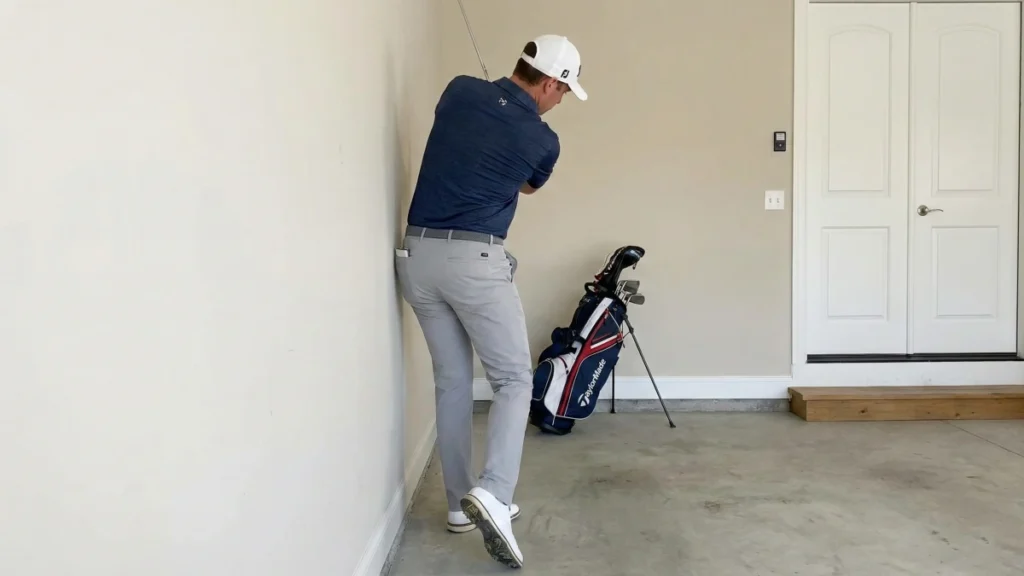
Theory requires practice to become muscle memory. To internalize this motion, golfers can utilize the Wall Drill.
Wall Drill Protocol
-
Setup Spacing
Stand back to wall, heels a fingertip’s distance away, arms crossed over chest.
-
Backswing Load
Turn so the trail butt cheek (right) touches the wall. Feel the glute load.
-
Sticky Transition
Crucial: Keep the right cheek on the wall as you start down; don’t let it peel off early.
-
Downswing Snap
Pull the lead butt cheek (left) back hard until it hits the wall.
The Wall Drill Protocol:
- Setup: Stand with the back to a wall. Heels should be about a fingertip’s distance away from the baseboard. Arms are crossed over the chest.
- Backswing: Turn the shoulders and hips so the trail butt cheek (right cheek) touches the wall. Feel the load in that glute.
- Transition: This is crucial do not let the right cheek come off the wall immediately.
- Downswing: Pull the lead butt cheek (left cheek) back until it hits the wall.
The Goal: The objective is to “swap cheeks.” First, the right cheek touches, then the left cheek touches. If the player spins out or fires the right side, the right cheek will instantly come off the wall and move toward the ball this is the dreaded “early extension” move.
Practicing this slowly helps the golfer get used to the sensation of maintaining depth and pulling the lead side back. Doing this for five minutes a day at home is an effective way to practice rotation without hitting a single ball.
Conclusion
Hitting the driver further is not a matter of brute strength; it is a chain reaction. First, the player turns into the leg to load the ground. Next, they pull the lead hip back to create speed and room. Finally, this allows the head to stay behind the ball, creating the high-launch power required for distance.
Just as this adjustment worked for Lynn, it can work for any golfer struggling with efficiency. By trying the Wall Drill for five minutes before the next range session and feeling that proper hip rotation, players can expect to see a massive increase in driver distance.