
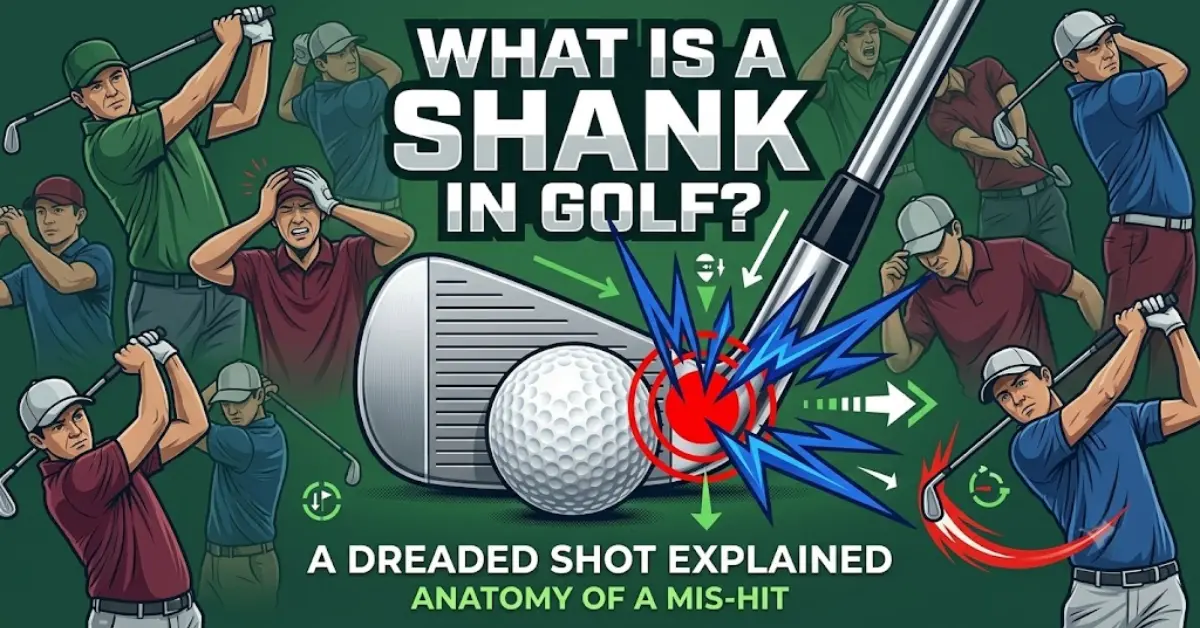
Picture this: you’re 90 yards out, wedge in hand, clean lie in the fairway. You make a smooth swing. Then comes a sound you’ll never forget – a hollow, metallic clang – and the ball darts 45 degrees right, skipping into the rough like a frightened rabbit. Playing partners go silent. You stare at your club as if it betrayed you.
That was a shank. I’ve hit them. You’ve hit them. Every golfer reading this has hit them, and most won’t admit how often. I’m a 9-handicapper who shanked three consecutive wedges in a pro-am two years ago and nearly walked off the course. Understanding exactly what happened – mechanically, not just emotionally, is what finally stopped it. Here’s everything you need to know.
Quick Answer: A shank happens when the hosel, the rounded socket connecting the shaft to the clubhead – strikes the ball instead of the face. The result is a shot that fires almost directly right (for right-handers) at roughly 75 degrees. It’s caused by the hosel moving closer to the ball than it was at address. Fixing it requires understanding which of the two types of shank you’re hitting.
The Shank Defined: What’s Actually Happening at Impact
A shank occurs when the ball makes contact with the hosel of the golf club rather than the clubface. The hosel is the rounded, cylindrical socket where the shaft connects to the clubhead – it sits directly behind and adjacent to the inner heel of the face. Because the hosel has no flat striking surface and curves outward from the shaft, any ball that meets it fires off in a wildly unpredictable direction. Most commonly for right-handed golfers, that means hard and low to the right, at an angle approaching 75 degrees from the intended target line.
The important distinction: a shank isn’t about where the clubface points at impact. Even a perfectly square face at impact produces a shank if the hosel – not the face – is what contacts the ball. This confuses most golfers who assume their shank is a face-angle problem. It isn’t.
What Does a Shank Feel and Sound Like?
Shanks have a unique signature. The sound is a sharp, thin “clank” rather than the satisfying thud of a centered strike. The vibration through the handle feels off – almost like the club jumped sideways in your hands. And the ball flight is unmistakable: there’s no height, almost no carry, and an immediate, severe veer to the right. Once you’ve felt a shank, you know immediately what you’ve done. Unfortunately, you’ll also know the particular horror that comes with it.
The Shank Has a Name – and Several Nicknames
Golfers don’t like saying the word “shank” on the course. The superstition is real: legend holds that saying the word can infect playing partners with the same affliction. Legendary teacher Harvey Penick refused to use the word at all, calling shanks “the laterals” or “pitch-outs” instead. The Kevin Costner film Tin Cup gave the world two more terms – “El Hosel” and simply “the laterals.”
Here’s the full glossary of shank nicknames currently in circulation:
- Hosel rocket – the most widely used alternative; the ball genuinely does rocket off the hosel
- El Hosel – from Tin Cup, still used on courses from Texas to Scotland
- Laterals / Pitch-outs – Harvey Penick’s preferred euphemisms
- Scud – named after the erratic missile; describes the unpredictable trajectory
- Snake killer – because the ball skips so close to the ground with venom
- The S-word – what people say when they won’t say the other thing
If you hear any of these terms on the first tee, just know someone has had a rough warm-up.
The Two Types of Shanks – and Why This Matters
Here’s the truth none of the other shank guides will tell you: there are two completely different swings that produce a shank, and they require opposite fixes. Treating one with the other’s cure makes the problem worse. This is why golfers spend weeks fighting shanks and can’t shake them – they’re applying the wrong medicine.
The most common cause of a shank in golf is the hosel moving too far outside its address position at impact. But how that happens differs based on your handicap and swing tendencies.
Type 1 – The Over-the-Top Shank (Most Common, High Handicappers)
This shank comes from an outside-in swing path. At the top of the backswing, the hands and arms cast outward and over the top as the downswing begins. The club drops too steeply outside the target line, pushing the heel of the club – and the hosel – directly into the ball’s path. If you regularly slice your driver, you’re likely an over-the-top player who shanks wedges for this exact reason.
The fix: shallow out your swing. During the transition from backswing to downswing, feel the handle of the club drop toward your right hip pocket rather than toward the ball. The board drill in the next section works directly on this.
Type 2 – The Inside-Out Shank (The One That Shocks Good Players)
Low handicappers get shanks too, and their version is worse because it seems to come from nowhere. This type stems from an excessively inside-out path – a swing that’s too flat and shallow. When the club approaches from too far inside, the heel of the clubhead leads the way through impact, dragging the hosel into the ball. Players who hook their irons regularly are more prone to this type.
The fix: feel more of an out-to-in direction through impact. Set up slightly closer to the ball and focus on keeping the face rotating through the strike rather than letting the heel lead. The toe-first chip drill addresses this directly.
What Is a Toe Shank in Golf?
A toe shank isn’t technically a hosel strike, but it belongs in this conversation. It happens when the ball contacts the extreme toe of the clubhead – so far out that the club twists violently in the hands at impact, and the ball behaves almost identically to a hosel rocket: hard, low, and to the right.
Toe shanks affect bigger-bodied players or anyone who stands too far from the ball at address. As the body rotates through impact, the arms get pulled inward, and the toe presents itself to the ball instead of the sweet spot. The opposite of a toe shank, mechanically speaking, is a traditional heel/hosel shank – and that’s the key to diagnosis. If your practice swings hit the mat exactly where the ball is but your actual shots fly right off the toe, you’re standing too far away.
What’s the Difference Between a Shank and a Slice?
Both shots go right. That’s where the similarity ends.
| Feature | Shank | Slice |
|---|---|---|
| Contact point | Hosel / heel of club | Face (typically toward toe) |
| Cause | Hosel moves outside address point | Open clubface at impact |
| Ball flight | Low, hard, immediately right | Higher, curves gradually right |
| Trajectory angle | 45–90 degrees right of target | 10–30 degrees right of target |
| Sound at impact | Sharp metallic “clank” | Slightly off-center thud |
| Distance | Severely reduced (often 20–40%) | Reduced, but ball travels further |
| Fix priority | Swing path / setup distance | Clubface rotation / grip |
| Who it affects | All handicap levels differently | Primarily higher handicappers |
The practical test: if the ball went right immediately and stayed low, that’s a shank. If the ball started left or straight and drifted right with height, that’s a slice. Getting that wrong means applying the wrong drill.
Why Wedges Shank More Than Your Driver
Ask any 18-handicapper where they shank it most and the answer is almost always wedges. There’s a mechanical reason for this, and it’s not bad luck.
Wedges have the shortest shafts and the most upright lie angles in the bag. That upright lie places the hosel significantly closer to the ball’s position at address compared to a driver or even a 7-iron. The margin between sweet spot and hosel – measured across the face – is narrower on a wedge than on any other club. One inch of mis-hit sends you from pure contact to hosel.
The second factor: wedge shots are finesse swings, not power swings. Most amateurs unconsciously slow down and decelerate through partial wedge shots, which disrupts timing, causes the hands to flip at impact, and – you guessed it – drags the hosel into the ball. Full iron swings have enough speed and commitment to carry through impact consistently. That half-swing 60-yard wedge to a back pin? It’s the most technically demanding shot in your bag, and nobody practices it enough.
For irons specifically, hitting shanks more often than driver or fairway woods is almost always a confirmation that the swing path issue (Type 1 or Type 2) amplifies with shorter clubs. Read more about hitting your irons cleanly.
How Much Is a Shank Actually Costing Your Handicap?
Golfers treat shanks as an embarrassment. They should treat them as a scoring emergency.
A single shank from 90 yards out doesn’t just cost you one stroke. It typically deposits the ball 30–50 yards sideways, in rough, behind a tree, or – if you’re genuinely unlucky – out of bounds. From there you’re chipping sideways, then pitching onto the green, then two-putting from distance. What was a realistic par chance becomes a double-bogey or worse. That’s 2–3 strokes above what you’d have made without the shank – on a single swing.
Across a round, two or three shanks translate directly into a handicap index that sits 3–5 shots higher than your actual ball-striking ability warrants. The shanks aren’t just embarrassing – they’re the most stroke-expensive mis-hit in golf per occurrence, and they cluster: one shank raises the fear of a second, and that tension causes exactly the mechanical conditions for the next one.
How to Cure a Shank in Golf – 4 Drills That Work
Before running any drill, determine which type of shank you hit (Type 1 over-the-top, or Type 2 inside-out) using the descriptions above. Drill selection matters here.
Drill 1: The Board Drill (Type 1 shank fix) Place a 2×4 board or a long headcover on the ground, parallel to your target line, positioned about half an inch outside the ball – on the far side from you. Your goal: swing through without the clubhead touching the board. If you’re swinging over the top, the board stops you immediately. Ten repetitions with a 7-iron before moving to a wedge.
Drill 2: The Swim Noodle / Barrier Drill (Both types) Place a foam swim noodle or alignment stick a few inches outside the ball (away from you). Swing through impact without touching it. This drill works regardless of which shank type you have – the human brain will subconsciously reroute the swing to avoid the object. Bradley Turner at Keiser University College of Golf calls this “aspirin for a lot of different problems,” and he’s right.
Drill 3: The Feet-Together Drill (Type 1 shank fix) Stand with your feet touching and hit half-swing pitch shots. This forces balance and eliminates the weight lurching toward the ball that causes over-the-top shanks. Gradually widen your stance over 15–20 balls until you’re at full width. One session of this, done correctly, often produces immediate results.
Drill 4: The Toe-First Chip Drill (Type 2 shank fix) With a wedge, consciously attempt to strike the ball off the toe of the club with 30-yard chip shots. You don’t actually need to make toe contact — just aiming for the toe counteracts the heel-leading pattern. Strike 20 balls this way before returning to centered contact. Many low handicappers report this as the fastest fix they’ve found.
The 3-Step Mental Recovery When Shanks Strike Mid-Round
The mechanics start the shanks. The mind continues them. Here’s a specific protocol for stopping the bleed when shanks hit during a round.
Step 1: Walk away from the ball immediately. Don’t stand over the next shot right away. Take 30–45 seconds to walk behind the ball, stand tall, and take a full breath that reaches your stomach. The tension that causes the next shank lives in your shoulders and forearms – this pause is the fastest way to physically discharge it.
Step 2: Commit to a half-swing on your next shot. Don’t try to prove anything. Hit the next wedge shot with a committed 50% swing. Half-swings reduce the mechanical complexity; they also force you to focus on the strike rather than the result. Most golfers who string shanks together do so because they swing harder in desperation – this is the wrong response.
Step 3: Change your self-talk script. The internal monologue after a shank usually sounds like: “Don’t shank it, don’t shank it.” That instruction is useless – the brain doesn’t process “don’t.” Replace it with a specific swing thought tied to the fix: “Handle to the right hip” (Type 1) or “Lead the toe through” (Type 2). One specific instruction beats a dozen anxious warnings every time.
Sam Snead once observed that shanks are so contagious that even watching them creates risk. He wasn’t wrong about the psychological transmission – but that’s also why the mental reset matters more than the mechanical fix in the moment.
Frequently Asked Questions
The main cause is the hosel moving farther from the player at impact than it was at address – meaning the club’s striking arc passes too far outside the ball’s position. For high handicappers, this happens through an over-the-top swing where the club drops steeply outside the target line. For low handicappers, it happens when the club approaches too far from the inside, leading the heel first. Both produce hosel contact. Both require different fixes.
A shank is any shot where the ball makes contact with the hosel – the rounded cylindrical part where the club’s shaft connects to the clubhead – rather than the flat surface of the face. The result is a ball that fires hard and low, almost always to the right for right-handed golfers. Contact anywhere from the extreme heel of the face to the hosel’s outer edge qualifies. A ball hit so far on the toe that the club twists sideways is sometimes called a toe shank, though technically this involves a different contact point.
The mechanical opposite of a hosel/heel shank is a toe strike – hitting the ball so far on the club’s outer edge that the clubhead rotates in your hands at impact. Both produce poor results, though a toe strike typically sends the ball right for right-handers with a slightly higher trajectory than the low, hard shank direction. Some instructors use intentional toe-first contact as a cure drill for over-the-top shanks, because aiming for the toe counteracts the heel-leading pattern that causes the shank.
Yes – in everyday non-golf language, a shank can refer to a homemade blade or pointed weapon, most commonly associated with prison. It also refers to a cut of meat (lamb shank, pork shank), the lower leg bone, and the long part of a fishhook or nail between the eye and the tip. In golf, “to shank” someone means nothing violent – it just means they’re about to lose a ball in the rough and possibly their mind.
The Shank: You’re Not Alone, and You Won’t Be Alone for Long
Even Ben Hogan hit shanks. Sam Snead feared them. Amateur golfer Roger Weathered called shanking “the most outrageous golfing disease” back in 1931, and nothing has changed. Shanks happen to everyone, at every level, and they always will.
What separates golfers who cure them from golfers who carry them for years is understanding which type of shank they’re hitting and applying the specific fix – not a generic “swing more inside” instruction that works for one shank and makes the other worse. Run the board drill or the barrier drill this week. Settle on one swing thought. And check out the [best golf balls for low handicappers] if your ball-striking is improving and your equipment hasn’t kept pace.
The shank is fixable. That metallic clank doesn’t have to be part of your game.