
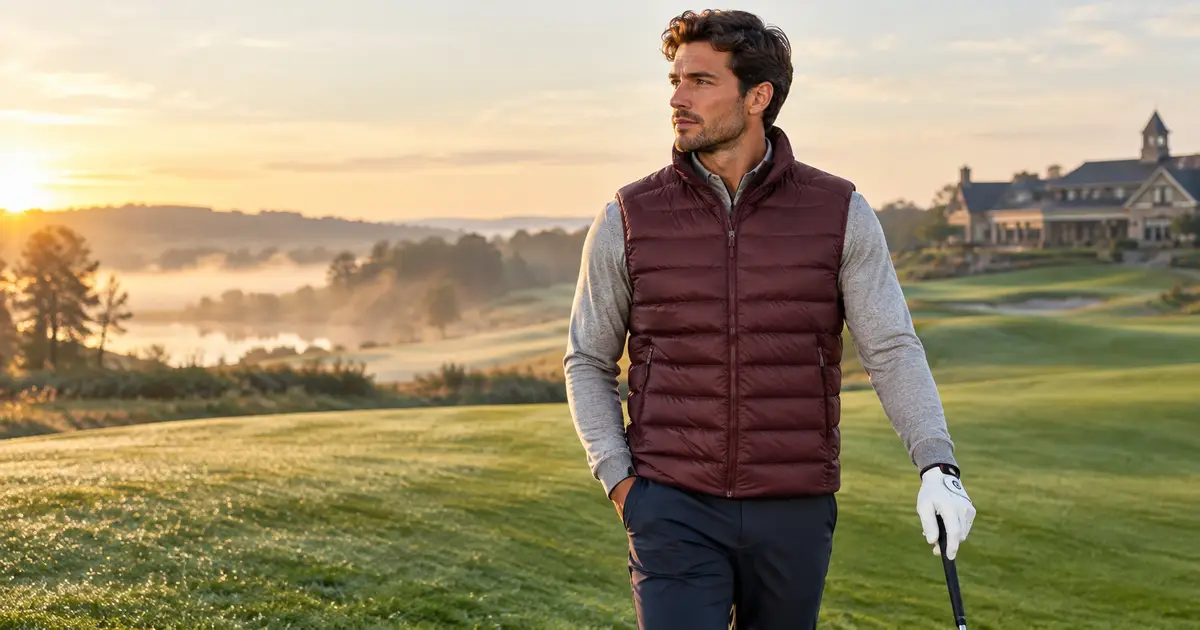
As temperatures begin to fall across many popular golfing regions, players are looking for ways to stay warm without sacrificing freedom of movement.
A discussion among members of the GolfWRX community has highlighted several popular options, with Patagonia, Arc’teryx, Rhoback and Zero Restriction among the brands mentioned by golfers preparing for cooler conditions.
The conversation, which began on September 21, 2026, raises an important question: Is the warmest golf vest necessarily the best choice for playing 18 holes?
For many golfers, the answer depends on much more than insulation.
GolfWRX Members Debate the Best Vests for Winter Golf
The discussion began when a GolfWRX forum member asked fellow golfers to recommend quilted vests suitable for playing in colder weather.
The golfer’s priorities were straightforward: protect the core against falling temperatures while allowing enough freedom through the arms and shoulders to swing comfortably.
Members responded with suggestions ranging from premium outdoor apparel to golf-specific designs.
The discussion revealed two different approaches to winter golf clothing.
Some participants argued that outdoor brands provide better insulation for truly cold conditions. Others preferred golf apparel designed specifically to accommodate the movements of a golf swing.
Rather than producing one universally favored product, the conversation highlighted how personal preferences, playing conditions and fit influence the choice of vest.
Patagonia and Arc’teryx Attract Attention for Warmth
Patagonia’s Down Sweater Vest received a recommendation from a GolfWRX member who regarded it as a reliable option for cold-weather use.
The vest features 800-fill-power down insulation and a windproof outer shell, according to Patagonia’s official product specifications.
Another member recommended the Arc’teryx Cerium Vest for particularly cold rounds.
Designed primarily for outdoor activities, the Cerium uses 850-fill-power down alongside synthetic insulation in areas more susceptible to moisture.
Its lightweight construction and packability appeal to golfers looking for insulation without excessive bulk.
However, neither product is designed exclusively for golf.
That makes fit especially important. A vest that performs well during hiking or everyday outdoor activities may not necessarily provide the same comfort during a full backswing.
Golfers considering either option should test their shoulder rotation and address position while wearing their usual base layers.
Rhoback and Zero Restriction Offer Golf-Specific Alternatives
Not everyone in the GolfWRX discussion agreed that outdoor apparel was the better choice.
One participant praised a Rhoback vest, particularly its flexible side panels, which helped the golfer swing without feeling restricted.
Rhoback’s Fulton Performance Vest uses stretch side fabric and a two-way zipper, features designed to improve comfort and movement.
Zero Restriction also received positive mentions.
A forum member highlighted the brand’s PrimaLoft-insulated vests as lightweight options that work well underneath an additional wind-resistant layer.
Zero Restriction’s Z625 Windproof PrimaLoft Vest combines synthetic insulation with stretch side panels.
These features demonstrate the main advantage of golf-specific outerwear: designers can prioritize freedom of movement and wind protection alongside warmth.
For golfers who regularly play in cool but not freezing conditions, that balance may be more useful than maximum insulation alone.
Down vs. Synthetic Insulation: Which Is Better for Golf?
One of the most useful lessons from the discussion is that different insulation types suit different conditions.
Down insulation is known for delivering substantial warmth relative to its weight.
That makes it attractive for golfers playing in dry, cold weather who want a lightweight garment instead of a bulky jacket.
However, down can lose insulating efficiency when wet unless adequately protected.
Synthetic insulation, including materials such as PrimaLoft, is designed to maintain more of its insulating performance in damp conditions.
That makes synthetic-insulated vests worth considering for misty mornings, light moisture and changeable weather.
Neither material automatically makes a vest superior.
The amount of insulation, wind resistance, fit and overall garment construction are equally important.
For golfers, breathability also matters. Walking an entire round in a heavily insulated vest may become uncomfortable as body temperature rises.
What Should Golfers Look for When Buying a Vest?
Before choosing a cold-weather golf vest, consider these four factors:
- Freedom of movement: The vest should allow a full shoulder turn without pulling across the chest.
- Wind resistance: Wind protection can be particularly important on exposed courses.
- Insulation: Choose the type and amount of insulation according to typical playing temperatures.
- Layering compatibility: Make sure the vest fits comfortably over a thermal base layer or quarter-zip.
Price also deserves consideration.
The GolfWRX discussion included premium models alongside more affordable alternatives, including an Eddie Bauer Cirruslite recommendation.
A higher price does not automatically translate into better performance on the golf course.
The most useful choice is the vest that delivers sufficient warmth while allowing a player to swing naturally.
What the GolfWRX Discussion Tells Us
The debate highlights a familiar challenge in winter golf: maintaining comfort without compromising mobility.
Patagonia and Arc’teryx appealed to some contributors because of their outdoor insulation technology, while Rhoback and Zero Restriction attracted support for golf-oriented design features.
There is no independently established winner from the discussion, and individual forum recommendations should not be confused with laboratory testing.
Instead, the conversation offers golfers a useful starting point for comparing insulation, movement, wind protection and value.
For players preparing for colder rounds, the best golf vest is not necessarily the warmest one—it is the one that provides enough protection without interfering with the swing.