
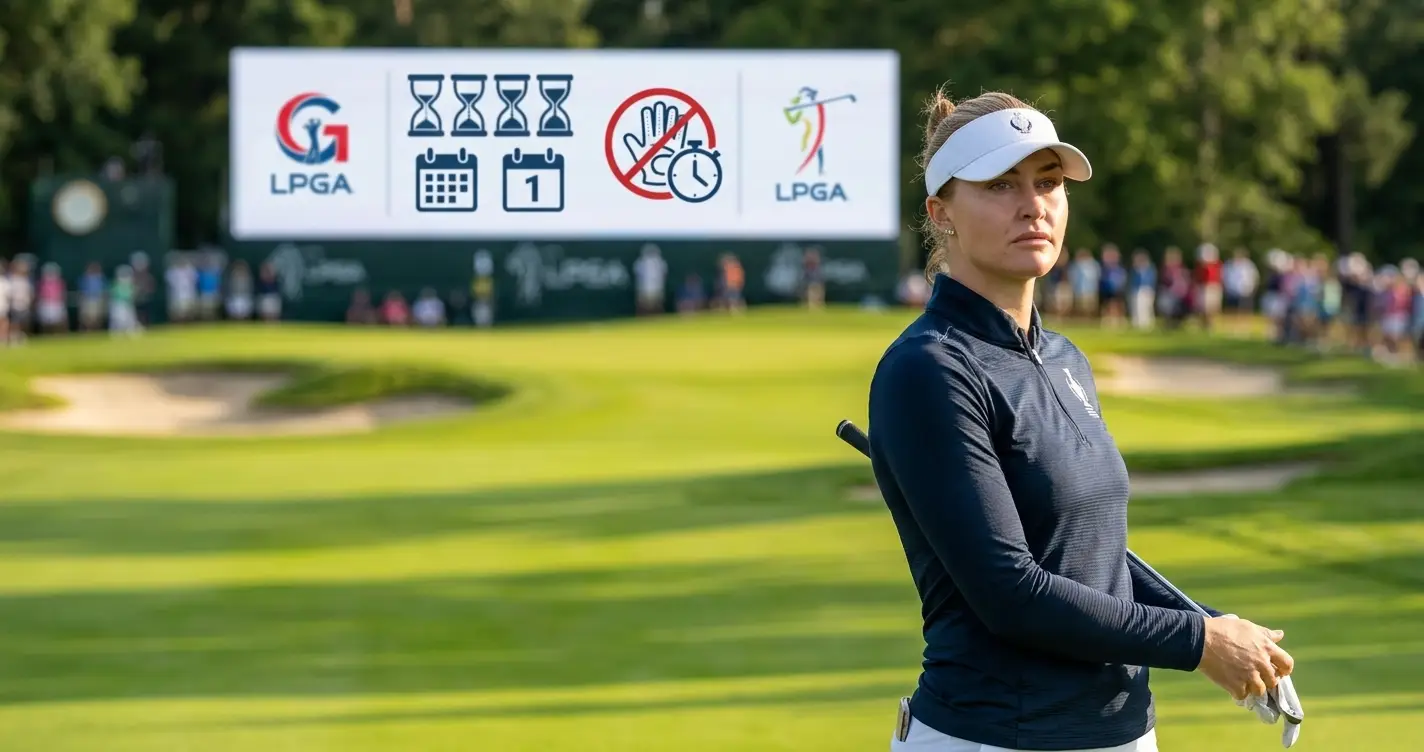
Charley Hull has proposed dramatically tougher punishments for slow play on the LPGA Tour, suggesting that repeat offenders could face suspensions lasting three months or even an entire year.
The 30-year-old English golfer outlined her ideas in an interview with Golfweek, published on October 18, 2026, as slow play continues to generate debate across women’s professional golf.
Hull believes the threat of missing significant tournament time could persuade players to move faster, going well beyond the fines and stroke penalties currently used by the LPGA.
Her comments come as the tour’s pace-of-play enforcement remains under scrutiny following a costly penalty for Carlota Ciganda at the Buick LPGA Shanghai.
Charley Hull Wants Stronger LPGA Slow-Play Punishments
Hull has been a vocal critic of slow play throughout her professional career, frequently expressing frustration with lengthy rounds and unnecessary delays.
During her latest Golfweek interview, she was asked what changes she would introduce to address the problem.
Rather than relying solely on financial penalties, Hull suggested suspending players from competition.
Her proposal included a year-long suspension or “a three-month ban to start off with.”
The idea is based on making the consequences serious enough to encourage players to complete their rounds more efficiently.
For professional golfers, losing tournament eligibility for several months could mean missing valuable ranking opportunities, prize money and important events.
Such sanctions would represent a substantial escalation from the LPGA’s existing pace-of-play regulations.
However, Hull’s remarks remain a personal proposal. The LPGA has not announced that it intends to introduce the suspensions she suggested.
Hull Also Proposes Smaller Fields and Weekend Twosomes
Suspensions were not Hull’s only proposed solution.
When Golfweek asked what she would change as LPGA commissioner for a day, Hull described a different tournament structure designed to reduce congestion.
She suggested limiting regular tournament fields to 100 players, reducing the field to approximately 50–55 after the cut, and using two-player groups during weekend rounds.
The proposals would change the way some tournaments operate.
Smaller fields could reduce the number of groups on the course, while two-player pairings could make it easier for golfers to maintain a consistent rhythm.
However, field reductions would also affect playing opportunities, particularly for golfers trying to establish themselves on tour.
The proposals therefore raise questions beyond pace of play, including how to balance efficient competition with access to professional tournaments.
What Are the LPGA’s Current Slow-Play Penalties?
The LPGA introduced a revised pace-of-play policy in 2025, strengthening the consequences for players who exceed official timing limits.
Under the published policy, penalties for exceeding the permitted time during official group timing include:
| Time over allowance | Consequence |
|---|---|
| 1–5 seconds | Accumulated toward financial penalties |
| 6–15 seconds | One-stroke penalty |
| 16 seconds or more | Two-stroke penalty |
The regulations also provide for disqualification following a third applicable pace-of-play breach during a round.
These punishments are designed to discourage unnecessary delays while allowing officials to account for difficult playing circumstances.
Hull’s suggested suspensions would go considerably further, potentially keeping golfers out of competition for months rather than penalizing individual rounds.
Carlota Ciganda’s Shanghai Penalty Highlights the Issue
Hull’s comments arrive shortly after another significant slow-play incident on the LPGA Tour.
During the third round of the 2026 Buick LPGA Shanghai on October 17, Spanish golfer Carlota Ciganda received a two-stroke penalty for a pace-of-play violation.
The penalty was assessed on the par-4 13th hole at Sheshan International Golf Club.
Ciganda initially recorded a par, but the ruling changed her score to a double bogey.
Despite the setback, she responded with consecutive birdies and completed her round in one-under-par 71.
The incident demonstrated how the tour’s existing rules can influence a player’s score during a competitive tournament.
It also reinforced the continuing debate about whether stroke penalties alone can sufficiently address slow play.
Ciganda has previously been involved in pace-of-play disputes, including an incident at the 2023 Evian Championship that resulted in her disqualification after she signed an incorrect scorecard following a disputed penalty.
Hull Has Criticized Slow Play Before
The latest comments are consistent with Hull’s previous position.
In November 2024, she expressed frustration after a lengthy round at The Annika, where her group with Nelly Korda required five hours and 38 minutes to complete play.
Hull suggested stronger stroke penalties and even the loss of LPGA Tour cards for repeated timing violations.
Her October 2026 interview continues that argument, this time focusing on lengthy suspensions as a potential deterrent.
While the LPGA has already strengthened its pace-of-play regulations, Hull clearly believes additional action could be considered.
Will the LPGA Introduce Suspensions for Slow Play?
There has been no confirmed announcement that the LPGA will adopt Hull’s proposed suspension system.
The existing policy remains the relevant framework for tournament officials and players.
Introducing lengthy bans would likely require consideration of enforcement standards, appeals, tournament eligibility and the effect on players’ careers.
For now, Hull’s comments are part of a wider discussion about how professional golf can make tournament rounds more efficient.
The question facing the LPGA is whether its current combination of fines, stroke penalties and other disciplinary measures is sufficient—or whether further changes may eventually be considered.