
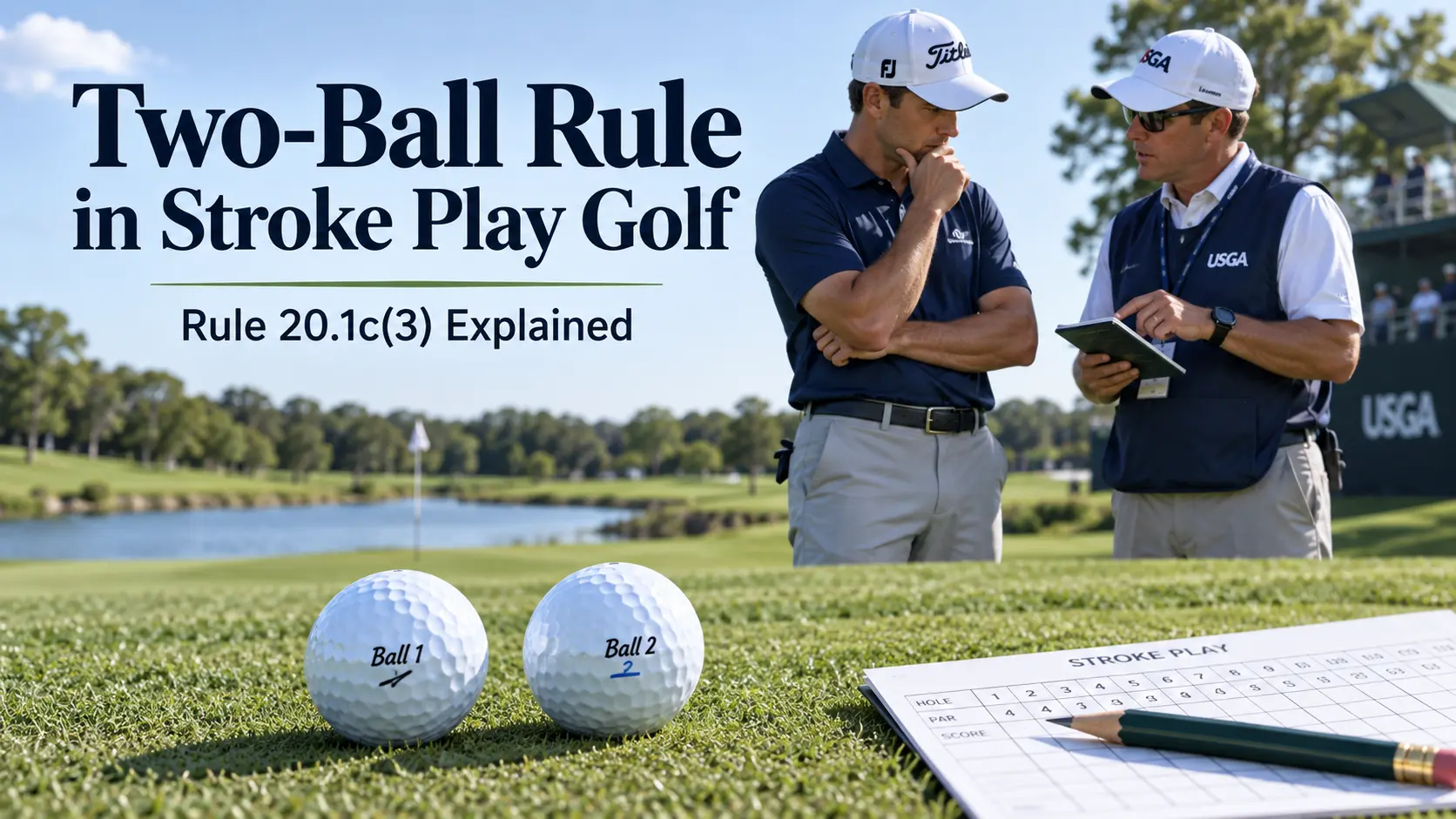
The two ball rule in stroke play golf gives you a clean way to keep playing when a genuine rules doubt appears and no quick ruling settles it. You do not have to stop the group while everyone searches a phone or waits for an official.
Timing controls everything. You need to decide on two balls after the doubt appears and before you make the next stroke. Once you hit a shot and then decide you would rather test another procedure, you have missed the window.
Quick Answer: Rule 20.1c(3) lets a player finish a hole with two balls in stroke play when the correct procedure is uncertain. Decide before making another stroke, tell your marker which ball you want to count, hole out both balls, then report the facts to the Committee before returning your scorecard.
When the two ball rule in stroke play golf applies
You can use the two-ball procedure only in stroke play, and only while playing a hole when you are uncertain about the correct Rules procedure. The Rules do not give you the same option in match play.
That distinction matters because stroke play protects the entire field. Your playing partner cannot make a binding ruling for everyone else in the competition. If a referee or Committee member is not available in a reasonable time, two balls let you keep pace and preserve both possible procedures for a later ruling.
A classic example involves disputed free relief. Suppose your ball sits beside a cart path and your marker thinks your proposed drop falls outside the relief area. If the uncertainty exists before you hit the next shot, you can decide to complete the hole under both procedures and let the Committee decide which score counts.
My strongest advice is simple: use Rule 20.1c(3) before guessing. One extra ball for one hole is easier to fix than a wrong-place problem after the fact.
The four steps that keep the procedure valid
The procedure is short, but golfers often miss one of the deadlines.
- Decide to play two balls after the uncertain situation arises and before making another stroke.
- Tell your marker or another player which ball you want to count if the Rules allow the procedure you use for that ball.
- Hole out with both balls so you preserve whichever score the Committee later selects.
- Report all the facts to the Committee before returning your scorecard.
The second step uses should rather than must. If you forget to choose a ball in time, the Rules treat the first ball you play as your chosen ball by default. That can matter later if both procedures turn out to comply with the Rules.
The fourth step has no such flexibility. You must report the situation before returning the scorecard, even when both balls produce the same score. If you skip that report, the Rules disqualify you.
The deadlines do different jobs. The pre-stroke decision stops you from judging the first result before choosing. The Committee report protects the field by putting the final ruling in the hands of the people responsible for the competition.
Which score counts after you play two balls?
You do not choose the lower score. The Committee applies Rule 20.1c(4) after hearing what happened.
If the Rules allow the procedure you used for your chosen ball, that ball’s score counts. If the Rules do not allow that procedure, the other ball’s score counts when the Rules allow the procedure used for the other ball.
If neither procedure followed the Rules, the Committee normally uses the chosen ball’s score. A serious breach from a wrong place can change that result, and a serious breach with both balls can end in disqualification.
Strokes and penalties that apply only to the ball that does not count disappear from the hole score. Penalties that arose independently of playing that ball can still remain.
This is why I’ll just play both and take the better one is the wrong mental model. Rule 20.1c(3) preserves two legal arguments. It does not give you a second chance at the shot.
The mistake that makes it too late
The most important clock starts when the uncertain situation appears.
If you make a stroke and only then decide to play a second ball, Rule 20.1c(3) does not apply to that uncertainty. The score with the ball you played before making the decision remains the score that matters, subject to any penalties that apply.
A drop does not count as a stroke. That detail creates a useful safety valve. If you take relief, then your marker questions the drop before you hit it, you can still decide to play two balls. Once you swing at the dropped ball, that option closes for the original uncertainty.
Do not wait to see whether the first shot turns out well. The Rule specifically prevents that kind of result-based decision.
Do you have to hole out both balls?
Treat the answer as yes when you use this procedure.
The official clarification creates a harsh edge case. Once you announce that you will play two balls and then put a ball in play or make a stroke at one of them, you commit to the procedure. If you pick up one ball and the Committee later decides that ball should have counted, you can face disqualification for failing to hole out.
If the Committee decides the abandoned ball would not have counted, the Rules do not add a penalty merely because you failed to finish it. The problem is that you usually do not know which ball the Committee will select while you are still on the course.
For tournament golf, holing out both balls is the safe habit. This is not for everyone in a casual round, where no Committee exists and you are not protecting a competition score. Rule 20.1c(3) matters when the round follows the Rules of Golf as stroke play.
Two balls and a provisional ball solve different problems
Rule 20.1c(3) handles uncertainty about the correct procedure. Rule 18.3 handles a ball that might be lost outside a penalty area or might be out of bounds.
A provisional ball can apply in stroke play or match play. The two-ball uncertainty procedure applies only in stroke play. With Rule 20.1c(3), you should name the ball you want to count and you must report the situation to the Committee. A normal provisional does not create those same steps.
A second ball under Rule 20.1c(3) is not a provisional ball. The official clarifications add one wrinkle in the other direction. If you already played a provisional and later need the two-ball procedure because you are uncertain whether the original ball is out of bounds or lost outside a penalty area, you must use that provisional as the second ball.
That edge case is easy to miss because the two Rules solve different problems. Keep their purpose straight and the procedure becomes much easier.
You can use the original ball for either procedure
Golfers often assume one ball must stay in the original position while the second ball takes relief. The Rules give you more flexibility.
For example, if you are unsure whether an abnormal course condition gives you free relief, you can use the original ball for the relief procedure and use another ball from the original spot. You can also reverse those roles.
The important part is preserving the two procedures clearly enough that the Committee can reconstruct what you did. Marking the original spot before lifting is a smart habit even when a specific clarification does not require it in that example.
Four situations where the rule can save your scorecard
Rules doubts usually appear around relief, boundaries, or a ball that moved.
One common case involves ground under repair that the Committee did not clearly mark. You believe the condition qualifies for free relief, while another player thinks you must play the ball as it lies. Decide on two balls before the next stroke and preserve both options.
Another case involves a questionable relief area. You drop, your marker says the ball came to rest outside the required area, and you are not sure who is right. Because you have not made another stroke yet, you still have time to invoke Rule 20.1c(3).
A third case involves a ball that natural forces moved. The Metropolitan Golf Association published a 2026 example in which a player’s ball moved from the first cut onto the putting green in the wind. The player and caddie disagreed about whether to replace it, so the player used two balls and let the Committee rule later.
The fourth case starts with a provisional. If you later face genuine uncertainty over whether the original ball is out of bounds or lost outside a penalty area, the Rules can require you to treat the provisional as the second ball under the two-ball procedure.
When you should not use two balls
Do not use this Rule in match play. Rule 20.1b governs rules issues there, and the two-ball procedure under Rule 20.1c(3) does not apply.
Do not use it after a bad result just because you want another attempt. The uncertainty has to concern the correct procedure, and you must decide before the next stroke.
Do not use it as ordinary practice during a competition round. A practice ball and a Rule 20.1c(3) second ball are different things.
Do not skip the Committee report because both scores match. Equal scores do not erase the reporting requirement.
If you are reading about stroke play because you are comparing formats, our guide to four-ball golf explains how individual balls and team scoring work in both stroke play and match play. Our dormie golf guide covers the match-play side, where the two-ball safety net does not exist. For handicap competition basics, see our guide to what a golf handicap means.
FAQ
What should I do when I don’t know how to proceed in stroke play?
Ask a referee or Committee member when one is reasonably available. If you remain uncertain while playing the hole, Rule 20.1c(3) lets you complete the hole with two balls. Decide before the next stroke, name the ball you want to count, finish both balls, and report the facts before returning your scorecard.
Can you play two balls in match play?
No. The two-ball procedure for uncertainty applies only in stroke play. Match play uses a different process for rules disputes and ruling requests.
What happens if I forget to choose which ball I want to count?
The Rules treat the ball you play first as your chosen ball by default. The Committee still checks whether the procedure used for that ball complied with the Rules.
Do I have to tell the Committee if both balls score the same?
Yes. You must report the facts before returning the scorecard even when both balls produce the same score. If you fail to report the situation, the Rules disqualify you.
Is the second ball the same as a provisional ball?
No. A provisional ball under Rule 18.3 deals with a ball that might be lost outside a penalty area or out of bounds. Rule 20.1c(3) deals with uncertainty about the correct procedure in stroke play.
Can I decide to play two balls after I hit the first one?
No. You must decide after the uncertainty arises and before you make the next stroke. If you hit first and decide later, Rule 20.1c(3) does not apply to that uncertainty.
Remember the two ball rule in stroke play golf under pressure
When a real rules doubt appears in stroke play, decide before you hit, name the ball you want, hole out both, and tell the Committee before you hand in the card.
That sequence prevents the two mistakes with the biggest consequences: waiting until after the stroke and forgetting the Committee report. If you can remember those deadlines under pressure, the two ball rule in stroke play golf does exactly what it should. It keeps the group moving without forcing you to gamble your scorecard on a guess.