
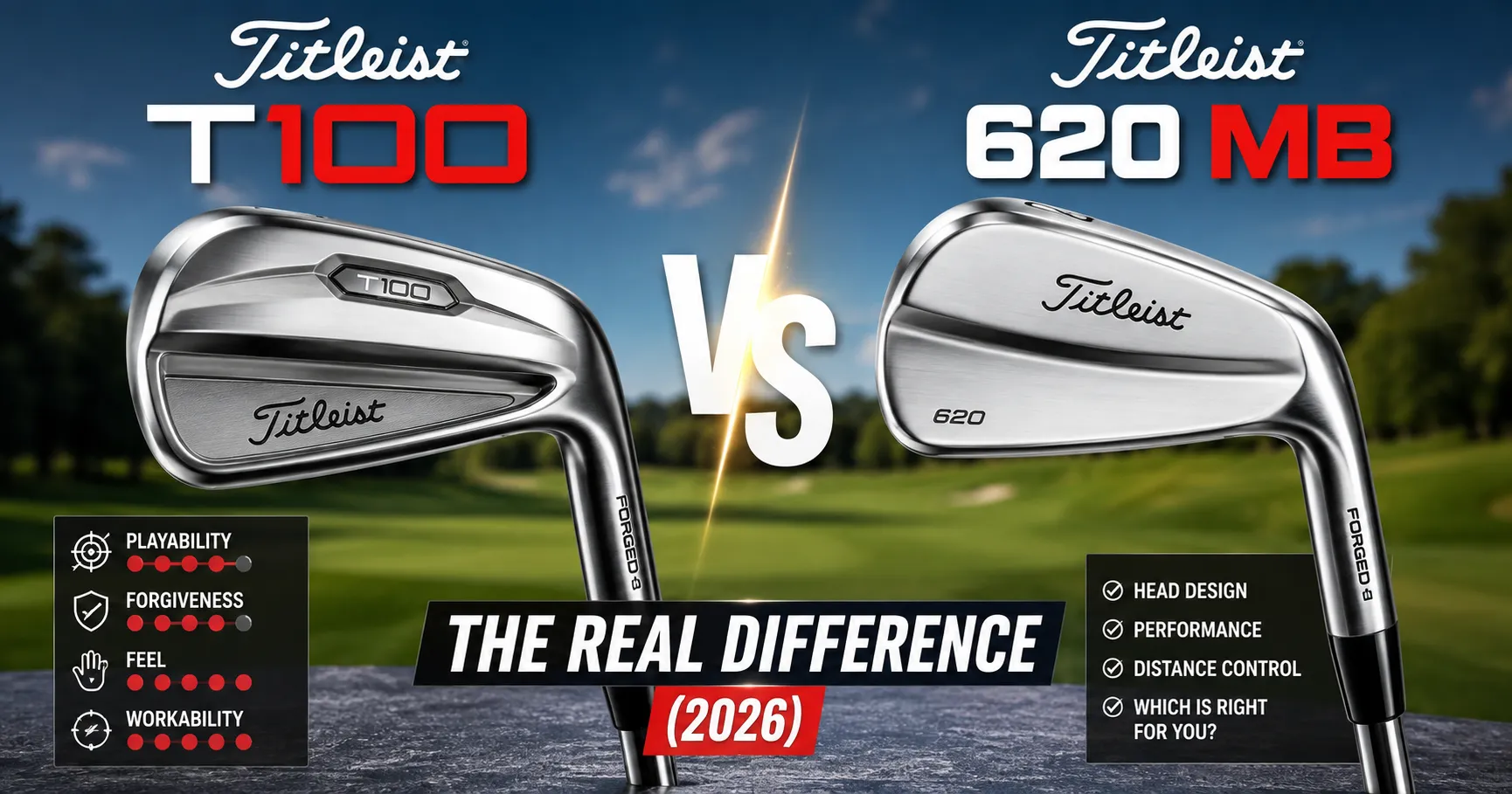
The T100 hides tungsten weighting in a split cavity that protects mishits; the 620 MB is a one-piece forged blade with nothing to bail you out. Pured strikes feel and perform close to identical. Miss the center and the T100 holds its distance, the MB won’t. Most golfers outside scratch belong in the T100.
I gamed the T100 for two full seasons a 6.2 handicap testing them week to week before a Saturday demo day put a set of 620 MBs in my hands and changed how I thought about half my bag. My 7-iron carry dropped from 172 yards to 166 with the MB on a pured strike, and that gap only got worse the moment I caught one off the toe.
This isn’t a spec-sheet rehash. Real yardage on a real course, backed by every loft, price, and forgiveness number Titleist and the secondhand market have published for 2026, tells the actual T100 vs 620 MB story.
Quick Answer: T100 or 620 MB?
- T100 — for scratch to 8 handicap. Tungsten weighting protects your distance when you miss the center, which is most golfers, most swings.
- 620 MB — for scratch and below, if you already find the center of the face on 8+ swings out of 10. Pure blade feel, zero forgiveness margin.
- Combo set — T100 (or 620 CB) in the long irons for forgiveness, 620 MB in the scoring irons (6-PW) for feel and control.
- Price — the MB is actually cheaper new and used than the T100, despite the more labor-intensive one-piece forging.
Titleist T100 vs 620 MB: Full Spec Comparison
Neither iron gets weaker lofts than the other by much – but the gap isn’t constant, and that detail matters if you ever plan to blend the two into one set.
| Club | T100 Loft | 620 MB Loft | Loft Gap |
|---|---|---|---|
| 3-iron | 20° | 21° | 1° |
| 4-iron | 23° | 24° | 1° |
| 5-iron | 26° | 27° | 1° |
| 6-iron | 29° | 31° | 2° |
| 7-iron | 33° | 35° | 2° |
| 8-iron | 37° | 39° | 2° |
| 9-iron | 41° | 43° | 2° |
| PW | 45° | 47° | 2° |
Notice the jump. The gap sits at a single degree through the long irons, then doubles from the 6-iron down. Build a combo set without accounting for that, and your gapping from a T100 6-iron into a 620 MB 7-iron won’t match the gapping everywhere else in the bag.
Construction is where the real separation lives.
| Facts | T100 (2025/26) | 620 MB |
|---|---|---|
| Build | Forged, split high-density tungsten, progressive dual-cavity | One-piece forged, 1025 carbon steel |
| Face tech | Variable Face Thickness in the long irons | None, solid face throughout |
| Sole | Variable Bounce Sole | Tour-refined progressive sole |
| Offset | Minimal | Reduced, near-zero |
| New price (steel, 7-club set) | $1,499 | Roughly $1,225 ($175/iron) |
| Used market range | $650–$950 | $550–$800 |
| Realistic handicap fit | 0–8 | Scratch and below |
Full published specs: Titleist T100 product page · Titleist 620 MB product page
Handicap Fit at a Glance
| Handicap | Best Fit | Why |
|---|---|---|
| 8 and above | T100 | Tungsten weighting protects ball speed on mishits — a 7–10 yard edge over the MB on off-center strikes |
| Low-single-digit, want a safety net | 620 CB | Same lofts and profile as the MB, plus a shallow cavity for forgiveness |
| Scratch and below, centering the face 8+/10 swings | 620 MB | Pure blade feedback and workability, with nothing to bail out a miss |
| Building a combo set | T100 or 620 CB (long irons) + 620 MB (6-PW) | Loft gap only widens to 2° in the short irons, keeping gapping tight |
What Actually Separates These Two Irons
The T100 is not a blade wearing a players-iron costume. Titleist forges it in pieces, then packs split tungsten weighting low and deep in the cavity before sealing it with a thin face. That construction is what lets a mis-struck 7-iron keep more of its ball speed than the number on the spec sheet suggests it should.
The 620 MB skips all of it. One solid piece of 1025 carbon steel, no internal weight, no face insert, no cavity to redistribute mass toward the perimeter. Titleist calls this restraint. I call it exactly what a blade should be, a tool that gives you nothing you didn’t produce yourself with the swing.
Titleist also builds progressive blade length into the MB, meaning the head grows slightly larger through the long irons and shrinks through the short irons. It’s a small concession to playability, and it’s the only one in the entire set.
Forgiveness: How Much Does a Mishit Actually Cost You
Is the T100 more forgiving than the 620 MB? Yes, and the gap widens on off-center strikes. Center-face contact produces similar ball speed and spin from both irons. Miss the heel or toe by even a groove’s width, and the T100’s tungsten weighting protects ball speed far better, testing and forum data consistently show a 7–10 yard advantage for the T100 on mishits, sometimes more. If you want to see how that compares to average amateur numbers, our golf club distance chart by handicap breaks down real carry data across skill levels.
Here’s what that looked like in my own numbers. The T100’s pured 7-iron carried 172 yards; caught slightly on the toe, it still carried 163, a 9-yard penalty. Swap in the 620 MB and a pured 7-iron carried 166 yards, since 2° more loft naturally flies a touch shorter.
That same toe miss dropped to 148 yards, seventeen yards gone on a strike that, to my eye at impact, didn’t look meaningfully worse than the T100 miss.
That’s not a minor difference. It’s the difference between a 150-yard approach that clears water and one that doesn’t.
One GolfWRX forum member summed up the trade cleanly, calling the 620 MB “beautiful but possibly the least forgiving iron on the market”, and nobody in that thread argued the point. Forgiveness was never the sale.
Feel and Sound: Why the 620 MB Feels Different at Impact
A single forged piece of carbon steel transmits vibration differently than a split, tungsten-loaded cavity does there’s no internal air gap, no second material bonded to the back, nothing to dampen or redirect the shock of impact. That’s the entire “pure” feeling golfers chase when they talk about muscle-back irons.
The T100 isn’t harsh. Engineered feel simply carries a different signature than raw forged feel, even when both are genuinely soft. Inside 10 shots, you can feel the difference on a well-struck ball. Miss the center, and you’ll feel it even more the MB telegraphs a bad strike straight into your hands, while the T100 muffles it.
When I swapped between the two on the range that Saturday, the sound gave it away before the feel did. The MB’s strike rang lower and more compact, deader almost, while the T100 stayed a touch brighter and more solid closer to what most modern players’ irons deliver.
Who Should Actually Play the T100
If you’re anywhere from scratch to an 8 handicap and you don’t find the center of the face on every single swing which is to say, if you’re human the T100 is doing real work for you that you’d otherwise have to do yourself with a flawless strike pattern.
Anyone dealing with turf interaction issues, inconsistent divot depth, or a swing still evolving under a new coach benefits even more from that extra margin. Tungsten weighting doesn’t care why you missed the center it just protects the result.
Still not enough forgiveness even after switching? The T100 isn’t the only option in Titleist’s forged lineup. Our Lydia Ko WITB breakdown covers the T150, built one degree stronger per club for players who want the same forged pedigree with a slightly bigger margin for error.
Jordan Spieth built his bag around the T100 for exactly this reason, and he’s not chasing forgiveness for a 20-handicap swing he’s chasing consistency across 72 holes of tournament golf, which tells you the margin this iron buys even elite players is real. Sungjae Im has gamed a T100 for three seasons for the same reason — the face feedback a blade-length iron gives tells him exactly where he missed before the ball even lands. The T100 is the smarter buy for the overwhelming majority of golfers reading this full stop.
Who Should Actually Play the 620 MB
Realistically? Scratch golfers and better, plus low-single-digit handicaps who already strike the center of the face on 8 or more swings out of 10. If your miss pattern is “occasionally 3 yards short,” the MB rewards you. If your miss pattern is “occasionally on the hosel,” it will punish you far more than the T100 ever would.
Even at the highest level, this iron isn’t universal. Our breakdown of Jackson Koivun’s WITB shows a 21-year-old PGA Tour winner gaming a 620 MB from 5-iron through 9-iron proof that elite ball-strikers still choose pure blade feel over built-in forgiveness, even in an era where nearly everyone else on tour has moved to cavity-backs. Chris Gotterup is cut from the same cloth — one of the only players on Tour still gaming a full muscle-back blade at a time when almost every other contender has switched to some form of cavity-back.
Here’s the honest truth: the 620 MB is not a step up from the T100. It’s a different tool for a narrower job, and for most golfers reading this, it’s the wrong one.
The Combo Set Question: Blending T100 and 620 MB
Every competing article on this topic goes quiet exactly where the forums get genuinely useful. The T100 vs 620 MB debate changes completely once you’re combo-building rather than picking a single iron for the whole bag: T100 (or 620 CB) in the long irons where forgiveness saves the most strokes, 620 MB in the scoring irons where feel and precise distance control matter more than a forgiving miss.
One Team Titleist member described exactly this build a staffer fit him into 620 MBs from 9-iron through 6-iron, with T100 filling the 4- and 5-iron slots above it. That split makes sense once you look back at the spec table: the loft gap between the two irons only widens to 2° in the short irons, so building MB from the scoring clubs down keeps your wedge-to-9-iron gapping tight and predictable.
If you go this route, get fit rather than guessing. Check the combined set’s lofts against a launch monitor instead of assuming from a spec sheet bend tolerances on both models can run close to a degree in either direction.
Price Comparison: New, Used, and What You’ll Actually Pay in 2026
A new 2025/26 T100 seven-club steel set (4-PW plus the utility wedge configuration) runs $1,499 through Titleist directly, or $1,599 with graphite shafts. That works out to roughly $214 per club before any custom shaft upcharge.
The 620 MB prices closer to $175 per club new, which puts a 4-through-PW seven-club set around $1,225 noticeably cheaper than the T100 despite the more labor-intensive one-piece forging process, mostly because there’s no tungsten, no VFT face, and no dual-material assembly to pay for.
Used pricing tightens that gap further. Full T100 sets in good condition typically list between $650 and $950 depending on shaft and iron count, while 620 MB sets often list from $550 to $800 for a comparable 3-PW or 4-PW run, since fewer golfers can actually play a blade and demand stays lower. Frame Titleist T100 vs 620 MB as a pure price question and the blade actually wins: less material processing per club, lower demand, and a smaller pool of buyers all push the MB below T100 pricing at both the new and used tiers. If budget matters more than ego, a used 620 MB gives you one of the cheapest ways to own a genuinely tour-grade forged blade.
620 MB vs 620 CB vs T100: Where the CB Fits In
If neither of these two irons sounds right, the 620 CB is the option almost nobody explains clearly. It shares identical loft gapping and matched profile shaping with the 620 MB same lofts, same lengths, same look at address but adds a shallow cavity that meaningfully improves forgiveness on mishits without changing the classic blade profile.
Titleist built the CB specifically to blend with the MB in a combo set, which is why so many fitted players end up in a CB/MB combination rather than a straight MB build. Think of the CB as the bridge: nearly all the look and feel of the MB, with enough built-in help that a low-single-digit handicap can play it every day without paying the MB’s full forgiveness tax.
If you’re deciding between all three, here’s the honest breakdown: T100 for anyone outside single digits, 620 CB for accomplished ball-strikers who still want a safety net, and 620 MB only for players who can already repeat a center-face strike under pressure.
Frequently Asked Questions
Is the T100 more forgiving than the 620 MB?
Yes. The T100’s split tungsten weighting protects ball speed on off-center strikes, typically preserving 7–10 more yards than the 620 MB on the same mishit. Center-face contact performs similarly on both irons.
What handicap should play 620 MB irons?
Realistically, scratch and below. Titleist markets the MB toward elite ball-strikers who find the center of the face consistently, and forum data backs that up golfers above a mid-single-digit handicap report inconsistent distance and more mishits than with a cavity-back alternative.
Can you combo a set with T100 and 620 MB irons?
Yes, and it’s one of the more common builds fitters recommend. The typical split runs T100 in the long irons (3–5) for forgiveness, with 620 MB taking over in the scoring irons (6–PW) for feel and control. Get fit by a professional for the combo, since the loft gap between the two models widens from 1° to 2° through the shorter clubs.
What’s the difference between the 620 MB and the 620 CB?
The 620 CB shares the same lofts, lengths, and profile as the MB but adds a shallow cavity for extra forgiveness. Titleist designed it to blend seamlessly with the MB in a combo set, and it suits accomplished ball-strikers who still want a margin for error.
How much does the Titleist 620 MB cost?
New sets run about $175 per iron, or roughly $1,225 for a 4-PW seven-club steel set. Used sets in good condition typically list between $550 and $800.
Are Titleist T100 irons considered blades?
No. The T100 is a forged cavity-back players’ iron. At address, it looks close to a blade thanks to its thin topline and minimal offset, but internally it uses split tungsten weighting and a dual-cavity design that a true blade like the 620 MB doesn’t have.
Do any PGA Tour pros play the Titleist T100?
Yes. Jordan Spieth built his bag around the T100 specifically for its consistency margin across 72 tournament holes. Sungjae Im has also gamed a T100 for three seasons, valuing the face feedback a blade-length iron gives on mishits — proof elite ball-strikers still choose it over more forgiving options.
What handicap range fits the Titleist T100?
Realistically, scratch to an 8 handicap. The T100’s split tungsten weighting protects distance on mishits, which matters most for golfers who don’t find the center of the face on every swing — in other words, almost everyone outside the elite tier of ball-strikers.
How many degrees weaker are the 620 MB lofts than the T100?
One degree through the long irons (3–5), widening to two degrees from the 6-iron down to the pitching wedge. That gap matters most if you’re building a combo set — a T100 6-iron paired with a 620 MB 7-iron won’t gap the same as the rest of your bag.
The Verdict
Neither iron is objectively better each one solves a different kind of miss. The T100 protects you from the ones you don’t see coming; the 620 MB simply doesn’t have anything to protect you with, which is precisely why low-handicap players still chase it.
If you’re not already finding the center of the face more often than not, save yourself the frustration and the resale loss: buy the T100. If you’ve already proven you can repeat a pure strike under pressure, the MB will give you feedback and workability the T100 can’t match.
Not sure where your current setup already stands? Start with our guide to how loft actually changes launch and distance before you spend four figures chasing half a degree of difference.