
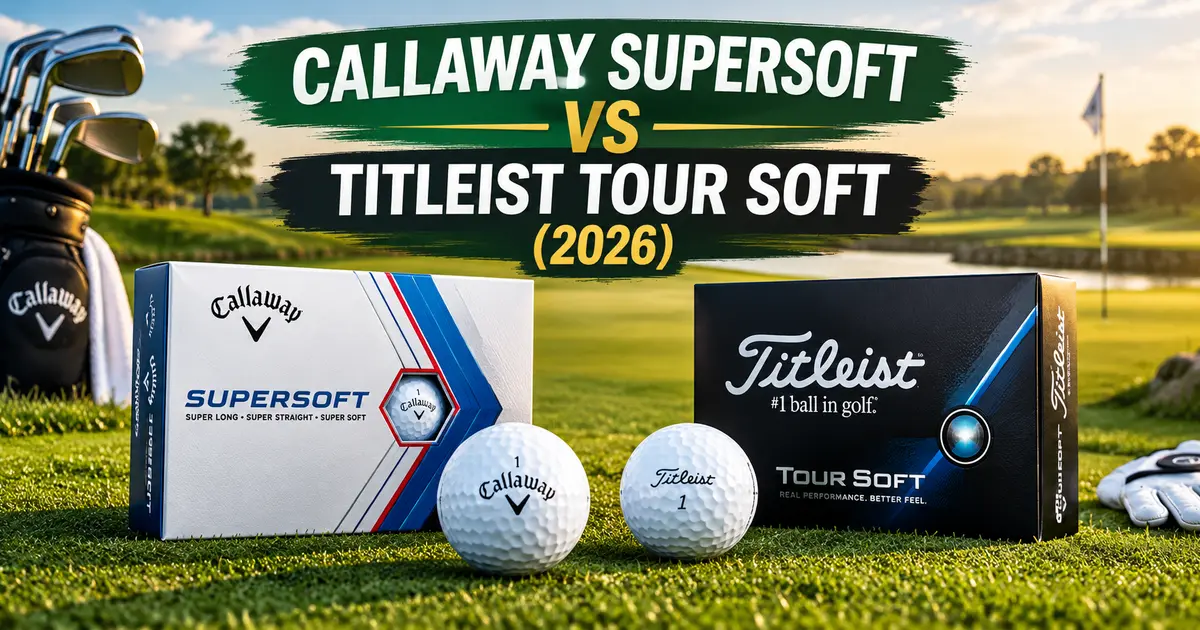
Swing speed decides the Callaway Supersoft vs Titleist Tour Soft question faster than feel or price. The Supersoft is a very low compression two-piece ball that rewards slower swings. Titleist rebuilt the Tour Soft for 2026 with a smaller core and a thicker, softer cover, so comparisons that predate this year describe a different ball.
I wrote this using the specs and list prices I checked on October 15, 2026. Every opinion comes from the construction of each ball and how swing speed loads a core, and I’m not claiming test results I didn’t run. If you want one number to anchor on, here it is: under 90 mph, buy the Supersoft.
Quick Answer: Play the Callaway Supersoft ($25 a dozen) if your driver swing speed sits under 90 mph. Play the Titleist Tour Soft ($39.99) at 95 mph and up. Between 90 and 95, choose the Tour Soft if you want better control around the greens and can spend the extra $15.
What’s inside each ball in 2026
Both balls have two pieces and a cover that isn’t urethane. That one fact explains most of what follows. The table lines up the current specs.
| Spec | Callaway Supersoft (2025 version) | Titleist Tour Soft (2026 version) | What it means on the course |
|---|---|---|---|
| Construction | Two-piece | Two-piece | Neither ball spins like a urethane tour ball |
| Core | HyperElastic SoftFast Core, very low compression | New, smaller core | The Supersoft compresses at slower swing speeds |
| Cover | Callaway hybrid cover, ionomer-based | Softer, thicker elastomer blend | Both scuff less than a urethane cover |
| Compression | Callaway rates it about 38 | Clearly firmer than the Supersoft | Slower swings favor the Supersoft, faster swings favor the Tour Soft |
| Price on October 15, 2026 | About $25 a dozen | $39.99 a dozen | The Tour Soft costs about $15 more per dozen |
| Best fit | Mid to high handicaps who want low spin and a very soft feel | Golfers who want soft feel plus stopping power without a high-spin tour ball | Match the ball to your driver speed first |
Compression numbers from different brands and labs come from different gauges, so a 38 from Callaway won’t line up with a figure from a third-party test. That’s why this guide leans on swing speed and a home test instead of a compression chart.
Callaway Supersoft vs Titleist Tour Soft by driver swing speed
Driver swing speed is the first filter. Here’s where I’d draw the lines.
| Driver swing speed | Play this | Why |
|---|---|---|
| Under 90 mph | Supersoft | The very low compression core still compresses at slow speeds, so you keep ball speed a firmer ball wastes |
| 90 to 95 mph | Either, split by short game and budget | Both balls compress well here, so greenside control and cost break the tie |
| 95 to 105 mph | Tour Soft | The Supersoft core over-compresses at these speeds, and you give up control on approach shots |
| Over 105 mph | Neither | You need a urethane tour ball to stop a wedge shot |
Treat those lines as rules of thumb. A launch monitor beats them, and so does the test near the end of this guide.
Most golfers guess their swing speed too high. If you’re unsure, assume the lower number. Many golf shops will measure it in about ten minutes.
The 2026 redesign most comparisons miss
Titleist built the earlier Tour Soft around the largest core in its lineup and a very thin cover. For 2026 it went the other direction. The new Tour Soft has a smaller core, a thicker cover and an elastomer blend that Titleist says is softer than before. A 386 quadrilateral dipyramid dimple pattern is new too.
Titleist says the redesign cuts long-game spin and sends iron shots higher with a steeper descent that holds greens. I can’t confirm those claims without a launch monitor, and a review that only repeats the spec sheet can’t either. What’s certain is the construction change, and it means older reviews describe a ball Titleist has replaced.
If a comparison still calls the Tour Soft a big-core, thin-cover ball, check its date. The Supersoft didn’t change this year, since the current version launched in 2025.
Which is softer, the Supersoft or the Tour Soft?
The Supersoft is softer. Callaway rates it around 38 compression, and the ball feels muted off every club, with almost no click on putts. The Tour Soft feels soft for a Titleist but still firmer than the Supersoft, with a clearer sound at impact.
Soft isn’t automatically better. A ball that feels like a pillow on a 6-foot putt can feel dull on a 150-yard approach, and golfers who like feedback from the face hate that. Golfers who miss the center often like the muted feel, because mishits sting less.
Greenside control without a urethane cover
Neither ball spins like a Pro V1 or a Chrome Tour around the greens. Their covers are firmer than urethane, so a chipped ball releases where a tour ball would grab. Land a wedge on a firm green with either one and expect it to roll out.
On full approach shots, the Tour Soft has the edge on paper. Titleist designed the 2026 version to launch higher and descend steeper, and both help a 7-iron hold a green.
Inside 40 yards, play the bump-and-run. Pick a landing spot closer to you than you would with a urethane ball and let the ball roll to the hole. Both balls reward that shot.
What the price gap costs you per round
Titleist lists the Tour Soft at $39.99 a dozen as of October 15, 2026. Callaway launched the Supersoft at $25 a dozen, and retailers sell it for up to about $28. That works out to about $3.33 a ball for the Tour Soft and $2.08 for the Supersoft, a gap of about $1.25 per ball.
Lose three balls a round for 20 rounds and you go through 60 balls. That costs $125 in Supersofts and about $200 in Tour Softs, a $75 difference over the stretch. If your local shop sells the Supersoft at $28, the gap shrinks to $12 a dozen, or $1 a ball.
Between 90 and 95 mph, let your ball-loss rate break the tie. Lose five a round and the Supersoft saves real money. Lose one or two and the Tour Soft’s extra control costs you little.
A 20-ball test you can run in one afternoon
Buy a dozen of each ball, which costs about $65 and gives you the balls you’ll play afterward anyway. Take 10 of each to a practice area with a range, a chipping green and a putting green. Set aside about 90 minutes.
- Warm up with range balls so your first swings don’t skew the results.
- Hit 10 drivers with each ball, alternating balls every shot. Record carry distance with a launch monitor, or note where each ball lands against the yardage markers.
- Write down the three worst drives for each ball.
- Chip 10 balls from 15 yards to the same hole with each ball. Count how many stop inside a 6-foot circle.
- Hit 10 pitches from 50 yards with one wedge and watch how far past the pin each ball releases.
- Roll 10 putts from 20 feet with each ball and note which one you leave short more often.
- Pick the ball whose worst shots hurt less. Your best shots will look good with either one.
Ten swings can’t prove a distance gap, but they show quickly which ball your short game likes. Use the same clubs, the same day and the same wind, or the results mean nothing.
Who should skip both
This comparison isn’t for everyone. If your driver swing speed tops 105 mph and you want to stop a wedge shot on a firm green, skip both and test a urethane tour ball like the Pro V1 or the Chrome Tour. Skip the Tour Soft if you swing under 80 mph and fight to get the ball airborne, because the Supersoft’s softer core will serve you better. Skip the Supersoft if you play fast, firm greens and need check on every pitch.
If you already play a urethane tour ball and score well with it, nothing here argues for a downgrade.
Questions golfers ask about the two balls
Is the Callaway Supersoft or the Titleist Tour Soft better?
Neither wins for every golfer. Under 90 mph, the Supersoft gives you more from a softer, cheaper ball. At 95 mph and up, the Tour Soft gives you more control and a core that doesn’t over-compress. Between those speeds, the 20-ball test above settles it.
Which is softer, the Supersoft or the Tour Soft?
The Supersoft, by a clear margin. Callaway rates it around 38 compression, and the Tour Soft feels firmer at impact even though Titleist builds it to feel soft by its own standards.
Does the Titleist Tour Soft go farther than the Callaway Supersoft?
Off the driver, that depends on your swing speed. Below 90 mph, the Supersoft’s lower compression usually keeps more ball speed. At 95 mph and up, the Tour Soft’s firmer core usually wins, and Titleist designed the 2026 version to cut long-game spin.
Is the Callaway Supersoft good for mid handicappers?
Yes, when the mid handicapper swings under 90 mph. Handicap tells you less than swing speed here. A 14 handicap who swings 98 mph will over-compress the Supersoft and give up control on approach shots.
Is the Titleist Tour Soft worth the extra money over the Supersoft?
Worth it if you swing 95 mph or faster, hit a lot of approach shots into greens and lose two balls or fewer a round. Not worth it if you lose five. At $39.99 versus about $25 a dozen, the gap runs about $75 across 20 rounds at three lost balls a round.
What swing speed suits the Supersoft and the Tour Soft?
Under 90 mph fits the Supersoft best. From 95 to 105 mph fits the Tour Soft best, and 90 to 95 mph works with either. Above 105 mph, neither gives you tour-level wedge spin.
Settle it on the practice tee
Swing speed settles the Callaway Supersoft vs Titleist Tour Soft choice in most cases. If you don’t know yours, a driver swing speed check at a fitting bay takes a few minutes. Then spend one afternoon on the 20-ball test before you buy a second dozen. The ball with the better worst shots belongs in your bag.