
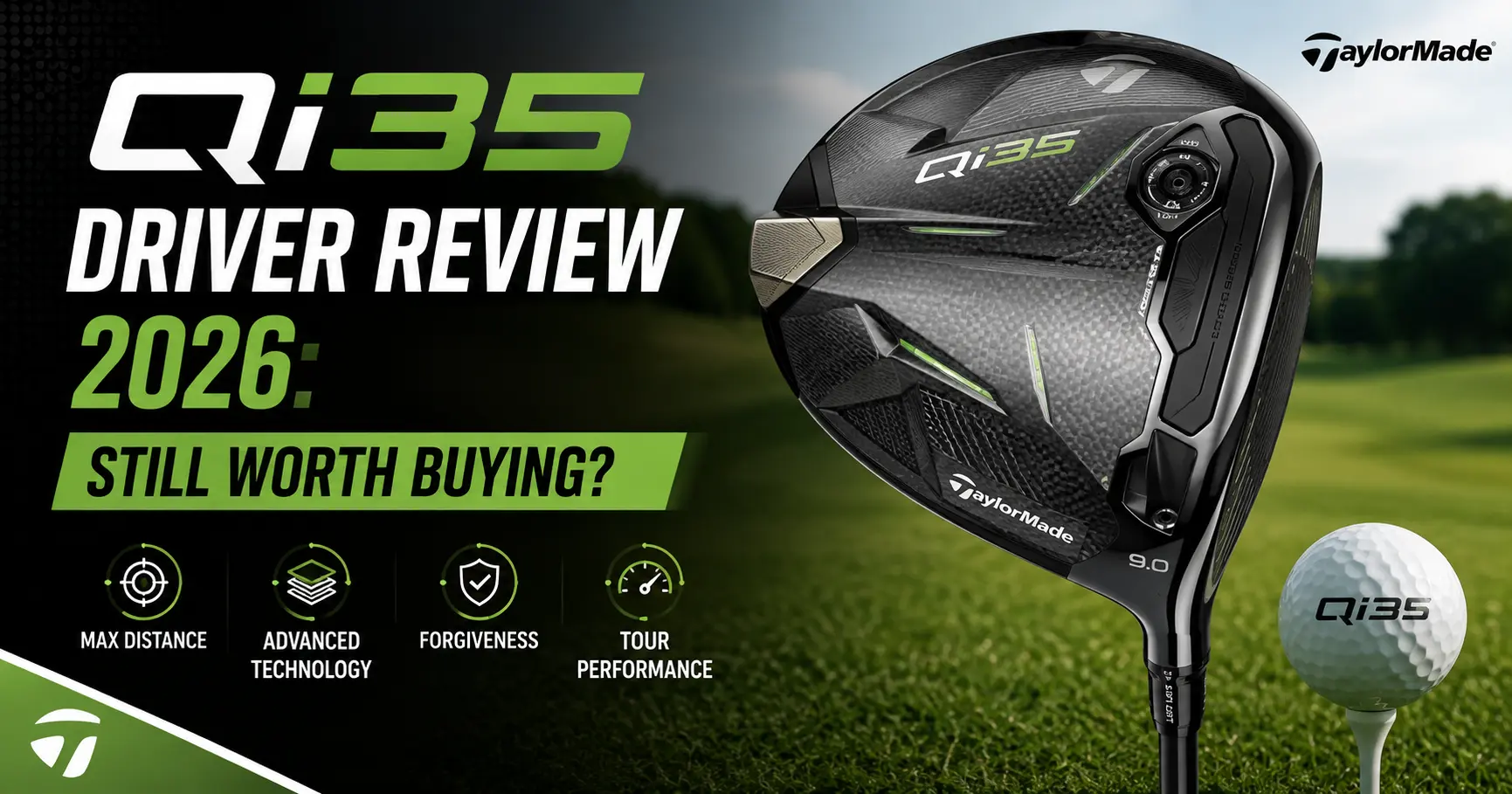
Quick Answer: The TaylorMade Qi35 is a genuinely forgiving, high-MOI driver now selling for $449.99 across all four models, down from $599.99 to $649.99, because TaylorMade replaced it with the Qi4D in January 2026. That makes it one of the smarter driver deals in golf right now, especially if you don’t need this year’s newest technology.
TaylorMade launched the Qi35 driver family in January 2025 with a lot of noise about a lowered center of gravity and record-tying forgiveness. A year later, in January 2026, the company quietly moved on and replaced it with the Qi4D. That timeline matters more than most Qi35 reviews let on, because it changes the entire buying decision. This review covers what the Qi35 does well, where it falls short, and whether the current $449.99 price makes it a smart buy or a leftover you should skip.
What the Qi35 Actually Is (and Why It’s on Sale Right Now)
TaylorMade builds the Qi35 around four models. The standard Qi35 sits in the middle of the lineup, and the Qi35 LS trims spin for faster swingers. The Qi35 Max chases maximum forgiveness with 10,000 MOI, the ceiling most manufacturers now treat as a practical limit. The Qi35 Max Lite strips weight from the head, shaft, and grip to help slower swingers generate speed.
Every model uses the same core ideas. A carbon crown and carbon face save weight high in the head. That saved weight moves lower and further back, which drops the center of gravity and raises MOI at the same time, something driver engineers usually have to trade off against each other. TaylorMade calls this its lowest CG projection in roughly a decade.
The part most Qi35 reviews miss is what happened next. TaylorMade replaced the entire Qi35 family with the Qi4D in January 2026, less than a year after launch. That’s a normal product cycle for TaylorMade, but it means the Qi35 is no longer the company’s current flagship. As of this writing, TaylorMade’s own site lists all four Qi35 models at $449.99, down from an original $599.99 for the standard, Max, and Max Lite models and $649.99 for the LS.
That’s a real discount on a driver that was TaylorMade’s best in early 2025, not a fire sale on something broken.
Qi35 Family Specs at a Glance
| Model | Lofts | Original Price | Current Price | MOI | Stock Shaft | Best For |
|---|---|---|---|---|---|---|
| Qi35 | 9°, 10.5°, 12° | $599.99 | $449.99 | 9K back weight, 8.1K forward weight | Fujikura Ventus Blue ’25 or Mitsubishi Diamana T+ 60 | Most golfers who want one adjustable driver |
| Qi35 LS | 8°, 9°, 10.5° | $649.99 | $449.99 | Lower than standard, lowest CG in the family | Mitsubishi Kai’li Blue or White DarkWave 60 | Faster swingers who already overspin the ball |
| Qi35 Max | 9°, 10.5°, 12° | $599.99 | $449.99 | 10K, fixed | Fujikura AirSpeeder ’25 or Mitsubishi Diamana T+ 60 | Higher handicaps who need maximum stability |
| Qi35 Max Lite | 10.5°, 12° | $599.99 | $449.99 | High, in a lighter package | Mitsubishi Vanquish 4 | Slower swing speeds, seniors, players rebuilding speed |
Every Qi35 model ships with a 4-degree adjustable loft sleeve, so the stamped loft is a starting point rather than a fixed number. Our full guide to driver lofts explains how to actually use that adjustability instead of guessing at it.
How the Qi35 Performs: Distance, Ball Speed, and Forgiveness
TaylorMade’s own testing claims the standard Qi35 delivers 13 percent tighter dispersion than the Qi10 when the 13-gram weight sits in the back position, and up to five additional yards when that weight moves forward. Those numbers come from the manufacturer, so they deserve a healthy amount of skepticism on their own.
Independent testing tells a more grounded story. MyGolfSpy included the Qi35 in its 2025 driver test of 37 different models and measured an average distance of 250.07 yards, good for 11th place in that category. Ball speed ranked second overall, and the driver earned a 9.2 out of 10 for distance and 8.6 for accuracy. Average spin came in at 2,630 rpm, and it was the highest-ranking TaylorMade driver in that test, though it didn’t crack the top ten overall.
The Qi35 Max is worth a specific callout here. Independent robot testing measured its average spin rate at roughly 3,200 rpm, one of the higher numbers among 2025’s forgiveness-focused drivers. That’s not necessarily a problem for a higher-handicap player who needs help getting the ball airborne, but it does undercut some of the marketing language around tighter dispersion. If you already launch the ball high and spin it too much, the Max is the wrong model to reach for.
Sound, Feel, and Look at Address
The Qi35’s carbon face produces a deeper, more muted sound than the sharper crack of a full titanium face. Reviewers who tested it consistently describe the feel as solid rather than explosive, which tracks with what carbon face construction usually delivers.
Visually, TaylorMade moved the standard Qi35 to a larger, rounder footprint borrowed from the Max model’s shape, replacing the more traditional pear shape used in earlier core models. Golfers coming from an older TaylorMade driver will notice the bigger profile at address immediately. Some players prefer that extra confidence. Others find it looks bulkier than they’d like on a driver marketed as the standard, adjustable option rather than the forgiveness-first Max.
Qi35 vs Qi35 LS vs Qi35 Max vs Qi35 Max Lite: Which Model Fits Your Game
| Model | Forgiveness | Spin | Best Swing Speed | Best Handicap Range |
|---|---|---|---|---|
| Qi35 | High | Mid | Moderate to fast | 5 to 20 |
| Qi35 LS | Moderate | Low | Fast | Scratch to 10 |
| Qi35 Max | Highest | Mid to high | Slow to moderate | 12 to 30+ |
| Qi35 Max Lite | Highest | Mid to high | Slow | 15 to 30+, and seniors |
The standard Qi35 is the best starting point for most golfers. It carries enough forgiveness to survive an off-center hit and enough adjustability, through the two movable weights and the loft sleeve, to fit a wide range of swings without needing the Max’s extra bulk.
The Qi35 LS makes the least sense for players who already struggle to launch the ball or spin it too little. Its whole design goal is spin reduction for players with excess spin and above-average speed. Put it in the hands of a moderate-speed player fighting a low, weak ball flight and it will make that problem worse, not better.
Qi35 vs Qi10: Is the Upgrade Worth It
If you already play a Qi10, the case for switching to a Qi35 is more modest than TaylorMade’s marketing suggests. The core technical change is a lower center of gravity across the board, which TaylorMade achieved by growing the standard Qi35’s footprint and cutting weight from the face, crown, and titanium ring. The Qi10 measured 8.4K MOI with a higher CG. The Qi35 pushed MOI to 9K in the back weight position while dropping CG at the same time, which is the harder engineering problem to solve.
That’s a real improvement, not a marketing trick, but it’s an incremental one. Golfers who found the Qi10 Max too spinny will notice the roughly 200 rpm spin reduction TaylorMade built into the Qi35 Max. Golfers who liked their Qi10 and never wanted more adjustability on the standard model have less reason to spend $449.99 chasing a generational step that mostly shows up in launch monitor numbers rather than scorecards.
Qi35 vs Qi4D: Should You Buy the Discounted Old Model or Pay More for the New One
This is the question most Qi35 reviews never address, because most of them were written before the Qi4D existed. TaylorMade launched the Qi4D family in January 2026 as the Qi35’s direct successor, built around a redesigned carbon face, four movable weights instead of two, and a smaller, more traditional profile on the standard model.
The Qi4D also arrived with a documented advantage: manufacturing consistency. Multiple outlets reported that the Qi35’s hand-ground carbon face led to real variation between individual heads, enough that top players including Rory McIlroy and Scottie Scheffler skipped it entirely. TaylorMade’s tour adoption for the Qi4D has reportedly been stronger as a result.
None of that makes the Qi35 a bad driver for the average golfer. It means you’re choosing between a proven, discounted driver with a documented consistency issue at the margins, or TaylorMade’s newer, pricier flagship with a cleaner manufacturing story. If the extra adjustability and consistency matter to you, spend the money on the Qi4D. If you want strong, current-generation performance at nearly half the original price, the Qi35 remains a legitimate option.
Who Should Buy the Qi35 (and Who Should Skip It)
Buy the Qi35 if:
- You want a forgiving, adjustable driver at a meaningfully lower price than TaylorMade’s current flagship.
- You’re upgrading from a driver older than the Qi10 and want a clear performance jump.
- You play the standard or Max model and don’t need tour-level face consistency.
Skip the Qi35 if:
- You already play a Qi10 and are happy with your numbers.
- You already launch the ball high and spin it too much. The LS model in particular won’t fix that, and even the standard and Max models carry more spin than their marketing suggests.
- Face-to-face consistency matters enough to you that you’d rather pay more for the Qi4D’s cleaner build process.
Qi35 vs the Competition: Ping G440 Max and Other 2026 Rivals
Head-to-head testing against the Ping G440 Max found the Qi35 producing tighter dispersion, with the Ping feeling slightly softer at impact. Neither driver clearly beat the other on raw numbers. The decision mostly came down to preference between TaylorMade’s firmer carbon feel and Ping’s traditional titanium sound. For a different flavor of low-spin forgiveness, our Ping G430 LST review covers a rival that solves the same problem from a different angle.
With the Qi35 now priced at $449.99, it also competes directly against other manufacturers’ previous-generation flagships rather than their current ones. That’s worth remembering before you compare it to a brand-new Callaway, Titleist, or Cobra driver at full retail. A fairer comparison puts the Qi35 against whatever each competitor is discounting right now, not their newest release.
New, Used, or Wait for a Deal: Buying Advice
At $449.99 direct from TaylorMade, the Qi35 comes with a full warranty and the ability to order your exact loft, shaft, and flex combination. That’s worth paying a premium for if you want a specific build.
The used market runs lower. Certified pre-owned listings from major retailers commonly price Qi35 heads and full builds well below the current retail sale price, and TaylorMade’s carbon construction has generally held up well in the secondhand market based on retailer condition grading. Check that the shaft and flex actually match your swing before buying used, since a mismatched stock shaft will cost you more in performance than you saved on the driver itself. If you’re also shopping fairway woods to match, our guide to the best fairway woods for every handicap breaks down how TaylorMade’s current Qi4D fairway wood stacks up against the field.
TaylorMade Qi35 Driver FAQ
Is the TaylorMade Qi35 driver still worth buying in 2026?
Yes, for the right buyer. At $449.99 it delivers real, independently measured distance and forgiveness gains over older drivers. It only loses to the Qi4D if newer face technology and tour-level consistency matter more to you than the price gap.
How does the Qi35 compare to the Qi10?
The Qi35 lowers the center of gravity across every model in the family without sacrificing MOI. The gain is real but incremental, and it shows up more clearly for golfers who found the Qi10 Max too spinny than for golfers already happy with a standard Qi10.
Which Qi35 model should I buy?
The standard Qi35 fits the widest range of golfers thanks to its balance of forgiveness and adjustability. Choose the LS only if you already have above-average speed and too much spin. Choose the Max or Max Lite if forgiveness matters more to you than workability.
Is the TaylorMade Qi35 driver good for beginners?
The Qi35 Max and Max Lite are the better beginner picks. Both use maximum MOI and easier launch conditions to help forgive mishits, and the Max Lite’s lighter overall build helps players who are still building clubhead speed.
Why did TaylorMade replace the Qi35 so quickly?
TaylorMade runs an annual driver cycle, and the Qi4D arrived in January 2026 as the standard yearly update. Reported manufacturing consistency issues with the Qi35’s hand-ground carbon face likely accelerated the push toward the Qi4D’s redesigned face process, though TaylorMade has not confirmed that as the primary reason.
Final Verdict
The Qi35 earned its reputation in 2025 as a genuinely forgiving, well-built driver, and independent testing backs that up with real distance and ball speed numbers rather than just marketing language. It’s no longer TaylorMade’s newest driver, and it comes with a documented consistency issue that pushed some tour players away from it.
None of that erases what the Qi35 does well at the price it sells at now. At $449.99, it undercuts its original price by $150 to $200 and still performs like a current-generation driver because, for most golfers outside the top level of the game, it is one. If you want the newest technology and don’t mind paying full price, buy the Qi4D. If you want strong performance without paying flagship prices, the Qi35 still earns a spot on your shortlist.
For golfers who want to get the most out of whichever driver they choose, our guide to golf driver drills is worth running through before your next range session.