
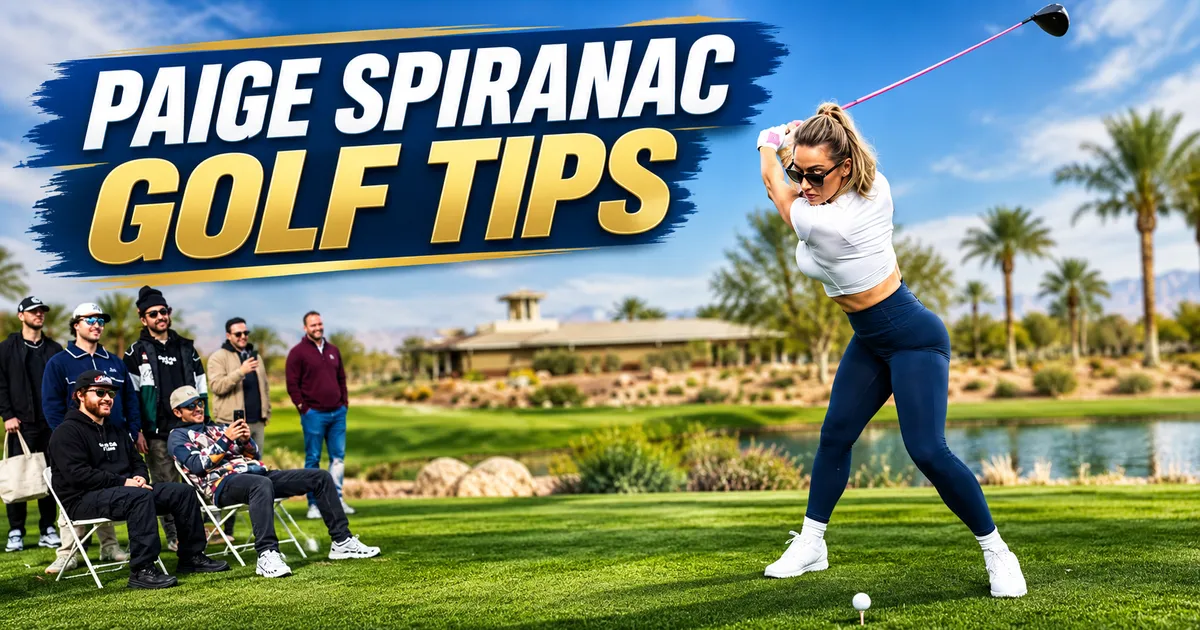
Former professional golfer and social media personality Paige Spiranac is drawing attention to the fundamentals of tee shots, offering practical advice on ball flight, course strategy and pre-shot routines that recreational golfers can use to approach the first tee with greater confidence.
Spiranac, who has built a substantial online audience through golf instruction and entertainment, has shared several lessons on choosing the right position in the teeing area, managing common shot shapes and establishing a repeatable routine.
Her instructional approach was also featured in an October 15, 2026, YouTube video with former Peloton instructor Kendall Toole, in which she helped a developing golfer navigate tee shots and other challenges on the course.
The lessons demonstrate that improving a drive is not always about hitting the ball farther. Sometimes, better positioning and more thoughtful preparation can make a meaningful difference.
Paige Spiranac Explains Why Tee Box Position Matters
One of Spiranac’s most useful tips involves selecting where to place the ball within the teeing area.
In an earlier instructional video discussed by BroBible, she explained that golfers should consider their typical shot shape before deciding where to tee up.
For right-handed golfers who regularly hit a fade or slice, Spiranac recommends considering the right side of the teeing area.
That position can create a different visual angle and allow the golfer to aim across more of the fairway while accounting for the ball’s tendency to curve from left to right.
Players who consistently hit a draw may find the opposite approach useful.
Spiranac, who described a draw as her preferred shot shape, explained that she likes using the left side of the teeing area to create room for a ball that curves from right to left.
The strategy is intended to make golfers think about the direction of their normal shots rather than automatically placing their ball in the middle of the tee box.
However, the best position also depends on hazards, course layout, wind direction and how much the ball curves.
A Consistent Pre-Shot Routine Can Help Beginners
Spiranac returned to the importance of preparation in her October 2026 video with Kendall Toole.
During their round, Toole admitted feeling nervous on the tee and worried about how other golfers might judge her performance.
Spiranac responded by demonstrating the importance of a consistent pre-shot routine.
Her process involved selecting a target, taking a breath, approaching the ball with that target in mind and focusing on one simple swing thought.
Rather than overwhelming a beginner with several technical instructions, the routine provided a repeatable process before each shot.
Spiranac also encouraged Toole to take the time needed to prepare properly instead of rushing because of embarrassment or pressure.
The lesson is relevant to recreational golfers who feel uncomfortable on busy courses or become distracted when other players are watching.
A clear routine can help direct attention toward the intended shot, although it cannot guarantee accuracy.
How High Should Golfers Tee Up the Ball?
Another important part of tee-shot preparation is choosing the correct tee height.
While the October 22 report about Spiranac does not provide specific tee-height measurements, established golf instruction offers useful guidance.
In a January 2026 article for GOLF.com, instructor Erika Larkin explained that players using a driver can begin with approximately half the golf ball positioned above the crown of the clubhead when the driver rests behind it.
This setup can help golfers make contact while the club is moving upward through impact.
Fairway woods and hybrids generally require a lower tee position, with the ball only slightly elevated above the grass.
For iron shots, a low tee height is often preferable because players normally seek a descending strike.
These positions are useful starting points rather than fixed rules. Individual swing characteristics and club designs may require adjustments.
Golfers can experiment during practice to identify the height that produces the most reliable contact.
Spiranac Encourages More Controlled Swings
Spiranac has also shared an alternative approach for golfers who struggle to keep their drives in play.
In her instructional series, she described a controlled swing in which the golfer grips slightly farther down the shaft and uses a shorter backswing and follow-through.
The objective is to prioritize control rather than maximum clubhead speed.
For golfers who frequently miss fairways, this approach provides a possible alternative to attempting a full-power drive on every hole.
A compact swing may also help players feel more balanced and reduce the number of moving parts they are trying to manage.
However, the effectiveness of the technique depends on the underlying swing problem.
Golfers who repeatedly slice or hook the ball may still need to examine clubface position and swing path.
The controlled-swing approach is best treated as a practice option rather than a guaranteed correction for inaccurate driving.
Teaching Kendall Toole Highlights the Mental Side of Golf
Spiranac’s recent lesson with Kendall Toole placed particular emphasis on the emotional challenges faced by beginners.
Toole discussed her concerns about appearing inexperienced and slowing down other golfers.
Instead of concentrating exclusively on technical mechanics, Spiranac encouraged her to approach each shot with a purpose and develop a routine she could trust.
The lesson included demonstrations covering tee shots, fairway woods, chipping, bunker play and putting.
Throughout the session, Spiranac blended instructional explanations with conversation and humor.
Her approach highlighted an important part of learning golf: players need opportunities to develop confidence while accepting that mistakes are inevitable.
For someone new to the sport, becoming comfortable with the process of playing can be just as important as learning a particular swing movement.
Three Common Mistakes Golfers Make on the Tee
The lessons provide a useful starting point for identifying mistakes that can affect tee-shot performance.
The first is ignoring natural ball flight. A golfer who consistently curves shots in one direction should consider that pattern when selecting a target and position in the teeing area.
The second is using an unsuitable tee height. Setting the ball too high or too low can influence strike location and launch characteristics.
The third is rushing the pre-shot routine. Golfers who hurry their setup may struggle to establish consistent alignment or maintain a clear target.
These are not the only causes of poor driving, and the same correction will not necessarily work for every player.
However, checking simple setup fundamentals can be a practical first step before attempting major swing changes.
What Amateur Golfers Can Learn From Paige Spiranac
Spiranac’s advice emphasizes preparation, course awareness and selecting a strategy appropriate to the player’s normal ball flight.
Her tee-box positioning tip encourages golfers to think about the shape of their shots.
Her pre-shot routine guidance focuses on confidence and consistency.
Meanwhile, her compact-swing suggestion provides an option for players who want to prioritize control over maximum distance.
Combined with appropriate tee-height guidance, these ideas give beginners several manageable areas to examine during practice.
The most useful approach is to change one variable at a time, observe the results and identify which adjustments improve contact or directional control.
Final Thoughts
Paige Spiranac’s golf tips demonstrate that better tee shots do not always require a completely rebuilt swing or additional distance.
Choosing an appropriate position in the teeing area, understanding ball flight and following a consistent pre-shot routine can help golfers make more deliberate decisions.
For beginners, the larger lesson is to avoid rushing and focus on building repeatable habits.
Whether the goal is hitting more fairways or simply feeling comfortable on the first tee, thoughtful preparation offers a practical starting point for improving the golf experience.