

Many golfers hit their irons pure but slice the driver into the woods. This is a very frustrating problem. Most players assume the golf swing is the exact same motion for every club. They try hitting driver vs irons with the exact steep angle.
This mistake ruins tee shots and inflates scores. As experts like Grant Horvat note, ignoring the difference between an iron swing vs driver swing creates big issues.
This guide breaks down the exact differences in setup and swing plane. Golfers will learn how to compress irons and launch drivers.
⛳ Perfect Setup Simulator
Match your body position to the club in your hands.
Ball Position
Weight Distribution
Shoulder Tilt
Swing Plane
Why the Driver and Iron Swing Must Be Different

The biggest mistake amateurs make is treating every club exactly the same. The environment for each club changes the goal. Golfers hit irons directly off the turf. They hit drivers off a wooden peg.
The main goal for an iron is striking the golf ball first. The club then takes a divot from the ground. This requires a descending blow. Trackman data shows professional players hit down on a 7 iron at a downward angle of 4 to 5 degrees. This downward strike compresses the golf ball.
The goal for a driver is entirely different. Golfers want to catch the ball on the upswing. This upward strike maximizes launch and reduces spin. Trackman data shows pros hit up on a driver at 2 to 5 degrees. This sends the ball flying much further.
Knowing this difference between iron and driver swing mechanics is the first step to better golf. The clubs are designed differently. The driver has a flat shaft angle. The iron sits much more vertically. These design traits force players to change their physical approach for every single swing.
Golf Swing Driver vs Iron Setup: Getting Address Right

The most important changes happen before the club even moves. A poor setup ruins the shot before it begins. Amateurs often place the golf ball in the exact same spot for every single club.
Irons
- Place the ball directly in the middle of the stance.
- Put more weight on the lead foot.
- Aim for 70 percent on the left side and 30 percent on the right side.
- Keep the shoulders relatively level to the ground.
- Position the head directly over the golf ball.
Driver
Driver Setup
Forward Alignment
Move the ball forward in your stance so it is positioned just inside the lead heel for an optimal upward strike angle.
Balanced Foundation
Keep your foundation stable by ensuring the weight is distributed evenly at 50 percent on both feet at address.
Upward Attack Angle
Create the correct spine tilt by dropping the trail shoulder significantly lower than the lead shoulder before taking the club back.
Visual Anchor
Ensure a powerful release through impact by actively placing the head clearly behind the golf ball during setup.
The physical design of the club naturally dictates these golf swing driver vs iron setup positions. A driver sits much lower to the ground when laid flat. An iron stands tall and vertical. Players must adapt their body to fit the club in their hands.
Weight distribution is especially critical. The heavy lead side for an iron ensures the player hits down on the ball. The balanced setup for the driver allows the player to tilt back and hit up. Feel the right shoulder drop lower than the left before starting the driver takeaway.
The Swing Plane: Up and Down vs Around the Body
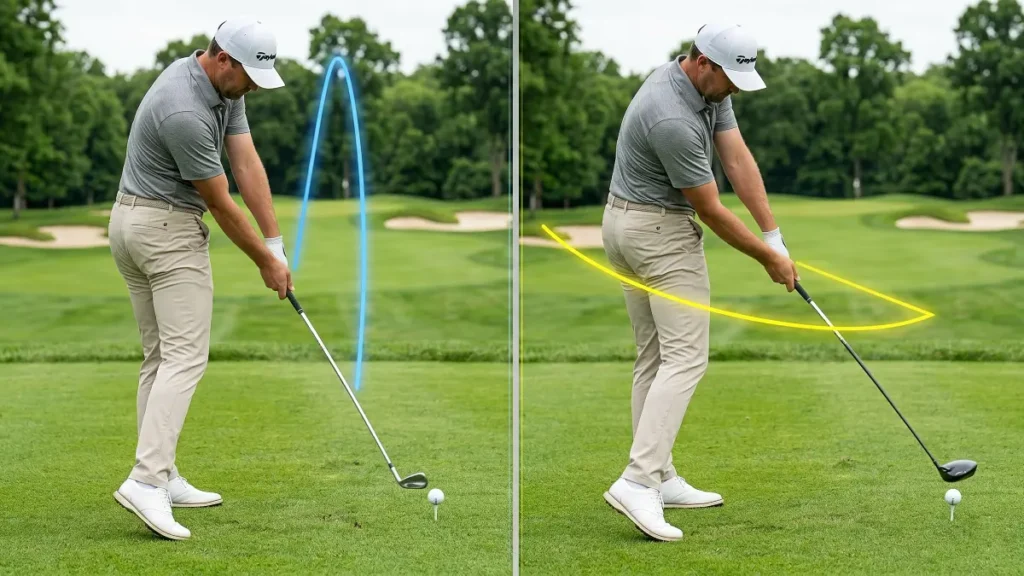
The length of the club changes how it moves through the air. An iron is much shorter. The player stands closer to the golf ball. This creates a backswing and downswing that are naturally upright and vertical. It feels like an up and down motion.
The driver is the longest club in the bag. The player stands further away from the golf ball. The swing must become much more rounded and horizontal. It feels like a sweeping motion around the body.
Using the steep iron swing on a driver is extremely dangerous. This steepness causes the club to chop straight down on the golf ball. The result is usually a severe slice or a weak pop up. Hitting driver vs irons requires a completely different path.
Players can try the baseball bat drill to feel this difference. Hold the driver parallel to the ground. Swing it horizontally like a baseball bat. Slowly lower the club a few inches with each swing. Retain that same rounded feeling until the club reaches the golf ball. This drill teaches the exact sweeping motion needed for a successful drive. Feel the club swing around the body rather than lifting straight up.
Controlling the Head at Impact
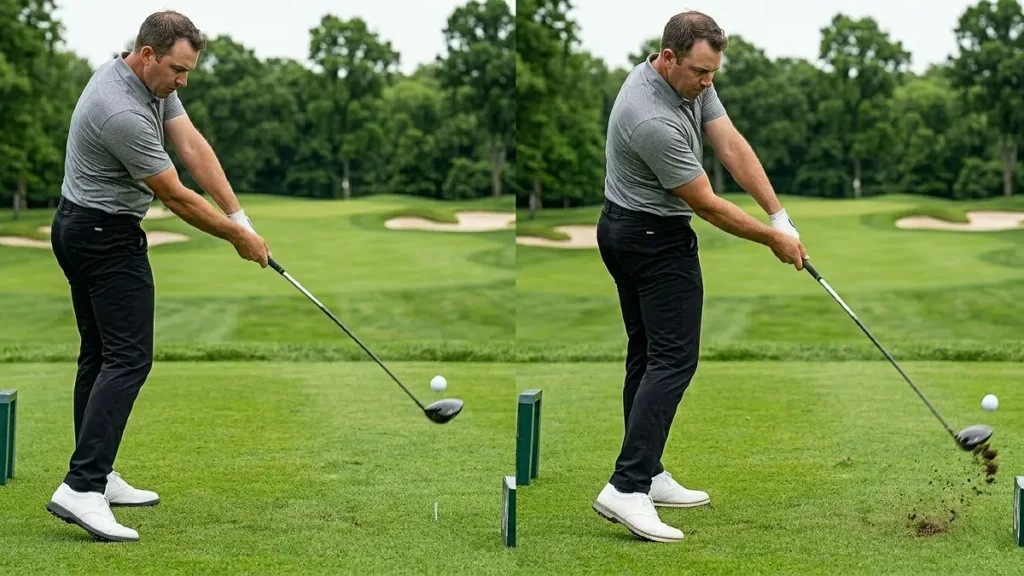
The final piece of the puzzle happens right at impact. The head position controls the entire angle of the strike. Many players struggle because they lunge forward during the swing.
With irons, the head and body naturally shift forward. This helps the player cover the golf ball. It traps the ball against the turf for a crisp strike. The weight continues moving left to ensure a solid divot.
With the driver, the head must stay entirely behind the golf ball. The player must keep it back through the entire impact zone. This allows the club to travel upward as it meets the ball. Driving the head forward with a driver ruins the shot. It creates a steep angle that leads to weak hits.
An average player swinging at 95 miles per hour needs a positive attack angle. They need to launch the ball at 12 to 15 degrees for optimal carry distance. Staying firmly behind the ball is the only way to achieve this perfect flight. Feel the head staying anchored back while the club releases through the zone.
What to Keep the Same: Universal Swing Habits
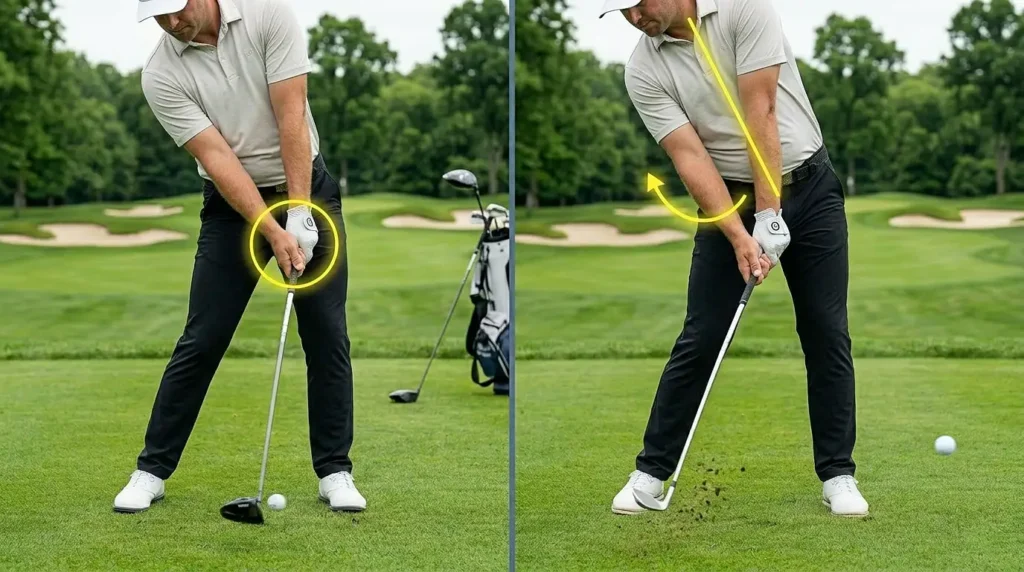
It is easy to think you need two completely different swings. You do not. Many parts of the golf swing stay exactly the same. Your grip does not change. Your takeaway feel often stays the same. The way your wrists hinge remains constant. Instructor Eric Cogorno notes that these small details are universal.
The big changes only happen in your setup and your swing plane. Once you fix your address position, you can trust your natural motion. Do not try to invent a brand new swing for your driver. Let the new setup do the hard work for you.
Iron vs Driver Quick Reference Guide
| Feature | Iron Swing | Driver Swing |
| Main Goal | Strike ball first then ground | Catch ball on the upswing |
| Ball Position | Middle of stance | Inside lead heel |
| Weight Setup | 70 percent on lead foot | 50 percent evenly balanced |
| Shoulder Tilt | Relatively level | Trail shoulder clearly lower |
| Swing Shape | Up and down | Around the body |
| Head Position | Moves slightly forward | Stays back behind the ball |
Conclusion
The grip and basic body mechanics stay mostly the same for every club. But the setup and swing plane must adapt to the specific tool being used. Mastering the iron swing vs driver swing requires conscious effort.
Players should head out to the driving range to build these new habits. They must separate their practice sessions into two distinct parts. Golfers need to consciously practice the rounded and sweeping feel for the driver.