

You are 10 yards short of the green with just short grass ahead. Do you grab a wedge or an 8 iron? The wrong choice easily costs you a stroke. Most amateurs use one club for every shot around the green.
This causes chunky strikes, thin rockets over the back, and lost confidence. Golf coach Chris Ryan breaks down the exact difference between chipping and pitching.
You will learn the step by step setup for each swing. Get ready to master the chip vs pitch with these golf short game tips.
What is the Difference Between Chipping and Pitching?
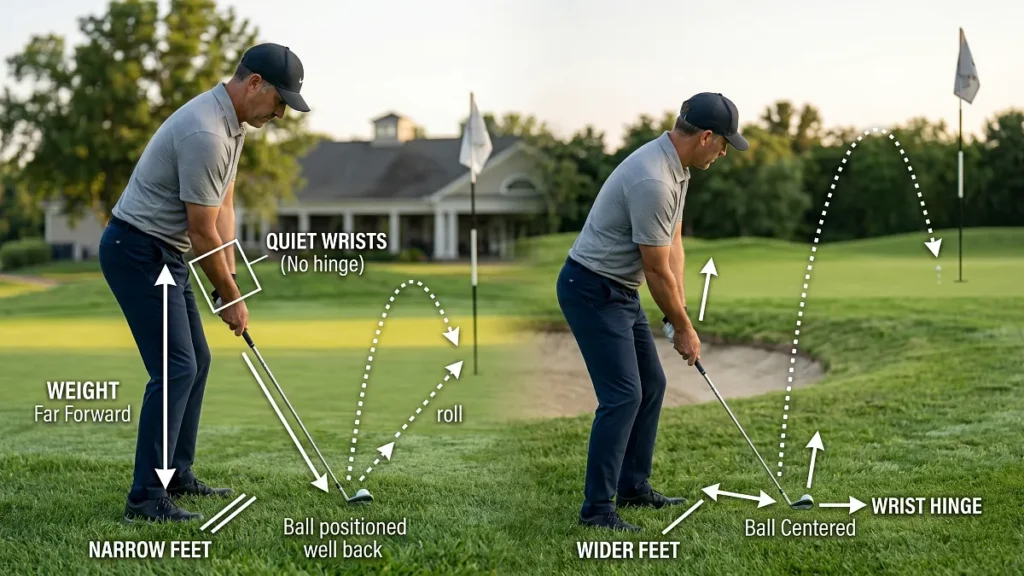
You need clear rules for shot selection. The difference between chipping and pitching comes down to air time and ground time.
A chip shot gives you maximum ground roll and minimum air time. It is essentially a putt played with an iron or a wedge. The ball pops over the fringe and rolls the rest of the way to the hole.
A pitch shot gives you maximum air time and minimum ground roll. It is a mini full swing meant to fly high and stop fast. You use this when you need the ball to land softly.
Elite players rely on high percentage ground control. Leaders on the 2026 PGA Tour in strokes gained around the green build their foundation on safe choices. Players like Brandt Snedeker save over 0.76 strokes per round by picking the most reliable trajectory. The common coaching rule is simple: minimum air time, maximum ground time.
The golden rule of the short game makes decisions easy. Putt when you can. Chip when you cannot putt. Pitch only when you absolutely have to. Why risk a high flop shot when a low bump and run guarantees the green? Knowing the chip vs pitch basics will immediately lower your scores.
How to Hit the Perfect Chip Shot
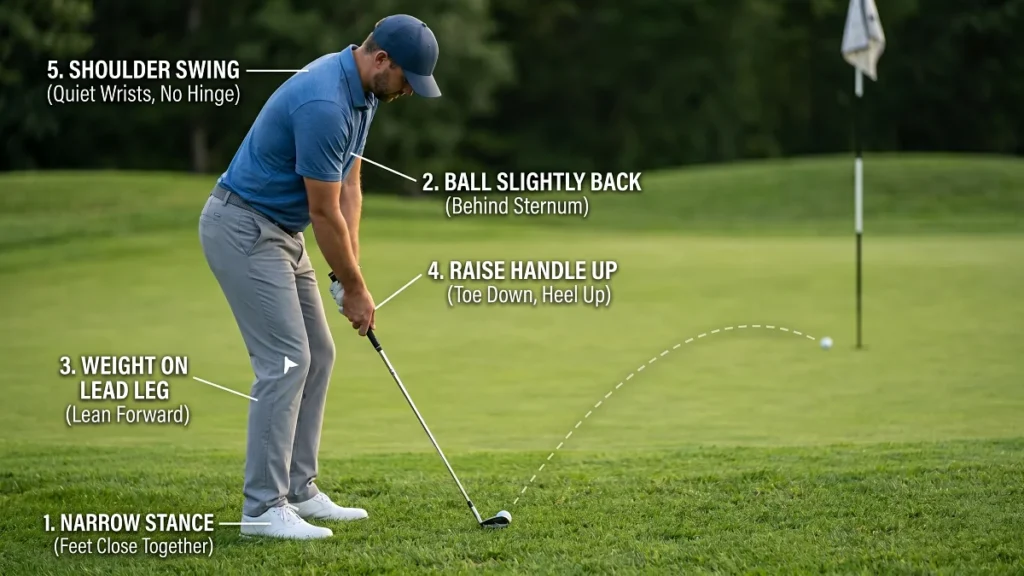
The chip shot requires a very specific setup. Everything you do here guarantees the direction and the strike. You want to control the ball like an extended putt.
Here is your setup checklist for a chip:
The Putting Chip
Narrow Stance
Keep your feet narrow and stand much closer to the ball than normal to promote an upright, putting-style stroke.
Vertical Posture
Raise the handle up so the toe of the club sits slightly lower than the heel. This drastically reduces turf interaction.
Ball Position
Place the ball slightly back of center. It should sit just behind your sternum for a clean, descending strike.
Forward Load
Keep your weight heavily favored on your lead leg throughout the entire motion to prevent scooping the ball.
- Stance: Keep your feet narrow. Stand much closer to the ball than normal.
- Posture: Raise the handle up. The toe of the club should sit slightly lower than the heel. This reduces turf interaction.
- Ball Position: Place the ball slightly back of center. It should sit just behind your sternum.
- Weight: Keep your weight heavily favored on your lead leg.
The swing is driven entirely by your shoulders. Keep your hands quiet. Keep your wrists quiet. Let your shoulders do the work. The club face rotates far less during this motion. This downward strike helps you miss any thick grass behind the ball.
You use one technique but multiple clubs for chipping. You can change the club from a 7 iron to a 52 degree wedge. A 7 iron rolls much further than a wedge. The motion stays exactly the same. You just change the club to dictate how far the ball rolls out.
Pro Tip: On a chip, if your wrists are flipping, you are doing it wrong. Keep things simple for the best golf short game tips. Knowing your chipping vs pitching form is crucial for consistency.
How to Hit a High Pitch Shot
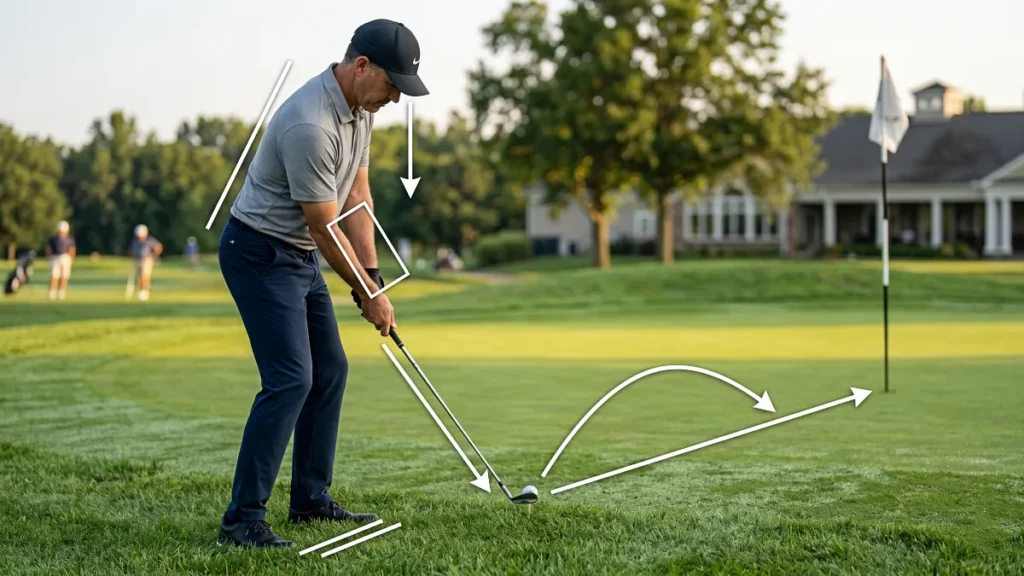
While the chip relies entirely on the shoulders for a low runner, the pitch requires you to wake up your wrists and hands. A pitch shot needs a different technique to get the ball up in the air.
Here is your setup checklist for a pitch:
The Standard Pitch
Adjusted Stance
Stand slightly wider than you would for a chip to create a more stable base for the longer, sweeping motion.
Ball Position
Ensure neutral contact by keeping the ball centered exactly under your sternum throughout the setup.
Club Posture
Unlike chipping, drop your hands to let the club sit completely flat on the ground to utilize the club’s natural bounce.
Weight Distribution
Keep your weight slightly forward but much more balanced than a chip, allowing for a shallower angle of attack.
- Stance: Stand slightly wider than you would for a chip.
- Ball Position: Keep the ball centered exactly under your sternum.
- Posture: Let the club sit completely flat on the ground.
- Weight: Keep your weight slightly forward but much more balanced.
The swing introduces wrist hinge and arm fold. It looks like a miniature drive. You must rotate your torso through the ball. Finish the swing with your chest facing the target. Let your trail heel lift from the ground to support the motion.
You use one club but vary your technique for pitching. You will usually play this shot with a sand wedge or a lob wedge. You make the swing longer to hit the ball further. This shot handles most of the distance in the air.
Pro Tip: The sole of the golf club must make contact with the ground. Make practice swings to brush the exact spot on the grass where the ball sits. This shows the real difference between chipping and pitching.
3 Ways to Know When to Chip vs Pitch
You have the technique down. Now you must make the correct decision on the golf course. Smart decisions separate good scramblers from struggling players.
1. Play the Chip When the Path is Clear You should chip when you have a clear path to the hole. If there are no hazards to carry and you have plenty of green to work with, play the chip. It is a high percentage play. The ball gets on the ground quickly and tracks to the hole.
2. Play the Pitch Over Obstacles You should pitch when you have to hit over an obstacle. This includes bunkers, rough grass, or water. You also pitch when the pin is short sided. This means the hole is very close to the edge of the green. The ball needs to stop quickly.
3. Use the Landing Spot Matrix Use this simple decision matrix. Visualize your landing spot first. If the landing spot is close to you and needs a lot of rollout, play the chip. If the landing spot is far away and requires a quick stop, play the pitch.
Picture this specific example. You are 30 yards away. Hitting a 56 degree pitch will fly 25 yards and roll 5. Hitting an 8 iron chip will fly 5 yards and roll 25. These golf short game tips will help you know exactly when to chip vs pitch.
The 5 Point Setup Checklist for Consistent Strikes
Setup is everything in the short game. A bad stance ruins the shot before you even swing the club. You need to know exactly where to place the ball. You also need to know how to hold the handle.
Small changes dictate how the club hits the ground. Use this quick comparison table to check your form. Memorize these five points to hit crisp shots every time.
| Setup Feature | The Chip Shot | The Pitch Shot |
| Stance Width | Narrow and very close to the ball | Slightly wider and more comfortable |
| Ball Position | Slightly back of center | Centered directly under the sternum |
| Body Weight | Heavily placed on the lead leg | Slightly forward but mostly balanced |
| Club Handle | Raised up so the toe points down | Resting completely flat on the grass |
| Swing Action | Quiet hands with zero wrist hinge | Wrists hinge while the arms fold |
Conclusion
Chipping is for predictable ground control. Pitching is for aerial stopping power. Mastering both allows you to adapt to any lie on the course. You need to use both shots to get up and down more often.
Hit the practice green this weekend with a 7 iron, a pitching wedge, and a sand wedge. Practice your technique. Map out your own rollout distances for each club. See how far a 7 iron rolls compared to a sand wedge.
Pin this guide to your golf tips Pinterest board right now. You can reference these setup checklists before your next tee time. Get out there and master the chip vs pitch.