
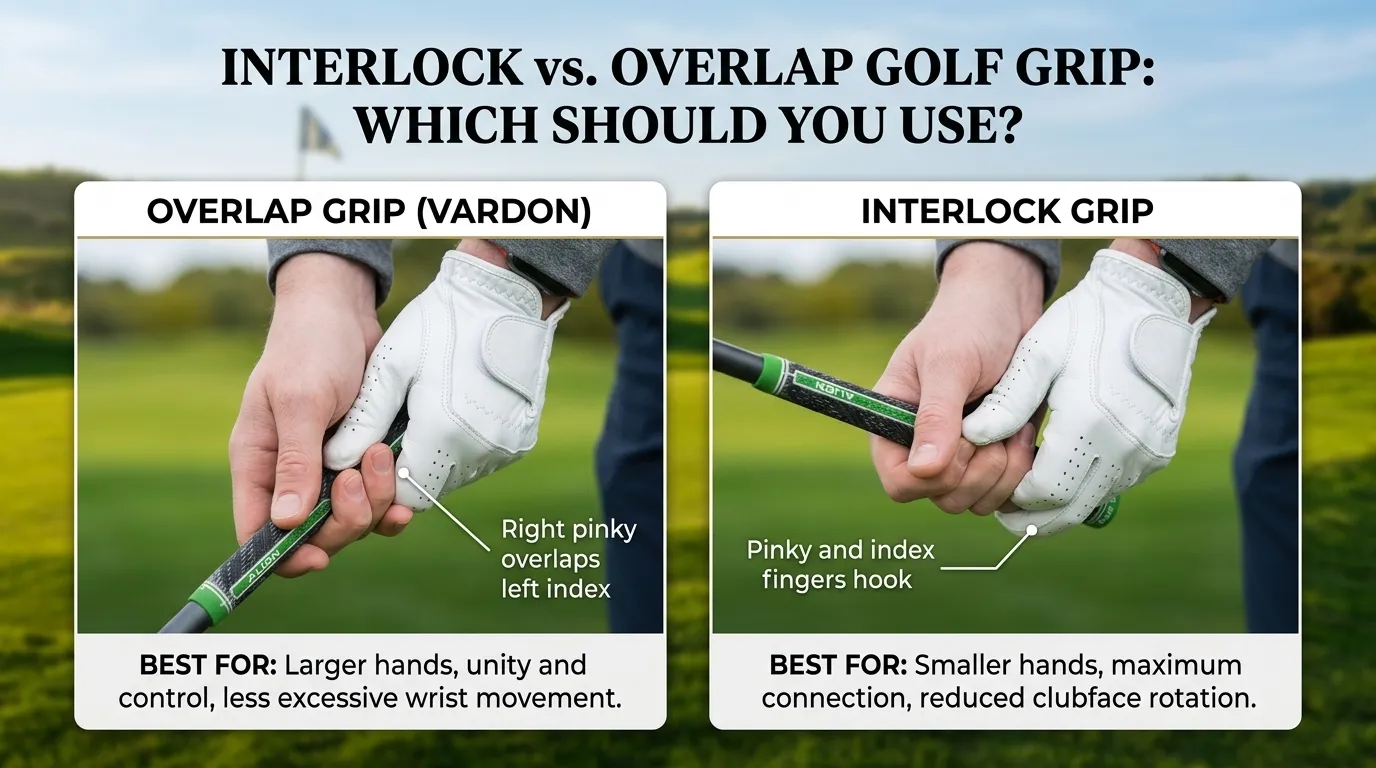
Quick Answer: The overlap grip rests your trail-hand pinky on top of your lead index finger; the interlock weaves the two fingers together instead. Interlock suits smaller hands and locks your hands into one unit; overlap suits larger hands and frees up your wrists. At the 2024 PGA Championship, 58.4% of pros interlocked and 40.9% overlapped.
I re-gripped my irons last winter and got talked into trying interlock by a scratch player at my home course. Two range sessions in, my right pinky was throbbing and my ball flight had gone from a soft draw to a dead-straight push. That’s the interlock vs overlap golf grip debate in one sentence: the grip that works beautifully for your buddy can wreck your ball flight for a month. This guide breaks down exactly what each grip does to your hands, backs it up with real 2024 PGA Championship data instead of guesswork, and tells you which one fits the actual shape of your hands — plus what to do if neither one is working yet.
The Real Difference: What Your Pinky Actually Does
Every golfer eventually asks the same question: interlock vs overlap golf grip, and which one is “correct.” Neither is correct. Both connect your hands into one working unit, just through different finger mechanics.
With the overlap (Vardon) grip, your trail-hand pinky rests on top of the gap between your lead hand’s index and middle fingers. It never actually grips the club — it just rides along on top. Five fingers from your lead hand wrap the club; only three from your trail hand do the same.
The interlock threads that same pinky between your lead index and middle fingers instead of resting it on top. Your hands physically can’t separate mid-swing once you’ve locked them together this way. Eight fingers end up gripping the shaft instead of ten — you trade two fingers’ worth of independent movement for a mechanical fuse between your hands.
Look at overlap golf grip pictures next to interlock photos and the difference jumps out fast. One pinky sits flat on top and never crosses under. The other threads between the fingers and locks.
Who Actually Uses Which Grip: The Real PGA Tour Numbers
Ask around a clubhouse and you’ll get confident, contradictory answers about which pros use overlap grip and which interlock. Golf Digest settled the argument in 2024 by physically auditing every player’s grip at the PGA Championship at Valhalla. Interlocking won by a wide margin: 90 of the 150-plus players in the field interlocked (58.4%), 63 overlapped (40.9%), and exactly one player used a baseball grip.
That baseball-grip outlier had a real reason for it, not a preference. PGA professional Kyle Mendoza shut a door on his pinky during his freshman year of college, played an entire season with the finger splinted and hanging off the club, and never regained enough clubface feel to go back to interlocking once it healed.
Interlockers dominate the biggest names in the sport, too. Tiger Woods, Jack Nicklaus, and Rory McIlroy all interlock. Tiger’s hit so many balls with that grip over 25-plus years that his right pinky has visibly changed shape — thinner and slightly bent compared to his left.
Ben Hogan’s grip history is messier than most “famous overlappers” lists let on. He started cross-handed as a kid, since he learned the game left-handed before switching to right-handed clubs. He moved through an interlock phase next, and only settled into the overlap grip that made him famous later in his career — then kept tweaking his thumb length and lead-hand position for years afterward.
Does Rory McIlroy Use Interlock or Overlap?
McIlroy interlocks, and he’s in good company. Golf Digest’s own tour audit groups him with Tiger Woods and Jack Nicklaus as one of golf’s most recognizable interlockers, and he hasn’t changed it across his entire professional career.
Does Bryson DeChambeau Interlock or Overlap?
This is where a lot of golf sites get it wrong. DeChambeau doesn’t use some exotic finger-lock system — he grips with a standard overlap, the same pinky-on-top style Vardon popularized. What’s actually unusual isn’t his finger placement; it’s the club underneath his hands.
He plays JumboMax grips roughly 3/8 inch fatter in diameter than a standard grip, built specifically to shut down excess hand and wrist action during his single-length iron swing. Change the grip size that dramatically, and the whole feel changes even with an ordinary finger pattern underneath it.
Interlock vs Overlap Golf Grip Pros and Cons
If you’ve gone down the interlock vs overlap golf grip Reddit rabbit hole, you already know how this argument goes: everyone’s certain, and everyone disagrees. Here’s the breakdown without the tribalism, plus a column most grip articles skip entirely — which miss each grip actually helps.
| Factor | Overlap (Vardon) | Interlock |
|---|---|---|
| Best hand size | Wrist-to-fingertip over 8 inches | Wrist-to-fingertip under 7 inches |
| Wrist action | More hinge, more shot-shaping freedom | Less hinge, hands locked as one unit |
| Grip pressure | Naturally lighter | Tempts golfers to squeeze harder |
| Miss it helps most | Golfers who over-tighten and lose clubhead speed | Golfers fighting a hook from overactive hands |
| Learning curve | Slightly longer to trust under pressure | Feels secure almost immediately |
| Notable users | Vardon, Palmer, Mickelson, Hogan | Nicklaus, Woods, McIlroy, Aberg |
Golf Digest’s own numbers kill the myth that overlap is “the pro grip.” It isn’t, and it hasn’t been for at least a decade — interlock has led at the tour level since long before that 2024 audit made it official. If your pinky hurts every time you interlock, switch to overlap. Full stop. No grip is worth training through joint pain for a season.
One honest limitation: if you’re already shooting your usual scores and your current grip doesn’t bother you, leave it alone. Neither grip fixes a bad swing path, and switching for the sake of switching can cost you months of feel while you relearn something that wasn’t broken.
Which Grip Fits Your Hand Size? (The Actual Test)
Grab a tape measure before you grab a club. Measure from the crease of your wrist to the tip of your middle finger — that single number tells you more than any forum debate ever will.
Under 7 inches, interlock gives you hand unity your fingers can’t create on their own. Over 8 inches, overlap lets your longer fingers wrap fully around the club without your pinky floating uselessly in space. Between 7 and 8 inches, the measurement stops mattering and grip pressure takes over.
| Wrist-to-Fingertip | Grip Pressure Tendency | Recommended Grip |
|---|---|---|
| Under 7″ | Any | Interlock |
| 7″–8″ | Tends to over-grip or squeeze | Overlap |
| 7″–8″ | Comfortable at moderate pressure | Either — test both |
| Over 8″ | Any | Overlap |
Grip thickness on the actual club matters just as much as finger placement, and it’s the piece most golfers never check. A grip that’s too thin forces you to squeeze regardless of which style you use, which quietly undoes whatever benefit you were chasing in the first place.
Interlock vs Overlap Golf Grip for Irons vs. Driver: Does It Matter by Club?
If you searched interlock vs overlap golf grip irons specifically, here’s the honest answer: use the same grip everywhere, full stop. Switching styles between your irons and your driver forces your hands to relearn pressure and feel every time you change clubs, and that inconsistency shows up in your dispersion before it shows up anywhere else.
That said, the two grips do feel different depending on the club in your hands. Interlock’s extra hand unity matters more with a short iron, where you need the clubface square through a small, precise arc. Overlap’s added wrist freedom shows up more with a driver, where extra hinge and release can add real clubhead speed off the tee.
None of that means you should mix grips mid-bag. It just explains why your grip might feel more locked-in on a wedge than it does on a full driver swing — same hands, same grip, different demands on it. Our 5 best tips for hitting irons covers the rest of the fundamentals that pair with whichever grip you settle on.
Common Interlocking Golf Grip Problems (And How to Fix Them)
Interlock has a real downside that most “benefits” lists conveniently skip.
Pinky and finger pain. The mechanical crossing point creates a genuine pressure spot, especially in your first few weeks. Build up gradually — ten minutes a session for the first week, not a full bucket on day one.
Restricted wrist hinge. Locked fingers can shorten your backswing hinge, which costs distance if your swing relies on wrist snap for speed. Check your top-of-backswing position on video; if your hands look “dead” compared to before, that’s the interlock talking.
Over-gripping. The security of the lock tempts golfers into squeezing harder, which kills both speed and feel. Consciously back your pressure off to a 4 or 5 out of 10 at address, and recheck it every few holes.
Reduced shot-shaping. Interlocked hands rotate less through impact, which makes it genuinely harder to work the ball both ways on command. If you need to hit an intentional draw or fade under pressure, this is the one honest spot where overlap wins outright.
Benefits of the Overlap Golf Grip
The real benefits of overlap golf grip come down to one thing more than comfort: shot-shaping control. Because your trail-hand pinky never locks into your lead hand, your wrists stay freer through impact, which is exactly what you need to work the ball left or right on purpose.
It also naturally lightens grip pressure. Hogan built the hook cure that saved his career around loosening his hands, and overlap makes that loosening easier because there’s no mechanical lock forcing tension into your fingers.
Bigger hands benefit most obviously. Five fingers from your lead hand plus three from your trail hand is plenty of surface contact once your fingers are long enough to wrap fully around the grip. Smaller hands can use overlap too — they just give up some of the built-in security interlock provides for free.
The Double Overlap Golf Grip: The Third Option Nobody Talks About
Every “interlock vs overlap” article treats those two as the only options. They aren’t.
Jim Furyk built a Hall of Fame career on a variation called the double overlap grip, where his trail-hand pinky and ring finger both rest on top of his lead hand’s fingers instead of just the pinky alone. It compacts his hands into an even tighter unit than a standard overlap, which is part of why Furyk plays a controlled fade instead of a full release through the ball.
Padraig Harrington uses a version of it too, but only on his driver. He grips every other club with a standard single overlap and switches to double overlap specifically off the tee, since it lets him throw his hands at the ball harder without losing control of the clubface.
You probably don’t need this grip. It’s a specialty tool for golfers who already control a fade and want to limit hand action even further — not a starting point for anyone still deciding between interlock and overlap.
The Reverse Overlap Golf Grip for Putting
Everything above applies to your full swing. Putting is a completely different grip conversation, and mixing the two up trips up more golfers than you’d expect.
The reverse overlap grip flips the full-swing overlap on its head. Instead of your trail-hand pinky sitting on top, your lead-hand index finger overlaps your trail hand’s fingers. It’s the most common putting grip on tour by a wide margin, and it works because putting doesn’t need wrist hinge or release — it needs your hands locked into your shoulders as one quiet unit.
Whether you interlock or overlap for your irons and driver has zero bearing on your putting grip. Plenty of full-swing interlockers, Tiger Woods among them, putt with a conventional reverse overlap without any conflict between the two.
How to Actually Test Which Grip Is Right for You
- Measure your wrist-to-fingertip distance and note whether you land under 7 inches, between 7 and 8, or over 8.
- Grab a 9-iron or pitching wedge — not your driver — and hit 15 to 20 half-swing shots with your current grip.
- Switch grips and hit another 15 to 20 shots with the same club, the same tempo, and the same target.
- Track your miss pattern on both, not your best shots. A tight dispersion with one grip beats a single pure strike with the other.
- Repeat the test with a mid-iron, then finally bring the driver in once you trust the feel.
- Commit to whichever grip grouped tighter for at least three full range sessions before you judge it on the course.
If you want structured drills for that driver-testing phase specifically, our best golf driver drills walks through practice routines that work with either grip style.
Frequently Asked Questions
Do PGA pros use interlock or overlap grip?
Both, but interlock leads by a real margin. Golf Digest’s 2024 PGA Championship audit found 58.4% of the 150-plus player field interlocked, compared to 40.9% who overlapped and 0.6% who used a baseball grip. Among American pros specifically, interlock’s lead grows even wider.
Does Rory McIlroy use interlock or overlap?
McIlroy interlocks. He’s grouped alongside Tiger Woods and Jack Nicklaus as one of the sport’s most recognizable interlockers, and he hasn’t changed it across his professional career.
Does Bryson DeChambeau interlock or overlap?
DeChambeau uses a standard overlap grip, not an invented hybrid. What actually sets his setup apart is grip size — his JumboMax grips run roughly 3/8 inch fatter than standard, built to reduce hand and wrist action during his single-length iron swing.
Are overlap grips better than interlock grips?
Neither is better in any absolute sense. Overlap tends to suit bigger hands and golfers who want more wrist freedom to shape shots; interlock tends to suit smaller hands and golfers who want their hands locked into one unit. Your hand size, grip pressure, and personal feel decide which is “better” for you specifically, not tour trends.
Can I switch between interlock and overlap for different clubs?
You can, but you shouldn’t. Alternating grips between clubs forces your hands to relearn pressure and hinge every time you switch, and that inconsistency shows up in your dispersion long before it shows up in your feel. Pick one grip and use it on all 14 clubs except your putter.
Is the interlocking grip better for beginners?
It’s a solid starting point, mainly because the physical lock gives new golfers instant hand security without needing to think about grip pressure. Beginners with larger hands sometimes find overlap more comfortable right away, though, so don’t force interlock if it feels wrong after your first few range sessions.
The Bottom Line
Stop treating this like a personality test. Interlock vs overlap golf grip comes down to two numbers you can measure in ten seconds — your hand size and your grip pressure — plus about 40 range balls of honest testing.
Measure your wrist-to-fingertip distance, hit both grips with a wedge, and trust your miss pattern over your best shot. If your hands already feel comfortable and your scores are trending the right way, leave your grip alone entirely — that’s the one piece of advice most swing content won’t give you, because it doesn’t sell a lesson package.
Once you’ve locked in your grip, give the rest of your setup the same attention. Our guide to golf club lofts is a good next stop for making sure the rest of your bag matches the swing you’re building around this decision.