
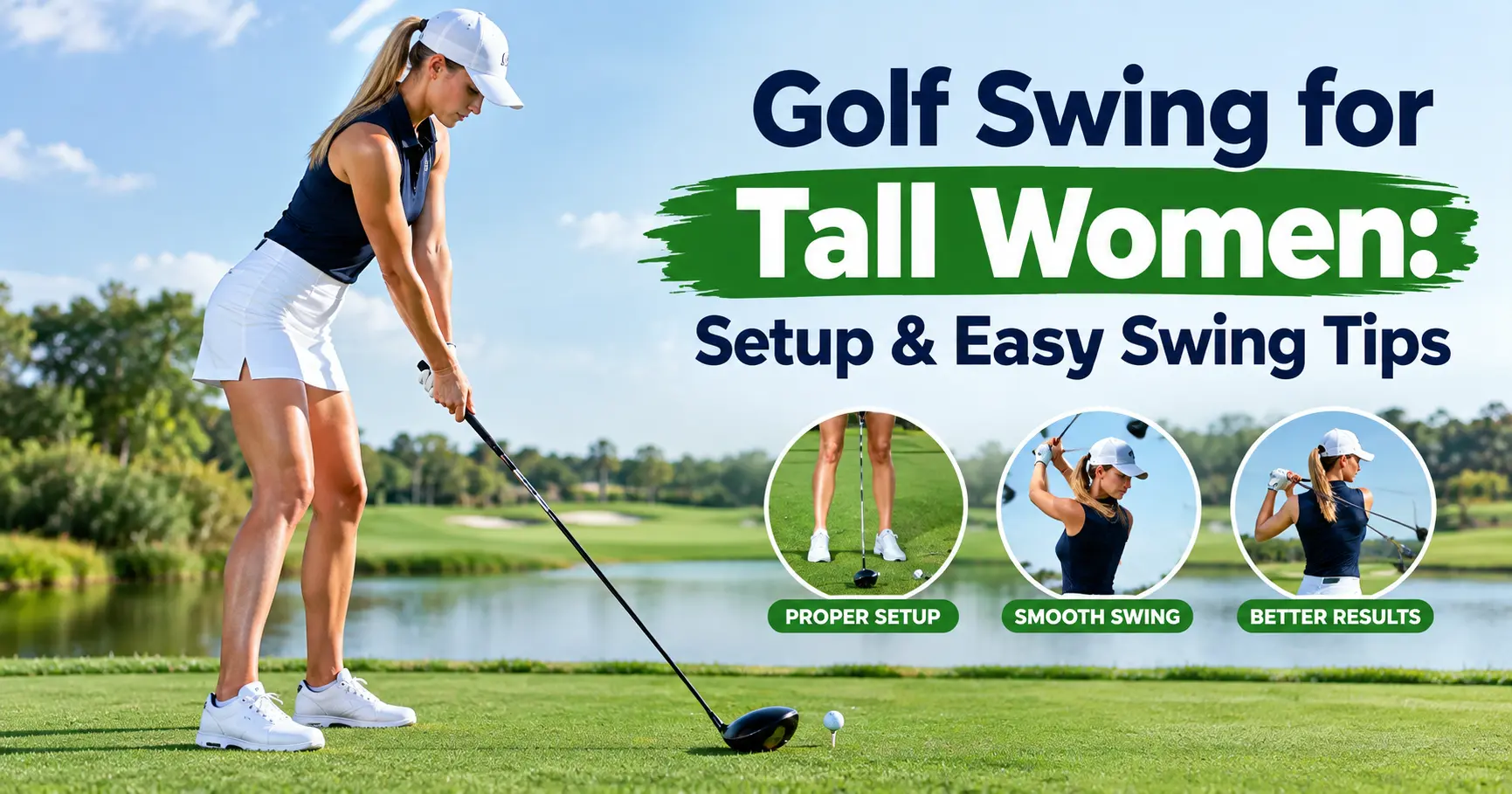
If you’re a tall woman and golf feels awkward before you even start the backswing, I wouldn’t rush to change your swing. Look at the way you’re standing over the ball first.
A lot can go wrong before the club moves. The club feels short, so you bend your knees a little more. Your hands still feel low, so you round your shoulders. By the time you’re ready to swing, you’ve made yourself several inches shorter and taken away much of the room your arms need.
That is a miserable position to learn golf from.
Tall women do not need their own version of the golf swing. Height changes how your body fits around the club, though, and that matters. Your leg length, arm length, posture and club specifications all affect how comfortable you feel over the ball.
The goal is simple. Find a setup where your body feels balanced and your arms have room, then make sure your clubs allow you to keep that setup.
Being tall matters, but your proportions matter more
Two women can both stand 5’11” and look completely different over a golf ball.
One might have long arms that place her hands fairly close to the ground. The other may have shorter arms and need more club length to reach the same comfortable position. Their legs, torso length and natural posture can differ too.
This is why I would never buy longer irons simply because a height chart says a tall woman should have them.
PING’s current fitting process gives a good example of why. Its iron fittings use measurements including height, wrist-to-floor distance and hand size as starting information, then the golfer hits shots so the fitter can refine the specifications. Height contributes to the answer, but height does not decide the answer by itself.
That same thinking works with the golf swing.
Your height gives you a clue about why standard golf posture might feel strange. Your actual proportions tell you much more.
If you’re tall with long arms, standard-length irons might feel perfectly normal. If you’re tall with relatively shorter arms, those same clubs can make you feel as though the ball sits near your shoelaces.
Neither woman has a swing problem simply because her address position looks different.
Stop lowering yourself to meet the golf club
This is where I think many tall beginners make golf harder than it needs to be.
They put the club behind the ball first and then arrange their body around it. Because the club feels short, they keep lowering themselves until the grip reaches a comfortable place.
Try reversing that order.
Stand normally with a 7-iron. Let your knees relax without dropping into a squat. Push your hips slightly backward and allow your chest to tilt forward. Then let your arms hang naturally below your shoulders.
Now take your grip.
The position should feel athletic, but it should also feel fairly ordinary. Your thighs should not feel loaded before the swing starts, and your shoulders should not feel as though you’re stretching down toward the ball.
There is no perfect amount of knee bend that works for every tall woman. I would pay more attention to what the knee bend is doing. If you’re using it mostly to make yourself shorter, you have probably gone too far.
Tall golfers sometimes get the opposite advice and try to stand extremely upright. That creates another problem. You still need enough hip hinge to give the arms somewhere to hang and swing.
The comfortable position usually sits between those two extremes. You should not feel folded over, but you should not feel stiff and vertical either.
Your arms can tell you whether the setup makes sense
There is an easy way to learn something about your address position without knowing a single swing angle.
Set up without a club and let your arms hang.
Pay attention to where your hands naturally fall. Then pick up your 7-iron and address a ball.
If you suddenly have to push your hands much farther away from your body, ask why. You might be standing too far from the ball. Your posture may have changed when you picked up the club. The club might also be a poor fit for your proportions.
The opposite problem happens too. Some tall women lower themselves so much that their hands end up crowded close to their thighs. The arms now have very little space during the downswing.
I would rather start with room.
Golf becomes difficult when the body has to create space halfway through the swing because there was none at address. A golfer who begins cramped often stands taller during the downswing, pushes the hips toward the ball or throws the hands away from the body simply to avoid running into herself.
Then someone sees the movement on video and tries to fix that movement.
Sometimes the better fix sits in the starting position.
What should an easy golf swing for a tall woman feel like?
It should feel less dramatic than you might expect.
Tall golfers already have long levers. If you have long arms, your hands travel a considerable distance even when your backswing feels controlled. You do not have to force extra width, make a huge weight shift or chase a very long backswing to create a powerful-looking motion.
I would put control ahead of length.
Make a comfortable turn and allow your trail hip to move behind you. Let the arms travel with the turn rather than dragging them deep behind your body. From there, swing through at a speed where you can finish without stepping out of the shot.
The finish tells you quite a lot.
Hit a ball and hold your finish for three seconds. If you immediately lose your footing or need to take a step to catch yourself, use less effort on the next swing.
That advice can sound too simple when golfers expect a technical answer, but balance has a way of exposing a swing that has become too violent. A tall player already has plenty of potential arc. There is little value in creating another ten percent of movement if you cannot control it.
For a beginner golf swing for tall women, I would keep the first goal boring: comfortable setup, balanced turn, solid strike.
Distance can come later.
Iron golf swing for tall women
Irons tend to reveal these problems more clearly because they get shorter as you move through the set.
A tall woman can feel comfortable with a driver and 5-iron, then pick up a pitching wedge and suddenly feel as though she has to fold herself in half.
Some change in posture is normal. You will stand closer to a wedge than a long iron because the club is shorter. The problem comes when changing clubs completely changes the way your body has to stand.
Try this the next time you practise.
Take a 7-iron and find the most comfortable setup you can. Hit a few balls without worrying about distance. Then pick up your pitching wedge and pay attention to what your body wants to do before you swing.
Do your knees suddenly bend much more?
Do your shoulders round?
Do your hands feel trapped near your legs?
Do you feel that you have to reach farther down?
Those feelings are useful information.
They do not prove that your wedges are too short. A swing fault can make perfectly fitted clubs feel awkward. But if the discomfort appears consistently as the clubs get shorter, I would want a fitter to look at the set before spending months changing technique.
There is another mistake worth watching with irons. Some tall golfers begin very low at address and then rise noticeably as they approach impact. Thin shots often follow, so they hear “stay down.”
I would check the starting posture first.
If your body began in a cramped position, standing taller during the downswing might be its attempt to create space. Forcing yourself to stay low can make the swing feel even worse.
Fix the first problem before chasing the second one.
Why slow-motion video can help, and where it goes wrong
Slow-motion golf videos are useful because they show movements you cannot feel at full speed. They also encourage golfers to obsess over positions that have very little to do with their actual problem.
If you’re filming your golf swing, start with the address position.
From behind, look at your knees, hips, back and arms. Do you look balanced, or does your body look as though it is working hard simply to reach the ball? Are your arms hanging or stretching?
Then watch what changes during the swing.
If your hips move much closer to the ball on the downswing, notice it. If your body suddenly becomes several inches taller, notice that too. You do not need to diagnose the movement immediately.
From face-on, watch your balance and the amount of sideways movement in the backswing. A taller player can make a large movement look smooth because there is simply more body moving, but bigger does not automatically mean better.
Your phone works best when you use it to answer one question at a time.
“Why am I hitting this thin?” is useful.
“Does my swing look like a professional golfer?” usually is not.
This matters when searching for “golf swing for tall women slow motion” too. Watching a tall professional player can give you ideas about rhythm, balance and space, but her exact positions belong to her body.
If her arms are longer than yours, her hands may sit somewhere different. If she has more hip mobility, her turn may look different. Her clubs probably fit her as well.
Copy the quality of the movement. Leave the tracing paper alone.
Do tall women need longer golf clubs?
Some absolutely will. Others will not.
This question causes so much confusion because people want height to give them a clean answer. Golf equipment rarely works that neatly.
Imagine two women who both stand six feet tall. One has long arms and a relatively short wrist-to-floor measurement. The other has shorter arms and her hands sit farther from the ground.
Those women can need different iron specifications even though they have exactly the same height.
That is why wrist-to-floor measurement can be useful alongside height, and why the final decision should involve actually hitting golf balls. PING’s current fitting process follows that kind of sequence rather than treating one body measurement as the final prescription.
Club length is only part of the conversation too.
Lie angle matters. Grip size can matter. Shaft weight and flex influence how the club feels while you’re swinging it. Changing length can also change other aspects of the club.
So if your irons feel short, resist the temptation to order extensions based on a chart alone.
Get measured and hit different options.
You may discover that longer irons immediately make your setup more comfortable. You may find standard length works fine and something else caused the awkward feeling.
Both results save you from guessing.
What I would practise before changing the equipment
You can learn quite a bit in one range session.
Take a 7-iron and hit the first five balls at around half your normal speed. Forget distance and watch the contact. Then hit five at a comfortable three-quarter speed, followed by five normal swings.
Pay attention to when the strike changes.
If you find the middle of the face repeatedly at lower speed and lose it only when you swing hard, I would work on control before blaming the club.
If every swing produces similar toe contact even when your balance and posture feel good, that gives you a different clue.
Now repeat the exercise with a wedge.
The point is not to diagnose your own club fitting from fifteen golf balls. You are trying to collect useful information instead of walking into a lesson or fitting and saying, “Something feels wrong.”
There is a big difference between saying that and saying, “My 7-iron feels comfortable, but I start crouching when I get to the 9-iron and wedge.”
The second description gives someone something to work with.
What if you’re tall and keep topping the ball?
Height often gets blamed because the golfer feels far away from the ground.
I would still avoid assuming that your clubs are too short.
A topped shot tells you the club met the ball too high. It does not tell you why.
Look at your setup and balance. If you’re reaching toward the ball at address, you might pull away from it during the swing. If you begin with excessive knee bend, your body might rise as you approach impact. If your weight moves toward your heels, the club can move with you.
This is why “keep your head down” is such unsatisfying advice.
Your head is one part of a moving body. Holding it down does not guarantee that the clubhead returns to the correct place.
Film the swing if the top keeps appearing. Watch your whole posture from address through impact.
You may find that your body is doing exactly what it has to do after the position you gave it at the start.
What if you’re hitting the ground before the ball?
The same rule applies to fat shots.
Being tall does not create one special cause.
You can hit behind the ball because your pressure stays back too long. Your body can lower during the downswing. Your arms can throw the clubhead toward the turf too early. Ball position can also contribute.
I would start by slowing down.
Hit several small shots where your only goal is to contact the ball before the ground. If the strike improves immediately, build the swing back gradually.
If nothing changes, get another pair of eyes on it.
Golf becomes frustrating when we turn one physical characteristic into the explanation for every miss. Tall players still hit bad shots for the same collection of reasons everyone else does.
Height matters most when it affects the way you fit around the golf club.
Your driver may actually feel easier
A lot of tall golfers feel less cramped with the driver.
That makes sense. The club is longer, the ball sits farther away, and the wider stance gives the body more room.
Notice how that feels.
You should not try to reproduce your driver setup exactly with a wedge, but the sense of space can teach you something. If your shoulders feel relaxed with the driver and stretched with an iron, pay attention to the difference.
With the driver, let the longer club create the extra distance from the ball. Do not push your arms away from your shoulders to manufacture more space.
A good driver setup should still feel connected to the rest of your golf posture. You have more room, but you are still standing on the same body.
What is the best golf swing for tall women?
I don’t think there is one.
A woman who is 5’10” with long arms can need something different from a woman who is 6’1″ with shorter arms. Add differences in strength, flexibility and club specifications, and height becomes only one piece of the picture.
The better question is whether your swing gives your body enough room to move without unnecessary compensation.
If you have to squat to make an iron reach the ground, look at that.
If you feel as though you’re stretching toward every shot, look at that.
If the wedges make you uncomfortable but the longer clubs feel natural, look at that.
Then decide whether you’re dealing with posture, equipment or technique.
That order matters.
I would much rather see a tall woman play from a comfortable position that looks slightly different from a textbook picture than watch her force herself into a “correct” setup she cannot swing from.
FAQ
Do tall women need longer golf clubs?
Not always. Height gives you useful information, but arm length and wrist-to-floor measurement change how far your hands naturally sit from the ground. A fitting should also include hitting shots before anyone decides on the final club length.
Should a tall woman stand more upright in the golf swing?
She may naturally look more upright than a shorter golfer, but standing upright should not become a goal by itself. You still need enough bend from the hips for the arms to hang freely and the body to turn comfortably.
Should tall golfers bend their knees more?
I would not add knee bend simply because you’re tall. Excessive knee flex can make a tall golfer feel cramped. Use enough to feel athletic and get most of the forward tilt from the hips.
Why do my golf clubs feel too short?
They might be too short for your proportions, but posture can create the same feeling. If you cannot address the ball comfortably without crouching, rounding your shoulders or reaching, have the club specifications checked.
Is an upright golf swing better for taller players?
Height alone does not decide swing plane. Your arm length, posture, turn and club fit all influence where the club travels. A tall golfer can swing too flat or too upright.
Can a tall woman use standard women’s golf clubs?
Yes. Plenty of taller golfers fit standard-length equipment because their arm length and swing suit it. Other tall women need longer clubs or different lie angles. Get measured rather than choosing from the label on the box.
What club should a tall beginner practise with?
A 7-iron is a sensible place to start. It is long enough to feel more comfortable than a wedge for many tall beginners, while still making it easy to work on contact, balance and a controlled swing.
Make the club fit into your golf posture
If you’re tall, you will probably notice your height most when the clubs get shorter.
That does not mean you should spend every round thinking about being a tall golfer.
Find a posture where you can stand comfortably, hinge from the hips and let your arms hang. Check whether your equipment works from there. If it does, move on and work on the same things every golfer has to work on: strike, face control, balance and consistency.
If the clubs force you to crouch or reach, answer that question before rebuilding your swing.
Your body has enough room to play good golf. Give it a setup that lets it use that room.