
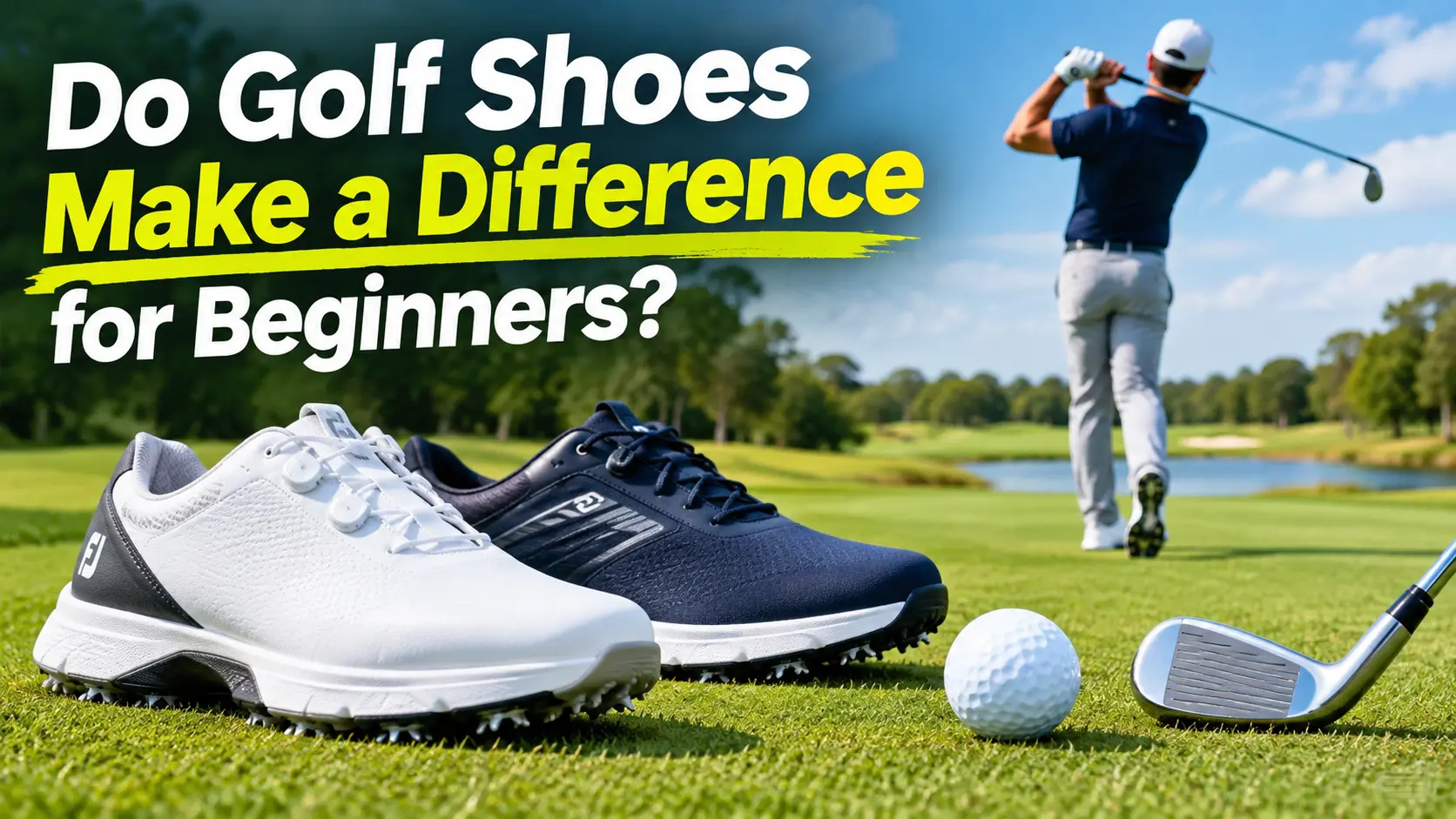
Quick Answer: Yes, golf shoes make a small but real difference for beginners. They grip wet and sloped grass that sneakers slide on, and they keep your feet dry for 18 holes. Shoes add no distance though, so if you only hit the range or play a few times a year, sneakers work fine.
Golf shoes make a difference for beginners in two places: grip and dry feet. Distance isn’t one of them. Your feet are the only part of you touching the ground through the swing, so one sliding back foot on a damp fairway can wreck a strike before the club arrives. Buy a first pair when that risk outweighs the cost, and not a round sooner.
Do golf shoes make a difference to a beginner’s swing?
Watch a good player’s feet through impact and you’ll see almost nothing happen. The lead foot braces, the trail heel lifts, and neither foot slides. That stillness is the whole job of a golf shoe.
Your downswing pushes into the ground, and the ground pushes back sideways as well as up. When the outsole can’t resist that sideways push, your foot creeps and your hips follow it. You won’t feel a slip. You’ll feel a strike that comes out thin one swing and fat the next.
Golf outsoles put grip under the ball of the foot and under the heel, and they angle it in several directions, because the load comes from twisting and sideways pressure as much as from front to back. Most golf shoes also sit lower and flare wider than trainers, so the platform under you stays level when you load the lead side. A running outsole does a different job. Its lugs help you push off forward and brake on landing.
Do beginners need golf shoes on day one?
Not on day one, no. On a dry course in a cart, sneakers get you through your first rounds. Golf shoes earn their price once you walk the round, tee off at dawn, play after rain, or hit from sloped lies, because those are where sneakers slip and soak through.
Beginners need traction more often than better players do. A low-handicap player’s ball usually sits on short grass with a flat stance. Yours finds the damp edge of the fairway and the side of a slope.
A slower swing puts less force through your feet, which is the best argument for skipping golf shoes. Worse lies cancel it out.
Why running shoes slip on a golf course
Cushioned running shoes are the worst non-golf option you can wear. Their midsoles use thick, soft foam that squashes under sideways load, so your lead foot rolls at the exact moment you need it solid. Their outsoles grip going forward and slide sideways, and their mesh uppers soak through in morning dew.
Trail runners have deeper lugs but the same squashy foam, and deep lugs can mark a green. If you’re going with sneakers, pick the flattest, firmest pair you own. A skate-style or court shoe with a low, hard midsole and a patterned rubber outsole beats a cushioned running shoe for golf.
How to tell if you need golf shoes yet
Three questions decide it. Answer them for the course you’ll actually play.
| Question | If yes | What a wrong guess costs you |
|---|---|---|
| Will the grass be wet or the ground sloped? (early tee times, rain in the past day, hilly holes) | Wear golf shoes | A slide mid-swing, or socks that soak through by mid-round |
| Are you walking all 18 holes? | Wear golf shoes, ideally waterproof | Sore, damp feet and a blister by the back nine |
| Does the course ask for golf shoes? | Wear golf shoes | An awkward conversation at the pro shop counter |
One yes is enough to buy. Three nos mean you can wait, and the money goes further on a lesson.
Spikeless or soft spikes for a first pair
Spikeless shoes use molded rubber lugs, and soft-spike shoes screw replaceable plastic cleats into the sole. Buy spikeless first. They feel like sneakers, walk fine on pavement, and grip well enough on most dry or damp turf that a beginner won’t notice the gap.
Soft spikes win in one situation: steep, soaked ground. If your home course is hilly and wet for half the year, ignore the spikeless advice and buy soft spikes. They also click on hard floors and wear their cleats flat on concrete, so you’ll swap them out before you leave the clubhouse.
What a first pair needs
A first pair needs four things: a firm midsole, visible grip under the forefoot and heel, a toe box that lets your toes spread, and a waterproof liner if you play where it rains. Everything else is optional. Dial lacing, carbon-fiber plates, and tour-player branding add cost without adding grip. Spend the difference on a lesson.
When golf shoes make no difference
Golf shoes aren’t for everyone, and the honest answer for plenty of beginners is to skip them for now. Range mats grip almost anything. Pitch-and-putt and par-3 courses give you short, usually flat walks. If you play two or three rounds a year from a cart on a dry day, spend the money elsewhere.
How to test a pair before you buy
- Shop in the afternoon, when your feet have swollen a bit, and bring the socks you’ll play in.
- Walk the aisle for two minutes and watch for heel lift. A heel that slips in the shop becomes a blister on the course.
- If the shop allows it, make five slow swings with a club from their rack. Feel whether your lead foot rolls outward or your heel lifts.
- Squeeze the midsole at the heel. If it squashes like a running shoe, the sideways support is soft.
- Read the label for “waterproof,” not “water-resistant,” if you play in a wet climate.
Check the course footwear rules before you book
Every course sets its own policy. Most ban metal spikes because they scar greens, so soft spikes and spikeless soles are the standard. Many courses also ban bare feet and open-toe sandals, and some private clubs require golf shoes.
Call the pro shop or read the course’s website. A beginner’s first round shouldn’t open with a shoe swap at the counter.
FAQ
Can you use running shoes for golf?
Yes, and plenty of beginners do. They hold up on a dry, flat day. Skip cushioned models if you own a firmer pair, because the soft midsole rolls under the lead foot, and skip mesh uppers on dewy mornings.
What’s the difference between golf shoes and trainers?
Trainers, which Americans call sneakers, fit everything from the gym to the street, so they compromise on grip direction, platform width, and water protection. Golf shoes tune all three for one job: holding your feet still through a swing on wet, uneven grass.
Are golf shoes necessary?
Not by law, and not at every course. Some clubs require them or at least soft-soled shoes, and many public courses don’t check. A two-minute call to the pro shop gives you the answer for your course.
Do golf shoes add distance?
No shoe adds swing speed. A good outsole just keeps wet or sloped ground from stealing some of it.
Can you wear golf shoes off the course?
Spikeless pairs, yes. They look like casual sneakers, so lunch after the round is no problem. Soft-spike pairs click on hard floors and wear their cleats down on concrete, so swap them for sneakers before you walk anywhere hard.
When to buy your first pair
Golf shoes make a difference for beginners the moment the grass gets wet or the walk gets long. Buy your first pair as soon as one of the three questions above gets a yes. A spikeless pair covers most of that, and our spikeless versus soft spikes breakdown covers the exceptions. Until you buy, wear your flattest, firmest sneakers and make three-quarter swings from wet slopes.