
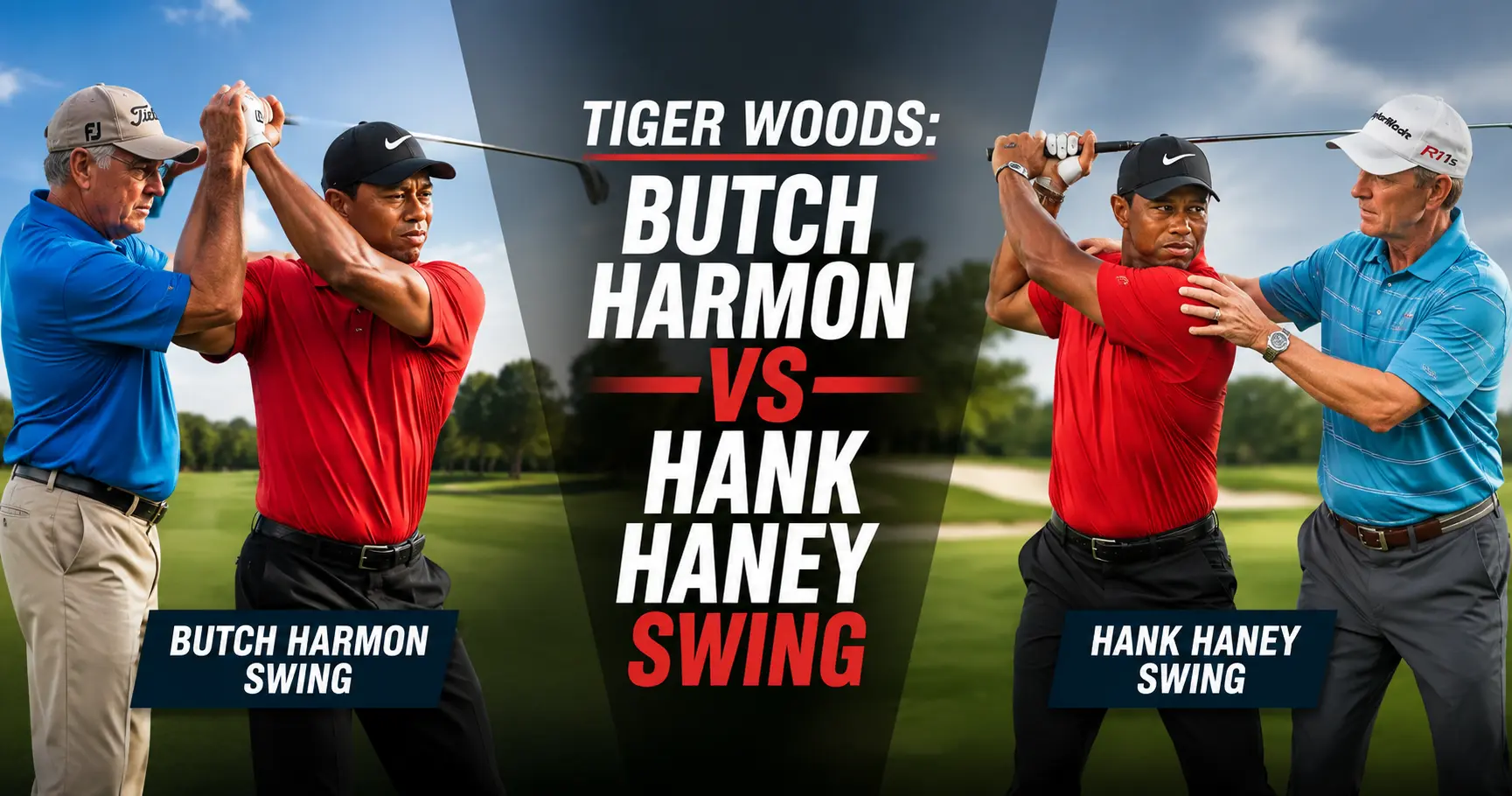
Quick Answer: Tiger Woods won 8 majors and 34 PGA Tour titles under Butch Harmon (1993-2002), swinging on a wide, upright two-plane path with high hands. Under Hank Haney (2004-2010), he won 6 majors and 31 titles with a flatter plane and a weakened, Hogan-style grip. Neither swing was better. Each one solved a different problem.
Tiger Woods built two of the most dominant stretches in golf history with two completely different golf swings. One coach gave him width and height, and the other gave him plane and control. Forums have argued about which version was actually better for over a decade, usually without looking past the major count. This breaks down the grip, the plane, the takeaway, and the real Tour stats behind both eras, then tells you which pieces are actually worth stealing for your own swing.
The Timeline: Two Coaches, Eleven Years, One Restless Superstar
Woods started working with Butch Harmon in 1993, while he was still an amateur. Harmon guided him through three straight U.S. Amateur titles, the record-breaking 1997 Masters win, and the 2000-01 Tiger Slam, when Woods held all four major trophies at once. Their professional partnership held through August 2002, though Woods didn’t make the split official until 2004, a detail most timelines skip past.
Hank Haney took over in March 2004. He’d built his teaching reputation on Jim Hardy’s one-plane and two-plane theories and six years coaching Mark O’Meara to two majors, and Woods wanted a swing built around Ben Hogan’s mechanics that only Haney seemed able to deliver. The partnership lasted until May 2010, when Haney resigned right before the Players Championship. His statement made a point of calling it “this is my decision,” a distinction that mattered given the timing, just months after Woods’ personal scandal became public.
Here’s the part most competitor articles gloss over: there was no clean handoff between eras. Woods spent most of 2003 without an official coach, and that year’s numbers, five wins and 62.7% driving accuracy, read like a bridge season rather than a true Harmon or Haney year.
The Trophy Case: Majors, Wins, and World Golf Championships Compared
Line the two eras up side by side and the numbers immediately start arguing with each other.
| Metric | Butch Harmon Era (1993-2002) | Hank Haney Era (2004-2010) |
|---|---|---|
| Majors won | 8 (of 24 starts, 33.3%) | 6 (of 23 starts, 26.1%) |
| PGA Tour wins | 34 (of 127 starts, 26.8%) | 31 (of 93 starts, 33.3%) |
| World Golf Championships | 5 | 9 |
| Weeks at World No. 1 (with that swing) | 264 | 281 |
| Best single-season scoring average | 67.79 (2000) | 67.79 (2007) |
| Signature achievement | 2000-01 Tiger Slam | Record 281 straight weeks at No. 1 |
Harmon’s era produced the higher major percentage. Haney’s era produced the higher overall win percentage and nearly double the World Golf Championship titles. Golf analytics researcher Lou Stagner ran the numbers in 2020 and found something that surprises most fans: Woods carried his best estimated career handicap index, +9.4, in 2008, deep into the Haney years and well past the point most casual observers assume he peaked.
None of that settles which swing was better. It proves the question is more complicated than a major count.
Grip, Plane, and Takeaway: What Actually Changed in Tiger’s Swing
Butch never coached Tiger into a fixed system. He coached the fundamentals and let the individual pieces fall out from there. Golf instructors who’ve broken down his teaching describe a wide takeaway with the clubhead kept outside the hands, a short backswing that stopped well before parallel, and an upright, two-plane path finishing with high hands. Harmon’s own philosophy, in his words, is “the art of teaching people to play golf, not teaching golf to people.”
There’s no single Harmon swing model. There’s a Harmon checklist.
Haney worked from the opposite direction. He came up through Jim Hardy’s plane theories, and his stated approach is “to teach my students to become their own best teacher,” with heavy emphasis on finding a repeatable swing plane. Woods wanted Ben Hogan’s ball-flight control, the same controlled fade that still wins at courses like Riviera decades later, and Haney was the guy who could build it.
With Tiger specifically, that meant weakening the grip toward a Hogan-style position, Vs pointing closer to the chin than the right shoulder. The takeaway stayed wide, but the wrists rotated more through it, landing the club in what most teachers call a “laid off” position at the top, pointed left of the target instead of parallel to it.
| Element | Butch Harmon Swing | Hank Haney Swing |
|---|---|---|
| Grip | Strong, Vs toward the right shoulder | Weakened toward the chin, Hogan-style |
| Takeaway | Wide, clubhead kept outside the hands | Wide, more clockwise wrist rotation |
| Top of backswing | Upright, high hands, pointed at the target | Flatter, “laid off,” pointed left of target |
| Clubface angle at the top | Roughly 37 degrees | Roughly 43 degrees by 2008 |
| Typical miss | Occasional pull or hook left | Push or block to the right |
That grip change alone explains most of what happened to Tiger’s miss pattern. A strong grip like his Harmon-era setup tends to produce an occasional hook when the hands get too active through impact. Weaken the grip and flatten the plane, and the miss almost always moves the other direction, out to the right. Every serious account of Woods’ Haney years mentions the same shift: a more consistent one-way miss, right instead of left.
If your own slice or push comes from a grip that doesn’t match your swing path, our strong vs. weak grip breakdown walks through how to test your own hand position in about five minutes on the range.
The Driving Accuracy Numbers Nobody Puts in One Table
Here’s the stat that gets buried under the major count: Tiger’s driving accuracy dropped sharply the moment Haney’s swing changes took hold, and it never fully recovered to Harmon-era levels.
| Year | Coach | Driving Accuracy | Driving Distance | PGA Tour Wins |
|---|---|---|---|---|
| 1997 | Harmon | 68.6% | 294.8 yds | 4 |
| 1999 | Harmon | 71.3% | 293.1 yds | 8 |
| 2000 | Harmon | 71.2% | 298.0 yds | 9 |
| 2002 | Harmon | 67.5% | 293.3 yds | 5 |
| 2004 | Haney | 56.1% | 301.9 yds | 1 |
| 2005 | Haney | 54.6% | 316.1 yds | 6 |
| 2007 | Haney | 59.8% | 302.4 yds | 7 |
| 2009 | Haney | 64.3% | 298.4 yds | 6 |
Source: PGA Tour season stats via StatMuse.
In 2000, Woods hit 71.2% of fairways averaging 298 yards. By 2005, in full Haney mode, his average drive had climbed to 316.1 yards, 18 yards longer, but his accuracy fell to 54.6%. A peer-reviewed analysis published in The Sport Journal ranked that figure 188th out of roughly 200 players on Tour that season.
That’s not really a knock on Haney’s coaching. It’s a trade Woods made on purpose. He wanted Hogan’s plane and the extra length modern driver technology made available, and he accepted fewer fairways as the cost.
Accuracy climbed back to 64.3% by 2009 as the swing matured, but it never touched his Harmon-era numbers again.
Which Swing Was Actually Better? What the Insiders Say
Brandel Chamblee, who has picked apart every Tiger swing on television for two decades, made an argument in 2017 that still holds up. Judged by almost any measurable outcome instead of an aesthetic preference for how a swing looks on camera, the Haney years were arguably Tiger’s most successful stretch. He won 41% of his PGA Tour starts between 2005 and 2009 and matched his own all-time scoring average record, 67.79, in 2007, seven years after first setting it under Harmon.
Steve Williams, who caddied through every shot of both eras, split the difference when Chasing Majors host Evin Priest put the question to him directly. His single best individual tournaments, he said, came under Harmon. But Tiger’s swing “became more repetitive” under Haney, and Woods trusted himself not to hit the big miss left.
Here’s my read after going through both eras stat by stat: Harmon built the swing that made Tiger a phenomenon at 21 years old. Haney built the swing that kept him at the top of a sport that had spent a decade catching up to him. Both jobs mattered enormously, and neither coach gets to claim the title outright. Anyone who tells you differently is picking a side before looking at the numbers.
What Mid-Handicappers Can Actually Steal From Each Coach
None of this history matters if you can’t use it on your own swing this weekend. Here’s what actually translates from pro-level theory to a real range session.
From the Harmon side, steal the width checkpoint. Take the club back until your hands reach waist height, then check that the clubhead is still outside your hands rather than tucked in behind you. That single position, more than grip strength or plane angle, is what let Tiger’s swing hold up under tournament pressure for a decade. Get the club too far inside on the way back, and you’re fighting an uphill battle for the rest of the swing no matter what you do at the top.
From the Haney side, steal the palm-grip test. Haney’s own instruction is blunt about this: hold the club more in your palms than your fingers, because a finger-heavy grip lets the clubface twist open at impact. Woods tried it skeptically, according to Haney, and “never went back.” It costs you nothing to test for ten balls on the range.
If your miss is a slice that starts left and drifts right, remember what happened to Tiger’s own numbers in 2005: a flatter, more rotated takeaway paired with a weaker grip genuinely reduces a hook, but it needs real plane discipline behind it, or it turns into the exact push-right miss that showed up in his own driving stats that year.
Which Swing Should You Actually Try to Copy?
If you already carry a strong grip and tend to lose shots left, don’t copy Haney’s setup wholesale. You’ll likely trade a hook for a push, and few amateurs have Tiger’s hand speed to time out that kind of compensation. Weakening your grip only helps if your actual miss is a draw or a hook to begin with.
If you fight a slice and an over-the-top move instead, the Harmon-style width and outside-the-hands takeaway is the better starting point, not a full grip overhaul.
Here’s the honest limitation neither coach’s fan club likes to admit: Tiger could make almost any swing model work because of hand-eye coordination and clubhead speed most golfers will never have. Copying his exact positions without his speed and hands usually just moves your miss to a different side of the fairway instead of fixing it.
Frequently Asked Questions
Which coach did Tiger Woods win more majors with, Butch Harmon or Hank Haney?
Tiger Woods won 8 majors with Butch Harmon between 1993 and 2002, compared to 6 majors with Hank Haney between 2004 and 2010. Harmon also holds the higher major win percentage, 33.3% to 26.1%, though Haney’s era produced more total PGA Tour wins and a higher overall win rate.
Why did Tiger Woods stop working with Butch Harmon?
Woods wanted to rebuild his swing again after winning the 2002 U.S. Open, and Harmon felt no rebuild was necessary. The disagreement ended their day-to-day partnership by August 2002, though Woods didn’t confirm the split publicly until 2004, after a year of working mostly on his own.
Why did Tiger Woods and Hank Haney split up?
Haney resigned in May 2010, right before the Players Championship, not long after Woods returned from a personal scandal and a difficult 2010 Masters. Haney’s statement stressed that it was his own decision. He later detailed the partnership’s final years in his 2012 book, The Big Miss.
What is the biggest technical difference between the Butch Harmon swing and the Hank Haney swing?
The grip and the plane. Harmon kept Tiger’s grip strong and his plane upright with high hands. Haney weakened the grip toward a Hogan-style position and flattened the plane, laying the club off at the top and trading an occasional hook for a more frequent miss to the right.
Did Hank Haney teach Tiger Woods the stack-and-tilt swing?
No. Stack-and-tilt is a separate system built by Mike Bennett and Andy Plummer, popularized after Haney’s time with Woods had already ended. Haney’s own philosophy came from Jim Hardy’s one-plane and two-plane theories. It’s Sean Foley, Tiger’s coach after Haney, who is more closely associated with Stack & Tilt-style ideas.
Which swing did Tiger Woods have his best results under?
Statistically, it depends on the measure. Harmon’s era has the higher major win percentage. Haney’s era has the higher overall PGA Tour win percentage, nearly double the World Golf Championship titles, and Tiger’s own best estimated career handicap index. Most insiders, including longtime caddie Steve Williams, call it too close to separate cleanly.
So, Which Swing Wins?
Two swings, one restless superstar, and a debate that has now lasted longer than either partnership did. Harmon built the swing that announced Tiger to the world at 21, and Haney built the swing that kept him winning after the rest of the Tour had caught up to his talent. Nobody should call either one the failure, and neither coach earns the crown outright either. If you’re working on your own swing this week, start with the basics in our how to hit irons guide, because grip and takeaway will move your scores more than which pro’s swing you’re trying to copy.