
Walk into any pro shop and you’ll see dozens of different golf balls — different brands, different colors, different prices. The obvious question is whether are all golf balls the same size, or whether the $50 sleeve of Pro V1s is literally a different object than the $15 box of range balls sitting next to it.
Short answer: same size. Longer answer: same size, very different everything else — and the rules are about to change in a way that affects every golfer on the planet starting in 2028. I’ve played everything from Kirkland Signature to Chrome Soft to off-brand range balls, and understanding what’s actually regulated versus what isn’t transformed how I think about ball selection for my 12-handicap game.
Here’s every spec you need to know, plus the one development nobody in the golf ball world wants to talk about plainly.
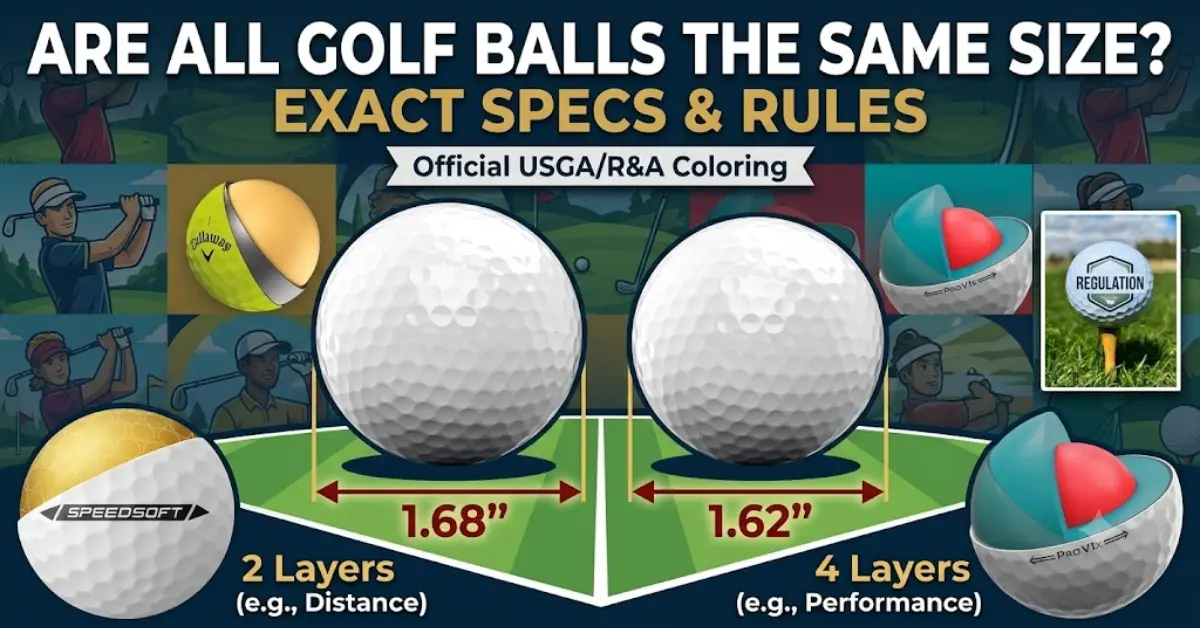
Quick Answer: Yes – all conforming golf balls share the same minimum diameter of 1.68 inches (42.67 mm) and can’t exceed 1.62 ounces in weight. But construction, dimple count, and cover material vary wildly between models. That variation is what actually separates a $1.50 range ball from a $5 Pro V1.
Are All Golf Balls the Same Size? Here’s the Direct Answer
Yes – all golf balls the same size in terms of minimum diameter. Every ball played in competition anywhere in the world must measure at least 1.68 inches (42.67 mm) in diameter and must not exceed 1.62 ounces (45.93 grams) in weight. These standards come from the USGA and R&A, the two governing bodies that control equipment rules globally.
| Specification | Regulation |
|---|---|
| Minimum diameter | 1.68 inches / 42.67 mm |
| Maximum weight | 1.62 oz / 45.93 grams |
| Maximum size | No upper limit |
| Dimple count | No requirement — manufacturer’s choice |
| Dimple symmetry | Required (must be symmetrical) |
| Distance limit | 317 yards + 3-yard tolerance at 120 mph (current standard) |
One thing most golfers don’t know: there’s no maximum size in the rules. A manufacturer could legally produce a 2-inch golf ball. Callaway actually marketed a larger “Magna” version of the SuperSoft for a while. Nobody plays it — more drag, less distance — but it’s technically legal.
Golf Ball Size Through History – The British Ball That Started This Whole Debate
Golf balls the same size everywhere wasn’t always true. Before 1990, the USGA and R&A operated under different minimum diameter rules, which created one of golf’s strangest equipment splits.
The USGA had required a minimum diameter of 1.68 inches since the 1930s. The R&A allowed a smaller “British ball” with a minimum diameter of 1.62 inches. Those 0.06 inches don’t sound like much — until you realize that the smaller ball flew farther, sat lower in rough, and performed better in wind. Arnold Palmer switched to the smaller ball when competing in the Open Championship. Jack Nicklaus did the same.
American players crossing the Atlantic would literally change the ball in their bag. Competing at St Andrews? Play the small ball. Back home for the US Open? Switch back. It was the golf equivalent of changing tire compounds for different tracks.
The R&A mandated the larger 1.68-inch ball at The Open Championship in 1974, and finally outlawed the smaller ball completely in 1990. That’s when the USGA and R&A finally aligned, and from that point forward, every conforming golf ball worldwide has shared the same minimum diameter.
Non-conforming balls with a 1.62-inch diameter still exist — you can find them on eBay from specialty brands like Zeus Impact. They’re not legal in any competition or official round, but they do fly noticeably farther. If you ever hold one next to a standard ball, you’ll feel the size difference immediately.
Do All Golf Balls Weigh the Same? (The Answer Might Surprise You)
Here’s where most golf ball articles skip something important: are all golf balls the same size and weight? The answer is no – and not because manufacturers are breaking rules.
The USGA sets a maximum weight of 1.62 ounces. There’s no minimum. So while the vast majority of golf balls cluster near the top of the legal range, two balls from the same sleeve can legally weigh different amounts.
In practice, a premium ball might weigh 1.61 ounces while a budget two-piece comes in at 1.57 ounces. That’s a difference of roughly 0.04 ounces – small enough that you won’t feel it on a full driver swing, but potentially noticeable on delicate chip shots or putts where you’re relying on feel.
Manufacturing tolerances also introduce minor variation in diameter. All conforming balls measure at least 1.68 inches, but some measure slightly larger. The difference sits in the thousandths of an inch – invisible to the eye – but it exists. This is why USGA conformance testing measures multiple samples from each production batch rather than a single ball.
The practical takeaway: don’t obsess over weight variation between brands. Do pay attention to how a ball feels at low speeds — that’s where weight and construction differences actually show up in your hands.
Dimple Count: Why Your Pro V1 Has 352 and Your Srixon Has 338
This is where golf balls diverge significantly despite sharing the same external diameter. Dimple count has zero regulation — manufacturers choose whatever number and pattern optimizes their specific ball’s flight characteristics.
| Ball | Dimple Count | Flight Profile |
|---|---|---|
| Titleist Pro V1 | 352 | Lower, penetrating, controlled |
| Titleist Pro V1x | 328 | Higher launch, more spin |
| Callaway Chrome Soft | 332 | Mid-high, soft landing |
| TaylorMade TP5 | 322 | High spin, workable |
| Srixon Z-Star | 338 | Consistent, tour trajectory |
| Callaway Supersoft | 332 | High, soft, suits slower swings |
Most balls fall between 300 and 450 dimples. The pattern – not just the count – drives performance. Fewer, deeper dimples tend to create higher flight and more spin. More, shallower dimples produce a more penetrating, wind-resistant trajectory.
Callaway has experimented with hexagonal dimples (the HEX pattern) to improve surface coverage. TaylorMade has run asymmetric patterns in prototype testing. The Titleist Pro V1 has kept 352 dimples across multiple generations because that count works exceptionally well for the player profile it’s built for.
One thing nobody tells you: a ball with 400 dimples isn’t automatically better than one with 322. Engineers use computational fluid dynamics to model millions of airflow variations before settling on a count. The Pro V1 at 352 outperforms most 400-dimple budget balls because the design, depth, and pattern work together as a system.
Two-Piece, Three-Piece, Multi-Layer: Does Construction Change the Size?
No — all conforming golf balls share the same minimum diameter regardless of how many layers are inside. Two-piece, three-piece, four-piece, and five-piece balls all measure 1.68 inches.
What construction actually changes is performance:
| Construction | Cover Material | Best For | Distance | Spin Control |
|---|---|---|---|---|
| Two-piece | Surlyn (hard) | High handicappers, beginners | High | Low |
| Three-piece | Urethane or Surlyn | Mid handicappers | Moderate | Moderate–High |
| Four/five-piece | Urethane | Low handicappers, scratch players | Moderate | High |
Surlyn covers are harder, more durable, and cheaper to produce. They produce less spin, which means fewer slices and hooks but also less ability to hold greens. Urethane covers compress more at impact, generating the sticky short-game spin that tour players depend on.
A three-piece urethane ball like the Kirkland Signature K-Sig is the same physical size as a two-piece Surlyn range ball. The difference isn’t the diameter — it’s everything happening inside and at the surface during impact.
Is There a Difference Between Cheap and Expensive Golf Balls? (Beyond Size)
Size is identical. The differences that matter are compression, cover material, spin rates, and how the ball responds at different swing speeds.
The 2025 MyGolfSpy golf ball test — one of the most comprehensive independent studies run that year, covering 44 models across three swing speeds — confirmed that higher prices don’t deliver more distance off the driver for most players. Where premium balls earned their cost was in spin consistency and flight predictability.
Urethane-covered balls like the Pro V1x, Chrome Tour X, and TP5 produced tighter dispersion and more stable launch patterns. Budget Surlyn options held their own off the tee but showed noticeably more spin variation on short-game shots and less ability to stop the ball quickly on firm greens.
Honest admission: if you’re shooting over 90 regularly, a premium ball probably doesn’t help your score. The short-game spin advantages of urethane only show up when you’re consistently hitting greens in regulation — and at that handicap, you probably aren’t. A $17-per-dozen Surlyn ball is the correct choice. Once you’re shooting in the low 80s, spending $45–$55 per dozen starts making real sense because you can actually feel and use the difference around the greens. That’s based on real playing experience, not marketing material.
For more on compression’s role in ball selection, check out our [golf ball compression guide] on madknows.com.
The Biggest Golf Ball Change Since 1990 — What the 2028 Rollback Means for You
Here’s something none of the top Google results tell you: the golf ball size and performance rules are changing significantly, and 2028 is the year it happens.
The USGA and R&A finalized a universal rollback of the golf ball distance standard. Beginning January 2028, all conforming balls will be tested at 125 mph club head speed (up from 120 mph). The practical effect: balls built to the current standard will fly shorter under the new test conditions.
For elite professionals hitting 190-mph ball speeds, the reduction will be 13–15 yards. For the recreational golfer — which is most of us – the governing bodies project a loss of 5 yards or less. Amateurs have until January 2030 to implement the new standard.
What does this mean for you right now? Nothing immediately. The balls you play today are legal through 2028 for pros and through 2030 for amateurs. But ball manufacturers are already developing new designs to meet the updated standard. Expect the next generation of “conforming” balls to look and feel slightly different from what’s on shelves today.
The physical diameter (1.68 inches) and weight limit (1.62 oz) are not changing. This rollback is about how the ball performs at high speed, not how big it is. Average golfers won’t notice the distance reduction at all — and that’s the point the governing bodies are trying to make.
Which Golf Ball Size and Type Should You Actually Play?
Every conforming ball is 1.68 inches. That part’s settled. The real question is which construction suits your swing.
| Handicap Level | Ball Type | Cover | Why |
|---|---|---|---|
| 25+ (beginner) | Two-piece, low compression | Surlyn | Durability, forgiveness, value |
| 15–24 | Two-piece or entry-level 3-piece | Surlyn or ionomer | Distance with some feel improvement |
| 8–14 | Three-piece mid-tour (Kirkland K-Sig, Srixon Z-Star) | Urethane | Short-game spin starts mattering |
| 0–7 | Multi-layer tour ball (Pro V1, TP5, Chrome Soft X) | Urethane | Full workability, maximum spin separation |
One practical truth: most golfers overestimate how much the ball affects their score and underestimate how much the right ball affects their feel and confidence. Playing a ball that suits your swing speed isn’t a luxury decision — it changes how the club feels at impact and how you read your short game.
Frequently Asked Questions
Yes. Every conforming golf ball must be at least 1.68 inches (42.67 mm) in diameter and must not exceed 1.62 ounces (45.93 grams) in weight. These standards come from the USGA and R&A and apply globally to any ball used in competition or official play. There’s no maximum diameter — only a minimum. Any ball measuring less than 1.68 inches is non-conforming and illegal in any regulated round.
Yes — significant differences, but not in size. All conforming balls share the same 1.68-inch diameter. The real gaps between a $1.50 range ball and a $4.50 Pro V1 are cover material (Surlyn vs urethane), compression rating, spin consistency, and how the ball responds on short-game shots. Premium urethane balls hold greens better and produce more consistent spin rates. Budget Surlyn balls offer more durability and distance at slower swing speeds but limited short-game control. The 2025 MyGolfSpy test of 44 models confirmed premium balls don’t add meaningful distance for most golfers — only spin control.
Between 180 and 220 yards is a realistic and respectable range for a 60-year-old male golfer, depending on swing speed and fitness. USGA data puts the average male golfer’s drive at around 195–200 yards regardless of age. Swing speed naturally decreases with age — a 60-year-old averaging 85 mph club head speed will carry the driver roughly 195 yards with a well-struck ball. A low-compression ball (70–80 compression rating) suits that swing speed better than a tour ball built for 105+ mph.
For most golfers, yes – the Kirkland Signature K-Sig performs extremely close to the Pro V1 in independent testing. Both are three-piece urethane balls with similar compression ratings (around 90), similar spin profiles, and similar feel on approach shots. The 2025 MyGolfSpy test confirmed they compete at the same performance level on most metrics. The real difference: Kirkland runs around $1.46 per ball versus $4.17+ per ball for the Pro V1. For mid-handicappers who can use urethane spin, the Kirkland delivers 90% of the Pro V1 experience at a third of the cost. Better players who prioritize feel consistency and specific flight windows will notice the small gap. Everyone else won’t.
The Bottom Line
All conforming golf balls share the same minimum diameter — 1.68 inches — and that spec has been universal since 1990. Weight, dimple count, construction, and cover material vary considerably between models, and those differences genuinely matter to how the ball performs. The 2028 rollback doesn’t change the size of the ball; it changes how energetic it is at high speeds. For recreational golfers, the impact will be minimal. For now, focus less on whether all golf balls the same size (they are) and more on whether your ball matches your swing speed and skill level. That’s the choice that actually moves the needle on your scorecard. See our full breakdown of the [best value golf balls] at madknows.com for the current top picks across every price point.