
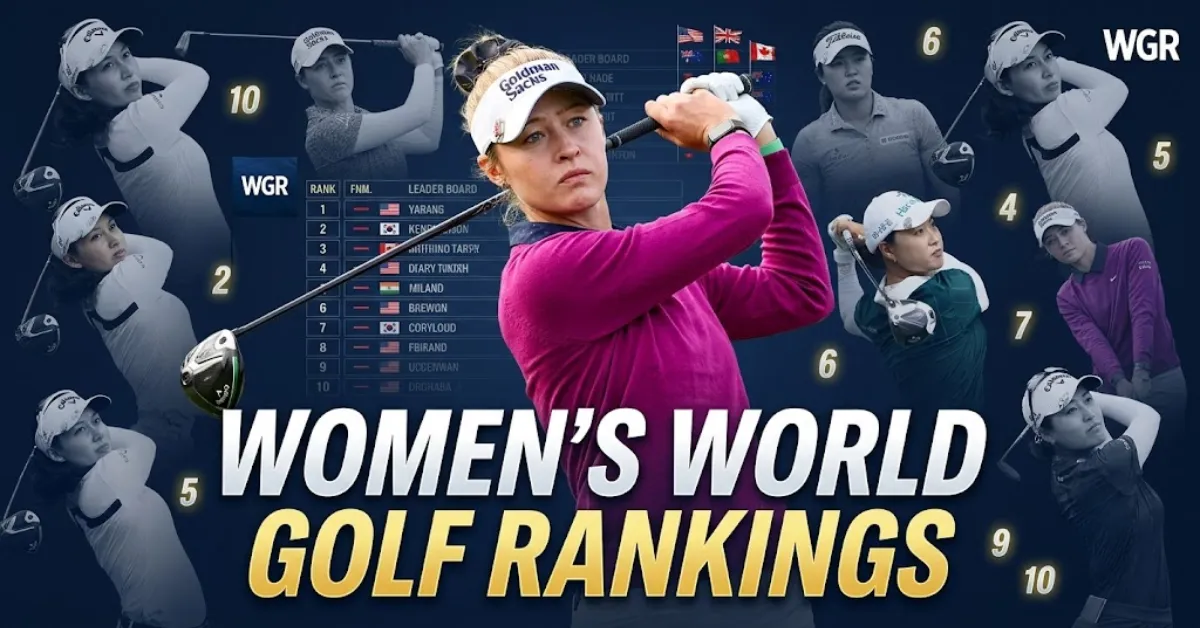
If you follow women’s golf at all, you already know the names. What the official websites won’t tell you is the story – why Korda and Thitikul keep trading the top spot, why a 22-year-old English rookie is suddenly the sixth-best player on the planet, and exactly what being ranked in the top 60 actually gets you. That’s what this page is for.
The Rolex Rankings update every Monday after the previous weekend’s events. The standings below are current as of June 2026.
Quick Answer: Nelly Korda sits at No. 1 in the women’s world golf rankings as of June 2026, with an average of 11.80 Rolex points. Jeeno Thitikul is second at 10.95. Rankings update every Monday and cover performances across 13 eligible tours over a rolling two-year period.
Current Women’s World Golf Rankings – June 2026
These are the official Rolex Women’s World Golf Rankings, reflecting performances across all eligible tours over the most recent 104-week period.
| Rank | Change | Player | Country | Avg Points | Total Points | Events |
|---|---|---|---|---|---|---|
| 1 | Nelly Korda | USA | 11.80 | 412.85 | 34 | |
| 2 | Jeeno Thitikul | THA | 10.95 | 459.77 | 42 | |
| 3 | Hyo Joo Kim | KOR | 7.28 | 312.89 | 43 | |
| 4 | Ruoning Yin | CHN | 6.16 | 221.89 | 36 | |
| 5 | +1 | Hannah Green | AUS | 5.83 | 239.04 | 41 |
| 6 | -1 | Lottie Woad | ENG | 5.83 | 204.03 | 26 |
| 7 | Charley Hull | ENG | 5.38 | 204.55 | 38 | |
| 8 | Miyu Yamashita | JPN | 5.38 | 290.63 | 54 | |
| 9 | Minjee Lee | AUS | 5.02 | 220.70 | 44 | |
| 10 | Lydia Ko | NZL | 4.67 | 168.27 | 36 | |
| 11 | Sei Young Kim | KOR | 4.35 | 182.84 | 42 | |
| 12 | Haeran Ryu | KOR | 4.17 | 191.98 | 46 | |
| 13 | Angel Yin | USA | 3.53 | 151.86 | 43 | |
| 14 | Lauren Coughlin | USA | 3.48 | 142.57 | 41 | |
| 15 | Hye Jin Choi | KOR | 3.25 | 178.75 | 55 | |
| 16 | Mao Saigo | JPN | 3.17 | 145.74 | 46 | |
| 17 | Nasa Hataoka | JPN | 3.11 | 146.11 | 47 | |
| 18 | Aki Iwai | JPN | 2.85 | 193.53 | 68 | |
| 19 | Rio Takeda | JPN | 2.84 | 181.63 | 64 | |
| 20 | +9 | Celine Boutier | FRA | 2.83 | 144.55 | 51 |
Source: rolexrankings.com – updated June 1, 2026
Notice that gap between No. 1 and No. 3. Korda sits at 11.80 average points and Thitikul at 10.95. Hyo Joo Kim is third at 7.28 – a massive 3.67-point drop from second. That’s a two-player race at the very top, and it’s been a two-player race for most of the past two years.
Who Is World No. 1 Right Now? The Korda–Thitikul Story
Nelly Korda is your current No. 1, having reclaimed the top spot after winning the 2026 Chevron Championship – her third major title – by five strokes in wire-to-wire fashion at Memorial Park Golf Course in Houston. That win handed her the seventh time she’s reached No. 1 in her career, and her 109th total week at the top of the Rolex Rankings.
Before that win, Jeeno Thitikul had held No. 1 since August 2025, when she overtook Korda after the AIG Women’s Open. Thitikul had spent most of 2025 as the dominant force on tour – winning three times, taking the Race to the CME Globe title for the second consecutive year, collecting $4 million at the season-ending CME Group Tour Championship, and winning Player of the Year. Nelly Korda didn’t win once in 2025. She was, by every measure, the second-best player in the world.
Then 2026 arrived. Korda’s first six LPGA starts produced three wins and three runner-up finishes. She hasn’t finished worse than second in any event until a T8 just before the US Women’s Open. The two players are separated by less than a point in average ranking score – 11.80 to 10.95 – and this rivalry defines what makes women’s golf so compelling right now.
The interesting detail that nobody mentions: Thitikul’s total points (459.77) actually exceed Korda’s (412.85) because Thitikul has played 42 events to Korda’s 34 over the two-year window. Rankings run on average points per event, not total accumulated points. Korda wins on average despite playing less. That matters when you’re thinking about who burns points most efficiently – and Korda does it with fewer appearances.
How the Rolex Rankings System Actually Works
Most explanations gloss over the mechanics. Here’s what actually drives the numbers.
1. The rolling two-year window. Rankings cover a 104-week (two-year) period. A win from 18 months ago still counts – but it counts less than a win from last month. Points reduce in 91 equal decrements after the first 13 weeks, so recent form weighs heavily. That’s why a player who dominates for six months can shoot up 30 spots, and why a player who stops competing drops slowly rather than immediately.
2. Field strength determines how many points are available. Not all tournaments pay the same ranking points. A major at full strength is worth far more than a co-sanctioned event on a developmental tour. The system calculates field strength using two inputs: the world ranking of every player in the field, and the prior year’s money-list ranking of those same players. The stronger the field, the more total points available to be distributed.
3. The minimum divisor of 35 events. This is the mechanic that trips people up. Your ranking score = your total points divided by your number of events, with a floor of 35. Play 40 events? Your total gets divided by 40. Play only 25? Your total still gets divided by 35. You don’t get credit for playing fewer events. This prevents players from cherry-picking high-value events, sitting out everything else, and protecting their points average. That’s exactly why Thitikul’s 42 events at 10.95 average is impressive – she’s carried a huge divisor and still sits second in the world.
4. Thirteen eligible tours. Points count from the LPGA Tour, JLPGA (Japan), KLPGA (Korea), LET (Europe), ALPG (Australia), Epson Tour (LPGA developmental), LETAS, CLPGA (China), WPGA, TLPGA, JLPGA Qualifying Tour, JSU, and – starting in 2026 – the ANNIKA Women’s All Pro Tour (WAPT). The LPGA majors carry a fixed allocation; all other tours use the field strength calculation.
5. Any golfer, amateur or pro, can be ranked. The rankings aren’t LPGA-exclusive. An amateur who plays in enough eligible events gets a Rolex ranking. This matters because it’s how players like Lottie Woad built ranking points before turning professional.
The 2026 Rule Changes That Made Rankings Fairer
In December 2025, the Rolex Rankings announced three meaningful changes effective January 5, 2026. These don’t make headlines, but they change who benefits from competing on smaller tours.
Previously: A tournament’s assigned “strength of field” determined how many players received ranking points. Tournaments below a certain strength threshold meant players who made the cut received nothing. Compete on the WPGA Tour or TLPGA, make every cut, and walk away with zero ranking points some weeks.
Now: Every player who makes the cut in any WWGR-eligible event receives ranking points, regardless of field strength. This helps players grinding on smaller tours build toward LPGA qualifying or Rolex Rankings eligibility.
Also changed: Strength of field distribution moved to a linear format instead of a banded range. Previously, any event assigned a SoF of 151–160 received identical points. Now each point of strength generates a distinct points distribution — fairer and more precise.
Also added: The ANNIKA Women’s All Pro Tour (WAPT), a US-based developmental tour running 13 events between April and September, joined as the 13th eligible tour in 2026. Founded by Annika Sörenstam, it creates a clearer pathway for players trying to work up to LPGA status through ranking points rather than Q-school alone.
Who Are the Top 10 Female Golfers Right Now?
Here’s what the numbers behind those rankings actually mean.
1. Nelly Korda (USA) – 11.80 avg pts Three LPGA majors, 17 career LPGA wins, and a 2026 season where she hasn’t finished outside the top 8 until May. Korda’s ball-striking ranks among the best in women’s golf – her iron play in particular is a generation ahead of the field. She’s won two Chevron Championships, an Olympic gold medal, and enough individual season awards that listing them all would take a paragraph. The one knock: she hasn’t won a US Women’s Open yet, which she’ll address this week at Riviera Country Club.
2. Jeeno Thitikul (Thailand) – 10.95 avg pts Twenty-two years old. Started playing golf at six on a driving range because her hometown had no course. Won her first professional tournament at 14 years and four months, which was then a world record for youngest professional winner. Turned 19, arrived on the LPGA, and immediately won twice in her rookie year. Won the Race to the CME Globe in back-to-back seasons (2024 and 2025), collecting $4 million at the 2025 CME Group Tour Championship. Her strongest asset isn’t power — it’s her iron consistency and a putting stroke that handles pressure rounds better than players twice her age. The Korda rivalry makes both of them better, and that’s genuinely good for women’s golf.
3. Hyo Joo Kim (South Korea) – 7.28 avg pts Consistent enough at 43 events played to sit third even with a point average barely above half of No. 1. Hyo Joo Kim doesn’t generate the same headlines as the top two, but she has finished in the top 15 at more than half her starts this season. South Korean women’s golf continues to produce extraordinary depth — six of the top 20 hold Korean or Korean-American flags.
4. Ruoning Yin (China) – 6.16 avg pts Won the 2023 Women’s British Open at 19. Has only played 36 events in the ranking window – if she competes more often in 2026, she’ll accumulate total points toward closing the gap to the top three. China’s presence in the top 5 reflects the KLPGA and broader Asian women’s golf pipeline producing genuine stars.
5. Hannah Green (Australia) – 5.83 avg pts Five-time LPGA winner, including the 2019 Women’s PGA Championship. Green moved up one spot this week to fifth. Her consistency across 41 events over the two-year window – with total points of 239.04 – tells you she isn’t dependent on one or two big weeks. She grinds results across a full schedule.
Top 6–10 at a glance: Lottie Woad (ENG, 5.83), Charley Hull (ENG, 5.38), Miyu Yamashita (JPN, 5.38), Minjee Lee (AUS, 5.02), Lydia Ko (NZL, 4.67).
Two English players in the top 10 is notable – Great Britain has never been more represented at the top of women’s golf than it is right now.
The Fastest Rise in Recent Memory: Lottie Woad
Here’s the stat that puts Lottie Woad’s rise in perspective: she turned professional in summer 2025, entered the Rolex Rankings at 62nd, and sat sixth in the world by June 2026. That’s 56 spots in under a year without an LPGA Tour card at the start of it.
Woad grew up in Farnham, Surrey, went to Florida State on a golf scholarship, won the ACC Golfer of the Year award in 2024, and earned the Mark H. McCormack Medal as the world’s top-ranked amateur woman that same year. She won the Augusta National Women’s Amateur in 2024 – which bought her exemptions into multiple LPGA majors – then won her professional debut at the 2025 ISPS Handa Women’s Scottish Open before she even had full LPGA membership.
She was 21 and had never played a full LPGA season. Nelly Korda, who was paired with her at the Scottish Open and lost to her, called Woad’s game “absolutely amazing” and specifically mentioned her process under pressure: “She stuck to it every single time. I think that’s one of the main things I noticed – how mature she is for her age.”
In May 2026, Woad won her second LPGA title at the Kroger Queen City Championship, edging out Haeran Ryu by two strokes at 12-under. She hit 15 of 18 greens in regulation in the final round. At 22 years old, two LPGA wins, a world ranking of sixth, and a Solheim Cup debut ahead of her – Woad is the most interesting young player in women’s golf right now, and she isn’t close to her ceiling.
All-Time Weeks at World No. 1 – The Record Books
The Rolex Rankings launched in February 2006, with Annika Sörenstam as the first-ever No. 1. Twenty years in, here’s how the all-time record for weeks at the summit looks:
| Player | Country | Total Weeks | First Reached No. 1 |
|---|---|---|---|
| Jin Young Ko | South Korea | 163 | April 2019 |
| Lydia Ko | New Zealand | 125 | February 2015 |
| Yani Tseng | Taiwan | 109 | January 2011 |
| Nelly Korda | USA | 109* | March 2021 |
| Inbee Park | South Korea | 106 | April 2013 |
| Lorena Ochoa | Mexico | 158† | April 2007 |
| Annika Sörenstam | Sweden | 61 | February 2006 |
*Korda’s total as of June 2026, 7th stint at No. 1
†Ochoa’s entire record came in one consecutive run before her 2010 retirement; Jin Young Ko surpassed it in June 2023
Jin Young Ko’s 163 weeks is the record. That number looks more extraordinary the more you understand the system — 163 separate Mondays when her average points were higher than every other woman on earth. Ko’s most remarkable stretch was 100 consecutive weeks at No. 1, from July 2019 through June 2021, bridging a pandemic-shortened season without losing the top spot.
Korda’s 109 weeks make her joint-third all time. She’s 27. If she matches her 2024 form (seven wins) for the next two to three seasons, Ko’s record is reachable. That’s not a prediction – it’s just the math.
The list also tells you something about the South Korean school. Ko, Park, and Inbee Park combined for 269 weeks at No. 1. The KLPGA pipeline has reliably produced the world’s best players for 15 years straight.
What Rankings Actually Decide (Beyond the Scoreboard)
The Rolex Rankings aren’t just a bragging-rights table. They determine tournament entry in ways most fans don’t realize.
Women’s British Open field: 40 of the 144 spots come directly from Rolex Rankings – 10 reserved for LET members and 30 for LPGA members. Miss the top 30 on the LPGA rankings, and that route closes.
US Women’s Open entries: The USGA uses Rolex Rankings among its exemption criteria for the US Women’s Open, giving automatic spots to players in the top-50 range. The cutoff shifts each year but typically sits around the top 75.
Solheim Cup selection – US team: The top two Americans in the Rolex Rankings who haven’t qualified through points automatically make the US Solheim Cup team. That means being ranked inside the top 10 as an American isn’t just personal pride – it’s a direct route to the most important team event in women’s golf.
Solheim Cup selection – European team: Four of the 12 European Solheim Cup spots go directly to European players on the Rolex Rankings list. For players like Charley Hull (No. 7) and Lottie Woad (No. 6), their rankings position has direct consequences every two years.
Race to the CME Globe vs. Rolex Rankings: These are separate systems. The Race to the CME Globe tracks season-only LPGA points to determine the 60 players who enter the CME Group Tour Championship, where the winner takes $4 million. A player can win the Race to the CME Globe (as Thitikul did in 2024 and 2025) and not be No. 1 in the world rankings – or vice versa. The LPGA money list, CME standings, and Rolex Rankings all operate independently and can reward different types of performance.
Frequently Asked Questions
As of June 2026, the top 10 in the Rolex Women’s World Golf Rankings are: 1. Nelly Korda (USA), 2. Jeeno Thitikul (Thailand), 3. Hyo Joo Kim (South Korea), 4. Ruoning Yin (China), 5. Hannah Green (Australia), 6. Lottie Woad (England), 7. Charley Hull (England), 8. Miyu Yamashita (Japan), 9. Minjee Lee (Australia), 10. Lydia Ko (New Zealand). Rankings update every Monday following the previous weekend’s tournaments.
Yes. Korda reclaimed No. 1 on April 28, 2026, after winning the Chevron Championship – her third major championship – by five shots at Memorial Park Golf Course in Houston. Korda had spent 71 consecutive weeks at No. 1 before Thitikul overtook her in August 2025. Korda’s career total now stands at 109 weeks at the top, making her joint-third all time alongside Yani Tseng. She holds the No. 1 spot with an average of 11.80 Rolex points as of June 2026.
Annika Sörenstam is the most cited answer – 72 LPGA Tour wins, 10 major championships, 8 Rolex Player of the Year awards, and the first (and still only) woman to shoot 59 in a professional round. She was the first ever Rolex Rankings No. 1 when the system launched in February 2006. The strongest active case belongs to Jin Young Ko, who holds the record for most career weeks at No. 1 with 163. Ko’s 100 consecutive weeks at the summit from 2019 to 2021 is arguably the most dominant run in the ranking system’s history. Nelly Korda’s back-to-back seasons of 2024 (seven wins, five consecutive) and 2026 (three wins in six starts) have put her firmly in the conversation too.
The two players everyone is watching are Nelly Korda and Lottie Woad. Korda is the current world No. 1 and hasn’t finished outside the top 8 in 2026. Woad is 22, ranked sixth, won twice in her first full LPGA season, and hit 15 of 18 greens in her second title victory. Jeeno Thitikul, still only 23, won back-to-back season titles in 2024 and 2025, which is a standard no player had matched in over two decades. Any of those three would be a defensible answer, depending on whether you mean currently dominant, fastest rising, or most consistently excellent.
The Best Women’s Golf You’ll Watch This Summer
The US Women’s Open tees off this week at Riviera Country Club in Pacific Palisades, California – and Korda is the overwhelming favorite. She’s motivated by a specific score to settle after a near-miss at the 2025 edition. Thitikul will push her. Lottie Woad will be in the mix. Hyo Joo Kim could easily take a major on any given week.
Rankings tell you who’s performing well across a sustained period. They don’t tell you who’s going to make the putt on Sunday. That’s what makes women’s golf in 2026 genuinely worth watching – the top of the rankings is as competitive as it’s been since Jin Young Ko was piling up those 163 weeks a decade ago.
For a deeper look at what Korda puts in the bag to produce those iron numbers, check out our breakdown of her 2026 setup Nelly Korda WITB 2026. And if you want to follow along with the full LPGA schedule this season, we keep that updated weekly LPGA Tour schedule 2026.