
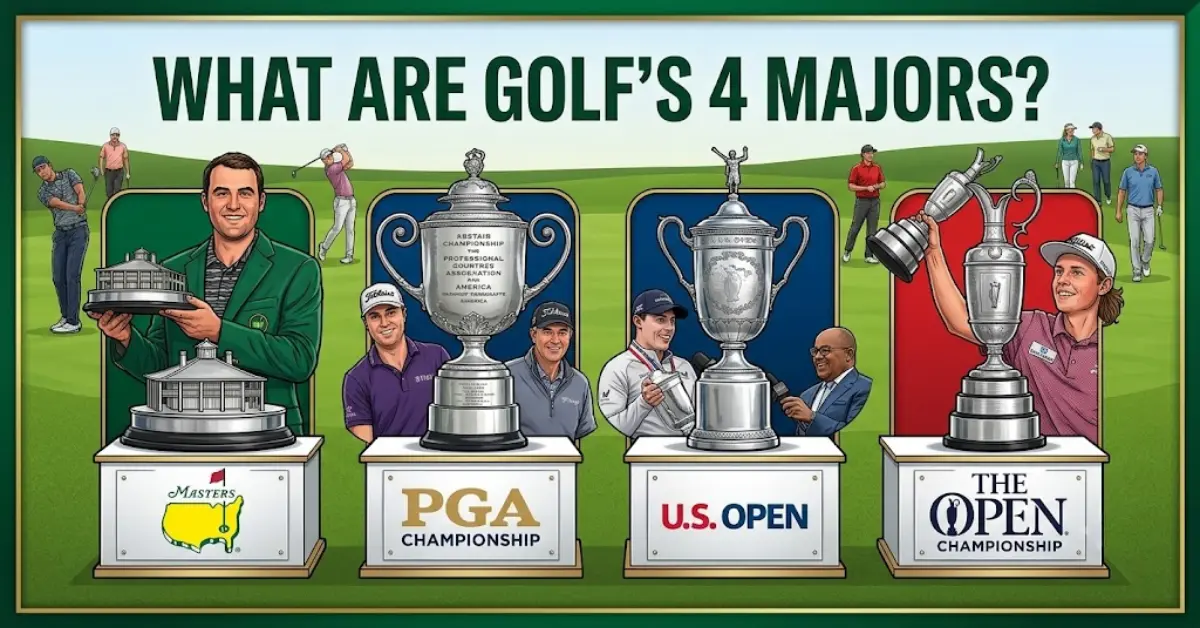
The first time I watched golf’s four majors back to back in a single season, I couldn’t believe how different each one felt. Augusta looks like a painting. Shinnecock Hills looks like it’s trying to break you. The Open Championship looks like weather happened to a golf course. Every tournament carries a completely different personality, and once you understand what makes each one tick, watching them is a different experience entirely.
Golf’s four major championships – what are golf’s 4 major tournaments, and why do they exist above everything else on the calendar? The answer comes down to history, independence, and tradition. Each major is run by a different organization, played on a different style of course, and tests a completely different skill set. Win one, and your career has meaning. Win all four, and your name goes onto a list that has only six people on it.
Here’s everything you need to know about what are golf’s 4 major championships, how the 2026 season is playing out, and what’s genuinely at stake in the second half of the year.
Quick Answer: Golf’s four major championships are The Masters (Augusta, every April), the PGA Championship (US venues, May), the US Open (US venues, June), and The Open Championship (British links courses, July). Together they form the Grand Slam – the ultimate measuring stick for every professional golfer’s career.
The Four Majors at a Glance – 2026 Schedule, Venues, and What Makes Each One Hard
Here are all four majors in order, including 2026 venues, dates, and the one thing about each course that separates it from a normal tour stop:
| Major | 2026 Dates | Venue | What Makes It Uniquely Hard |
|---|---|---|---|
| The Masters | Apr 9–12 | Augusta National, Augusta, GA | Lightning-fast, tilted greens that punish anything above the hole; a high draw is almost mandatory off certain tees |
| PGA Championship | May 14–17 | Aronimink Golf Club, Newtown Square, PA | Donald Ross greens with complex contours that expose poor approach play; Aronimink punishes anything that misses to the wrong side |
| US Open | Jun 18–21 | Shinnecock Hills GC, Southampton, NY | USGA deliberately narrows fairways and grows rough to penalize wayward shots; Shinnecock’s exposed links-style layout adds unpredictable wind from multiple directions |
| The Open Championship | Jul 16–19 | Royal Birkdale, Southport, England | True links golf — uneven lies, pot bunkers, wind that changes mid-swing, and ground game demands most tour players never develop elsewhere |
Those are what are the 4 golf majors in order for 2026 – and understanding the venue character is the fastest way to understand why certain players dominate certain tournaments.
The Masters Tournament – Augusta, Always Augusta
No other major works like The Masters. Every other tournament rotates venues. Augusta National has hosted every edition since 1934, which means the course itself becomes part of the competition in a way that simply doesn’t happen anywhere else. First-timers rarely win. Course experience is a measurable edge.
Rory McIlroy retained his green jacket in April 2026, becoming only the fourth player in history to win back-to-back Masters titles, joining Jack Nicklaus, Nick Faldo, and Tiger Woods. That’s the context you need to appreciate what winning at Augusta means. The list of people who’ve won there twice or more is golf’s Mount Rushmore by another name.
The Masters invites the smallest field of any major – typically under 100 players – and uses one of the tightest cuts in golf, set around the top 50 and ties after 36 holes. Former champions receive a lifetime invitation to compete, which is why you still occasionally see 60-year-olds teeing it up on Thursday morning at Augusta. Amen Corner, the stretch from holes 11 through 13, has ended more major dreams than any other three-hole sequence in golf. Water lurks on both sides of 12, and 13’s second shot over Rae’s Creek has produced the tournament’s most dramatic moments for 90 years.
The Green Jacket stays at Augusta National. Winners take it home for one year, then return it. That detail alone tells you everything about the culture of the place.
The PGA Championship – The Most Underrated Major (and the Deepest Field)
People who don’t follow golf closely often dismiss the PGA Championship as the fourth major in prestige. That’s wrong, and the results prove it. The PGA draws 156 players – the largest field of any major – and has consistently produced the most surprising winners of any of the four tournaments. Aaron Rai, 290-to-1 before the week began, won the 108th PGA Championship at Aronimink in May 2026 with a three-shot victory over Jon Rahm, becoming the first English-born player to win the Wanamaker Trophy in more than a century.
The Wanamaker Trophy, for the uninitiated, is enormous – reportedly 28 pounds of silver – and winners traditionally struggle to lift it cleanly on the 18th green. It’s a minor detail that says something about the PGA’s self-confidence as a tournament. They don’t need to be subtle.
Aronimink is a Donald Ross design, which means diabolical green contours and approach angles that demand precision rather than power. Ross layouts tend to sort out the field by the third round, when the greens firm up and missed approaches stop being forgivable. That’s exactly what happened in 2026 – the leaderboard reshuffled completely on Saturday as Scottie Scheffler and Jon Rahm both struggled with approach play that had looked clean on the easier Thursday setup.
The PGA Championship is organized by the PGA of America, a separate entity from the PGA Tour. That independence matters, and it’s the same reason all four majors carry weight that Tour events – including The Players – simply don’t.
The US Open – The Hardest Test in Golf, by Design
The US Open doesn’t happen to be hard. The USGA deliberately engineers it that way. Every year, they take whatever course is hosting and set it up to be the most punishing version of itself – narrow fairways, rough grown thick enough to grab a club face, and greens rolled fast enough that putts from above the hole become genuinely dangerous. A score of even par has historically been enough to win. That’s the point.
The 2026 US Open returns to Shinnecock Hills in Southampton, New York, June 18–21. Shinnecock is a links-style American course that plays completely differently in wind than it does on calm mornings. The last time the USGA took the championship there, in 2018, the setup became so extreme on Saturday that it generated controversy – balls rolling off greens, players struggling to hold putting surfaces. Expect the USGA to have learned from that while keeping the teeth sharp.
Scottie Scheffler enters Shinnecock as the world number one and the pre-tournament favorite. More importantly, a win there would complete his career Grand Slam – he’s won the Masters twice (2022 and 2024), the 2025 PGA Championship, and the 2025 Open Championship. The US Open is the only missing piece. That storyline makes the 126th US Open the most narratively compelling of the four remaining 2026 majors.
The Open Championship – The One That Started It All
Every one of the four majors has a history, but The Open Championship has the deepest roots in the game. The first Open was played in 1860 at Prestwick Golf Club in Scotland, when eight professionals completed three rounds on a 12-hole course and Willie Park Sr. won with a score of 174. The modern four-major framework didn’t exist until The Masters was established in 1934, but The Open predates it by 74 years.
The 2026 Open heads to Royal Birkdale in Southport, England, July 16–19. Birkdale is the purest links test on the Open rota — dunes framing every fairway, turf so firm the ball runs 30 yards after landing, and a wind that has no obligation to be consistent. Jordan Spieth won the last time the Open was held at Birkdale in 2017, recovering from a wild adventure through the dunes on Saturday with one of the most memorable final rounds in recent major history. Scottie Scheffler won the 2025 Open at Royal Portrush and comes to Birkdale as defending champion and the player with the most to gain in 2026.
Links golf demands a skill that most American players spend zero time practicing – the bump-and-run, the low stinger, the art of using the ground rather than the air to control a shot. Players who can’t adjust to firm, fast fairways and unpredictable bounces regularly arrive at Open venues in top form and leave bewildered. That’s part of what makes The Open uniquely compelling to watch.
The Grand Slam – What It Means and Who’s Actually Done It
“Grand Slam” gets thrown around loosely in golf, so let’s be precise about what it means – because the answer to “has anyone ever won all 4 golf majors in one year” is more interesting than a simple yes or no.
The Calendar-Year Grand Slam means winning all four majors in a single season. In the modern era – using the current four tournaments – nobody has done it. Tiger Woods came closest. In 2000, Woods won the US Open, The Open Championship, and the PGA Championship. He won The Masters in 2001. Holding all four trophies simultaneously is what’s known as the “Tiger Slam” – technically consecutive major titles across two calendar years, not a true single-year sweep. Ben Hogan in 1953 won The Masters, US Open, and Open Championship in one year, but couldn’t compete in the PGA Championship because the schedules conflicted and transatlantic travel was too slow. Bobby Jones pulled off a calendar-year Grand Slam in 1930, but those four majors included the US Amateur and British Amateur, not the modern set of four.
The Career Grand Slam – winning all four at any point in a career – has been achieved by exactly six men in the modern era:
- Gene Sarazen (completed 1935)
- Ben Hogan (completed 1953)
- Gary Player (completed 1965)
- Jack Nicklaus (completed 1966)
- Tiger Woods (completed 2000)
- Rory McIlroy (completed 2025 – winning The Masters ended an 11-year wait)
Nicklaus holds the all-time record with 18 major championships. Woods has 15, though injury has kept him largely off tour since February 2025. Among active players, McIlroy leads with six majors after his 2026 Masters defense. Scheffler, at 29, already has four and is one US Open win from the seventh Career Grand Slam in history.
Is The Players Championship a Major? Here’s the Real Answer
The Players Championship is not a major. It isn’t going to become one. And honestly – that’s fine.
Here’s why The Players doesn’t qualify, in one sentence: the four majors are each organized and sanctioned by independent bodies that have existed for decades outside the PGA Tour. The Masters is run by Augusta National Golf Club. The US Open is run by the USGA. The Open Championship is run by The R&A. The PGA Championship is run by the PGA of America. The Players is organized by the PGA Tour itself. That structural difference matters, because the four majors developed their prestige precisely because they weren’t controlled by any one commercial entity or tour.
The PGA Tour tried rebranding The Players with the tagline “March is going to be Major” in 2026. Golf fans largely hated it. The Players offers a $25 million purse and 80 world ranking points for the winner – both among the highest in the sport. TPC Sawgrass’s island-green 17th is one of the most recognized holes in the game. Winning The Players is a genuine achievement. Xander Schauffele put it well: “Could they make it one? Probably. I don’t think the majors would like that very much.” The Players has carved out a legitimate identity as the best tournament that isn’t a major. Calling it one cheapens both that identity and the history of the four majors it would need to join.
Frequently Asked Questions
No professional golfer has won all four modern majors – The Masters, PGA Championship, US Open, and The Open Championship – in a single calendar year. Tiger Woods came closest with the “Tiger Slam”: winning the 2000 US Open, 2000 Open Championship, 2000 PGA Championship, and 2001 Masters, holding all four simultaneously but across two calendar years. Bobby Jones completed a calendar-year Grand Slam in 1930, but those four events included the US Amateur and British Amateur – not the same four tournaments that define the modern major set.
It depends on the major. Woods has a lifetime exemption into the Masters, which grants former champions a standing invitation regardless of age or world ranking. For the PGA Championship, he earned a lifetime exemption with his third PGA win in 2007. And the US Open, his 10-year exemption from his last win there ran out in 2019, and his five-year exemption from the 2019 Masters expired in 2024 – meaning he’s required to qualify or receive a special exemption from the USGA to compete at Shinnecock in 2026. For The Open Championship, past champions receive a five-year exemption, which has similarly expired.
Mickelson has a lifetime exemption into The Masters (three wins: 2004, 2006, 2010) and into The Open Championship (one win: 2013). He does not have one for the PGA Championship despite winning it once in 2021 – that award typically applies to multiple-time winners. Most notably, Mickelson has never won the US Open, having finished runner-up there a record six times. He doesn’t hold any exemption into that championship and would need to qualify or receive a special invitation.
In seasonal order: The Masters (April), the PGA Championship (May), the US Open (June), and The Open Championship (July). That’s the current calendar sequence for 2026 and has been the standard order since the PGA Championship moved from August to May in 2019 to avoid scheduling conflicts with the FedEx Cup playoffs.
The career Grand Slam means winning all four major championships – The Masters, PGA Championship, US Open, and The Open Championship – at least once during a career. Only six men have done it in the modern era: Gene Sarazen, Ben Hogan, Gary Player, Jack Nicklaus, Tiger Woods, and Rory McIlroy (who completed his at the 2025 Masters). Scottie Scheffler needs only the US Open to become the seventh.
The Stakes Are Real – and They’re at Their Highest Right Now
Golf’s four major championships aren’t special because someone decided they should be. They’re special because 90-plus years of history, independent governance, iconic venues, and the best players on earth competing under genuine pressure have made them that way. No committee voted them into relevance. The prestige is earned.
The 2026 major season has already delivered Rory McIlroy’s back-to-back Masters defense and Aaron Rai’s stunning PGA Championship win. Two majors remain – the US Open at Shinnecock Hills and The Open at Royal Birkdale – and Scottie Scheffler is one win from golf history. If you only watch four weeks of golf a year, you already know which four to choose.
Want to know more about the world’s best players chasing major titles? Read our full profile on what drives the modern Grand Slam pursuit.