
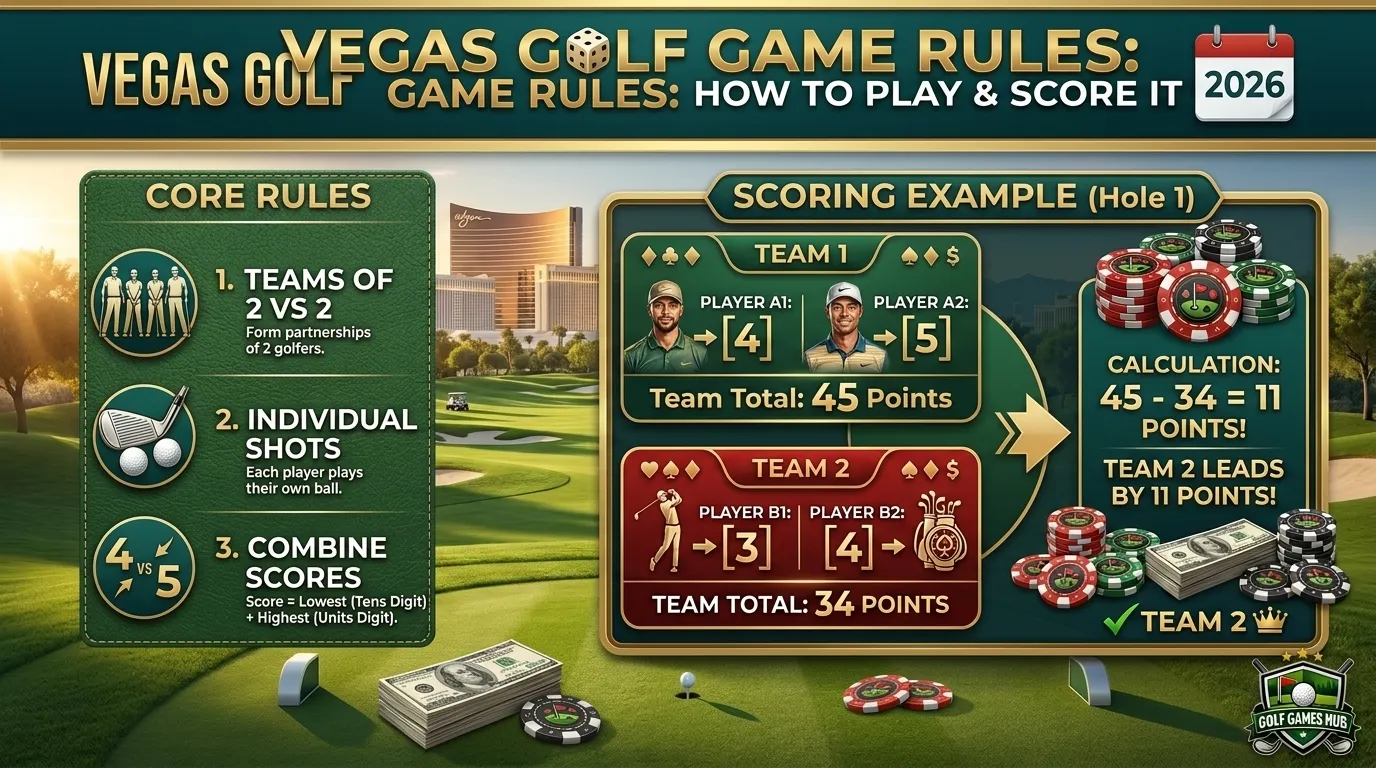
Quick Answer: Vegas is a 4-player golf betting game: two teams of two combine each partner’s score into a two-digit number, low digit first (a 4 and 5 becomes 45), and the team with the lower number wins the point difference. Birdies flip the loser’s number; a score of 10 or higher breaks the two-digit format entirely.
I’ve watched a 9-handicap partner make a routine bogey on a par 3 and still hand our opponents 40 points, because he had no idea a blow-up score flips the entire formula. That’s Vegas in one sentence: the golf is secondary, and the arithmetic decides who’s buying drinks at the turn. This guide covers the Vegas golf game rules that actually trip people up — the two-digit math, the birdie and eagle flips, Net Vegas for mixed handicaps, and the chips side-game that half the internet confuses with the scoring format itself.
Grab a scorecard. You’ll want to do the math by hand at least once before you trust an app to do it for you.
What Is the Vegas Golf Game?
Whatever you call it — Vegas, that vegas style golf game your buddy swears by, or the las vegas golf game rules you half-remember from a work trip — the mechanics below are what actually matter. Vegas splits four players into two teams of two. Nobody adds their scores together. Instead, each team turns its two individual scores into a single two-digit number, and the team with the lower number wins the hole.
Four players make up the standard Vegas golf game format, though a few groups run a three-player version where the extra player goes it alone and doubles their own score to compete against the pair. You apply handicaps before the two scores combine, which is what makes the format playable across a group with a real skill gap. Golf Digest’s own writers describe it as “not for the faint of heart,” and after watching a single bad hole erase a two-hour lead more than once, that tracks.
There’s no official rulebook for Vegas the way there is for stroke play under the actual Rules of Golf. It’s a house game, which is exactly why you’ll find real disagreement between sources on some of the finer points — including the one rule that causes the most arguments on the course. We’ll get to that.
How Vegas Scoring Actually Works
If you searched how to play Vegas golf game expecting a quick list, here it is — in the order you’ll actually use it during a round.
- Split into two teams of two. The most common method: the two balls that finish furthest left off the tee become one team, the two furthest right become the other.
- Play the hole under normal rules. Everybody plays their own ball, every shot counts, and you record gross (or net, if you’re using handicaps) score for each player.
- Combine each team’s two scores into one number, lower score first. A 4 and a 5 become 45. Two 5s become 55. A 3 and a 6 become 36.
- Compare the two team numbers. The lower number wins the hole.
- The winning team collects points equal to the difference. Post 45 against an opponent’s 56, and you’re up 11 points.
- Apply the birdie or eagle flip if one happened, then move to the next tee.
Left-Right vs. Middle Partners
Golfers usually just call it the left-right method, though you’ll also see it searched as left right vegas golf game — it rotates naturally since drives land differently every hole if you’re not fixing partners for the whole round. Some groups play “middle” instead — often searched as middle vegas golf game, and sometimes called Newtown — where the two balls that land closest to the center of the fairway become partners instead of the outer two.
For a group with a wide handicap spread, middle partners is genuinely the better version, and it’s not close: it rewards accurate ball-striking over just “getting one in play,” instead of punishing a big draw or fade off the tee the way left-right can. Whichever version your group runs, lock it in before the first tee shot. Switching mid-round is how a friendly Vegas game turns into a 19th-hole argument.
The Birdie Flip (and Why It Changes Everything)
This is the mechanic that makes a real Vegas golf game explained article necessary, because on paper it sounds simple and on the course it’s the part that decides matches. When a team makes a birdie, the opposing team’s number flips — the high digit leads instead of the low one.
Say Team A cards a 3 and a 5 on a par 4. That’s a birdie for the 3, so Team A’s own number stays 35. Team B, who made a 4 and a 6, would normally post 46 — but because Team A birdied, Team B’s number flips to 64.
Team A now wins the hole by 29 points (64 minus 35) instead of the 11 points (46 minus 35) they’d have won without the flip.
One putt. An 18-point swing. That’s why Vegas rewards aggressive play far more than a standard stroke-play bet does — a makeable birdie putt isn’t just worth one shot, it’s worth whatever the flip does to the other team’s number. Most groups agree that if both teams birdie the same hole, the flips cancel out and you score it straight.
What Does an Eagle Do in Vegas Golf Game Scoring?
Whether you searched vegas golf game eagle or eagle in Vegas golf game, here’s the real mechanic: an eagle typically does two things at once: it flips the opposing team’s number like a birdie would, then doubles the resulting point difference on top. So a flip alone worth 29 points becomes a 58-point swing off a single eagle.
I’ve seen this happen exactly once in ten years of playing Vegas regularly — a partner holed his second shot on a reachable par 5 — and it turned a close front nine into a rout in the space of one swing. For context on just how rare that actually is at your own skill level, we’ve run the real odds by handicap, and eagles live in the same rare-air territory as an ace.
Here’s the honest catch: not every group plays the eagle rule the same way. Some apply the flip-and-double only to true eagles and score a “both partners birdie” situation as a simple cancel-out. Others extend the double to any two-under result on a hole. Settle this on the first tee, not after somebody makes one.
The Rule Almost Nobody Explains Right: Scoring a 10 or Higher
Every blow-up hole eventually happens to somebody in your group, and this is exactly where the Vegas golf game rules genuinely diverge between sources — including reputable ones. When a player shoots a 10 or higher, you can’t just concatenate two digits the normal way, and different guides fix that problem differently.
Version one (the more common one): append the double-digit score as its own block after the lower score — a 4 and a 10 becomes 410. Version two: the double-digit score leads because it’s treated as the worse result, so a 4 and a 10 becomes 104.
Both versions genuinely exist in circulation, and they produce very different point swings for the identical pair of scores. Before you play for real money, get your foursome to agree — out loud, before the round — on which version you’re using. This single rule causes more disputes at the 19th hole than the birdie flip does, and it’s not close.
Whichever version you pick, the lesson is the same either way: never pick up on a hole in Vegas. A conceded double bogey costs you almost nothing. A conceded 10 can cost your team the entire match.
Vegas Golf Game With Handicap Scoring (Net Vegas)
Vegas golf game with handicap scoring — usually called Net Vegas — is how most real-world groups actually play it, because a genuinely even foursome is rare. Instead of using each player’s gross score, you subtract their handicap strokes for that specific hole first, then combine the resulting net scores the same way as above.
Net Vegas beats gross Vegas for almost every real-world foursome, and it’s not close — a group where all four players are truly even is rare enough that gross scoring just isn’t fair to the higher-handicap pair. In practice: a player with a Course Handicap of 14 gets a stroke on the 14 hardest holes by stroke index, so their net score on those holes runs one lower than what they actually wrote on the card.
If you’re not sure how to work out your Course Handicap for the specific tees you’re playing, our full breakdown of how golf handicaps actually work covers the Course Rating and Slope math the USGA uses — worth reading before you set your Net Vegas stakes if your foursome spans more than about eight strokes of difference.
Vegas Golf Chips: The Side-Game Everyone Confuses With Scoring
This is where vegas golf game chips, vegas golf game poker chips, and vegas poker chip golf game searches all go wrong the same way, because “chips” in Vegas golf actually means two different things depending on which group you ask.
Meaning one — literal poker chips as a payment tracker. Some groups use physical poker chips instead of writing down running point totals, handing chips back and forth as the differential changes hole to hole and cashing them in at the value they agreed on beforehand. A las vegas golf game chips setup like this needs nothing more than a cheap poker set — a basic 100-piece clay-style set runs about $18–$28 online and covers a group for years.
Meaning two — an entirely separate on-course side-game. This is the vegas golf on the course golf game a lot of searchers actually mean: a set of novelty chips, each printed with a specific on-course event — a sand save, a three-putt, a tree ball — that players hand off and trade during the round, independent of the Vegas scoring above. Vendors sell dedicated sets for this, often branded as golf betting chips or trash-talk chip games, running roughly $20–$35 for a starter pack of 12–15 designs.
You can run both at once — score the actual match with the two-digit Vegas system, and run a chips side-bet purely for laughs on top of it. Whether you call it the vegas golf chips game or just “chips,” just don’t confuse the two when you’re explaining the rules to a new player. It’s a separate bet that sits on top of the real scoring, not a variation of it.
Setting the Wager and Running a Full Round
Agree on a per-point value before anyone tees off. A quarter a point keeps a bad day under $30; a dollar a point can genuinely hurt. Here’s a real stretch of a round showing how the swings compound, using Net Vegas at $0.25 a point.
| Hole | Team A net scores | Team A number | Team B net scores | Team B number | Points this hole | Running total (Team A) |
|---|---|---|---|---|---|---|
| 4 (par 4) | 4, 5 | 45 | 6, 4 | 46 | A +1 | +1 |
| 7 (par 3, A birdies) | 2, 4 | 24 | 4, 5 | 54 (flipped) | A +30 | +31 |
| 11 (par 4, B blows up) | 4, 5 | 45 | 4, 12 | 412 | A +367 | +398 |
That third row is the whole game in one line: a single triple-bogey-plus turned a comfortable match into a rout. If Team B had picked up instead of holing out for the 12, they’d have had no score to enter and no way to even estimate the damage — exactly why nobody in Vegas ever concedes a bad hole.
By the time you’re through nine, a team down more than about 15–20 points often calls a press — a new bet on the remaining holes, usually doubling the stakes, to try to claw back before the round ends. It’s the same mechanic Nassau players will recognize, and it’s the single biggest reason Vegas rounds can end with far more money changing hands than the raw scores suggest.
Vegas Golf Game vs. Wolf: They’re Not the Same Game
If you searched vegas wolf golf game, you’re probably trying to figure out whether these are the same format with two names. They aren’t, and mixing them up will genuinely confuse a foursome mid-round.
Vegas locks two teams together for the entire round (or until you rotate partners) and decides each hole by combining two scores into one number. Wolf rotates a single “wolf” designation hole by hole — that player tees off first, watches the other three hit, then chooses to partner with one of them against the other two, or go it alone (“lone wolf”) for double or triple points if their tee shot looked strong enough to carry the hole solo. Wolf scores each hole individually by best net score on each side, not by digit-combining.
Both formats reward strong tee shots and punish blow-ups, and both work fine with mixed handicaps. But Vegas builds tension over 18 holes through one running total that can swing wildly on a single swing, while Wolf resets the drama every hole. Play whichever matches your group’s patience for one long match versus 18 short ones.
Best Apps for Scoring Vegas Golf
Doing this math by hand for four players across 18 holes is exactly the kind of thing golfers get wrong under pressure, which is why a vegas golf game app is worth using once your group plays it regularly.
None of these apps replace knowing the rules yourself. I’ve had an app disagree with my own math on a double-digit hole because it defaulted to a different version of the “10 rule” than my group plays — exactly the scenario the section above warns you about.
Who Vegas Is Best For (and Who Should Skip It)
Vegas rewards aggressive play and forgives almost nothing, which makes it a great fit for a foursome of similar-ish handicaps who actually want the pressure. Golfers who already carry the driver a solid distance and can scramble for pars tend to enjoy it most, since reachable par 5s and real birdie chances come up often enough to make the flip mechanic matter.
Here’s the honest limitation: if your group has a huge handicap spread and nobody wants to deal with net scoring, Vegas gets frustrating fast, because one player’s normal round can wreck a teammate’s entire day through no fault of their own. A simpler format like a standard Nassau, where bad holes just cost strokes instead of exploding a shared number, is a kinder choice for a genuinely mixed-ability group that just wants a relaxed bet.
Frequently Asked Questions
How does Vegas golf game work?
Four players split into two teams of two. Each team combines its two individual (or net) scores into a two-digit number, lower score first, and the team with the smaller number wins the hole and collects points equal to the difference. Birdies and eagles flip the losing team’s number to make the swing bigger.
How do you play Vegas golf game?
Pick teams (left-right off the tee is the most common method), agree on a point value and whether you’re playing gross or net, then play the round under normal rules. After each hole, combine scores into two-digit numbers, compare them, and tally the point difference. Repeat for 18 holes and settle up at the agreed rate per point.
What does an eagle do in Vegas golf game scoring?
It flips the opposing team’s number the same way a birdie does, then doubles the resulting point difference. Groups vary on whether this applies to any eagle or only specific situations, so confirm your group’s version before the round.
What’s the Las Vegas golf game rule for a score of 10 or higher?
Sources genuinely disagree here. Some groups append the double-digit score as its own block after the lower score (a 4 and a 10 becomes 410); others put the double-digit score first because it’s the worse result (becoming 104). Agree on your group’s version before you tee off.
Can you play Vegas golf with only three players?
Yes. The odd player out goes it alone against the two-person team and doubles their own score to create a two-digit-equivalent number — a net 5 becomes 55 for scoring purposes, and a birdie doubles that result again on top of the flip.
Is the Las Vegas golf game the same as gambling?
Not officially. Most groups play for points and settle a small per-point dollar value at the end, similar to a Nassau — a wagering game between friends, not a casino product. The “chips” some groups use are just a physical way to track points, not real-money casino chips.
Final Thoughts
Vegas rewards the golfer who keeps grinding on a hole that already feels lost, and it punishes the golfer who picks up a shot too early. Once your foursome agrees on the two rules that actually cause disputes — the eagle version and the double-digit score order — the rest of the format runs itself.
Now that you’ve got the real Vegas golf game rules down, the last thing to settle is the stakes. If your group is still working that out, our breakdown of how golf handicaps actually work is worth a read before you set your Net Vegas numbers for the season.