
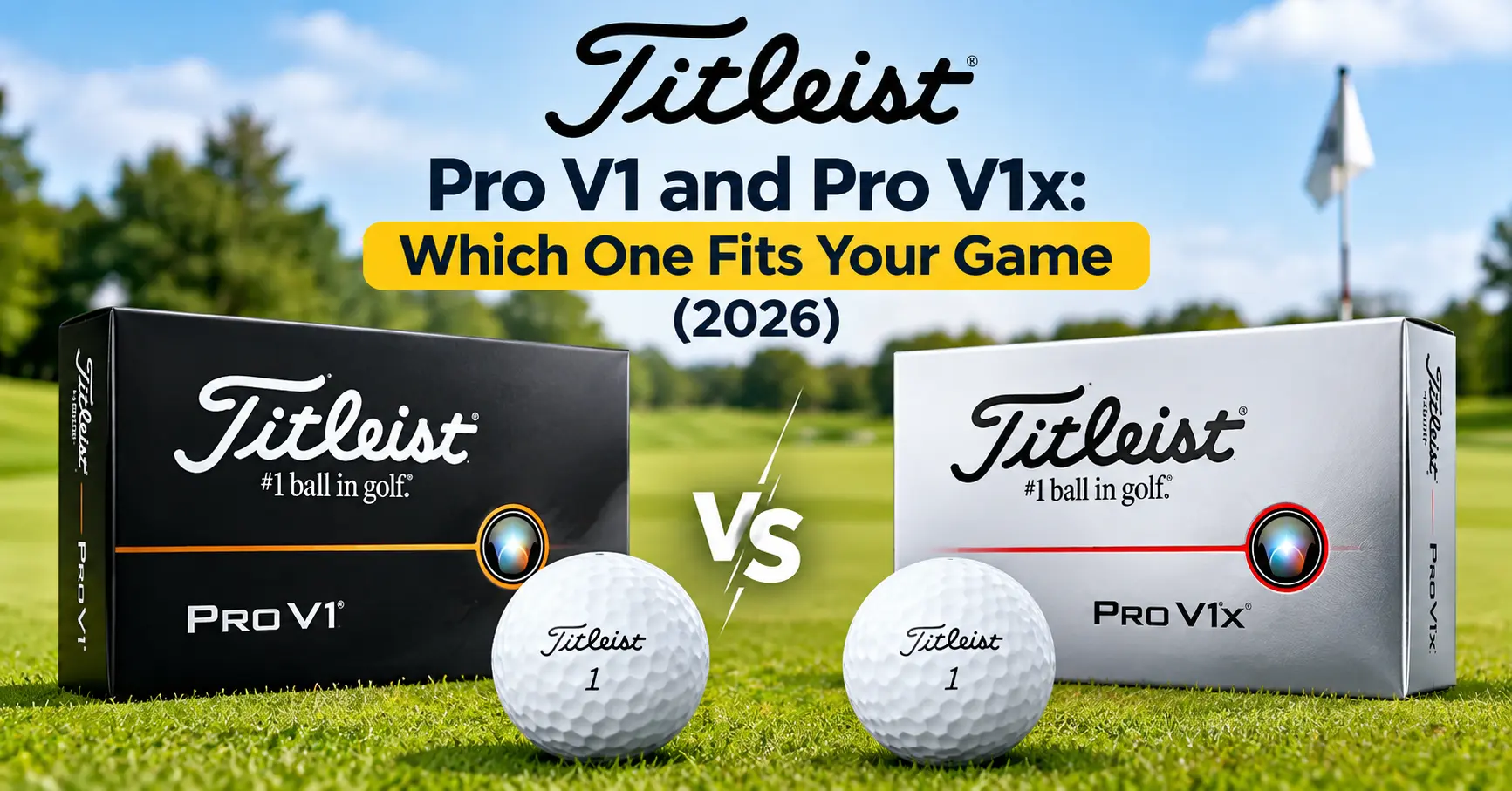
Quick Answer: The Pro V1 is softer (compression ~98) with a mid trajectory and less iron spin. The Pro V1x is firmer (~108) with higher flight and more wedge spin. Pick Pro V1 if you want a penetrating flight and soft feel. Pick Pro V1x if you need more height and stopping power on greens.
Two golf balls have dominated professional golf for a quarter century. Around 70% of tour players tee up one of them. Your club champion plays one. The guy who shoots 115 every Saturday plays one too, which tells you something important about how golfers choose equipment. They copy what works for the best players in the world without asking whether it works for them.
The Pro V1 and Pro V1x are not the same ball in different packaging. They’re built with different core constructions, different compression ratings, and different aerodynamic profiles. The performance gap between them is real, measurable, and worth understanding before you drop $55 on a dozen.
Here’s what nobody tells you upfront: the “best” ball in this family depends entirely on three things about your game. Your driver swing speed. Your typical ball flight. Where you lose the most strokes. Get those three answers right and the choice becomes obvious.
Pro V1 vs Pro V1x: The Short Answer (If You’re Standing in a Golf Shop Right Now)
The Pro V1 has a compression of approximately 98. The Pro V1x sits around 108. That 10-point gap is the engine behind everything else that’s different between them.
The Pro V1 flies lower with less spin on iron shots. The Pro V1x flies higher, spins more with irons and wedges, and feels firmer off the face. Off the driver, the two balls perform almost identically. Titleist’s own fitting data shows very little difference in driver spin between the models.
So the choice comes down to what happens after the tee shot. If you want a softer feel and a more controlled, penetrating flight through the wind, the Pro V1 is your ball. If you need help getting the ball in the air and stopping it on firm greens, the Pro V1x does that better.
One number that matters: on a 40-yard pitch shot, the Pro V1x produces about 260 rpm more spin than the Pro V1. That’s the difference between a ball that checks and a ball that releases.
The Real Difference: Compression, Construction, and Why Your Swing Speed Matters
Compression is the single most misunderstood number in golf ball marketing. Lower compression means the ball deforms more at impact, which generally produces a softer feel and can help slower swing speeds generate more ball speed. Higher compression balls need more clubhead speed to fully compress and unlock their performance.
Here’s the full spec comparison.
| Spec | Pro V1 | Pro V1x | Pro V1x Left Dash |
|---|---|---|---|
| Compression | ~98 | ~108 | ~108+ |
| Construction | 3-piece | 4-piece dual core | 4-piece dual core |
| Cover | Cast urethane | Cast urethane | Cast urethane |
| Dimples | 388 tetrahedral | 348 tetrahedral | 348 tetrahedral |
| Flight | Mid | High | High |
| Driver Spin | Low | Low | Very Low |
| Iron/Wedge Spin | High | Higher | Lower than Pro V1 |
| Feel | Soft | Firm | Firm |
| Best For | 90–105 mph driver speed | 95–110+ mph driver speed | 105+ mph, high-spin players |
| Price (per dozen) | $55–$58 | $55–$58 | $55–$58 |
Pro V1 Compression and Construction
The Pro V1 uses a solid core with a softer overall compression. Titleist engineers built it with a high-gradient core that’s soft in the center and firmer toward the outside. That gradient is what allows the ball to deliver low spin off the driver while still producing high spin on wedge shots. The cast urethane cover does the gripping work around the greens.
The 388 tetrahedral dimple pattern produces a mid-flight trajectory that holds up in wind. Fewer, larger dimples would create more lift and a higher flight. More, smaller dimples reduce drag for a more penetrating trajectory. Titleist chose the penetrating option for the Pro V1 because that’s what better players consistently ask for in fittings.
Pro V1x Compression and Construction
The Pro V1x takes a different approach. It uses a dual-core construction that produces a firmer overall compression. The outer core is firmer, which resists deformation at impact and keeps long-game spin low. The soft urethane cover sits on top of that firm core, which is the exact construction recipe that drives spin up on shorter shots.
Titleist’s own engineers explain it this way: a hard layer over a softer layer drives spin down. A softer layer over a firmer layer drives spin up. The Pro V1x is the second scenario. That’s why it spins more on iron and wedge shots despite having a firmer overall feel.
The 348 dimple pattern (40 fewer than the Pro V1) is designed differently to produce a higher flight. The dimples are larger, which generates more lift. That’s why the Pro V1x flies higher throughout the bag, not just on iron shots.
What Compression Actually Means for Your Game
A 90 mph driver swing speed player who picks the Pro V1x is leaving performance on the table. The ball won’t compress fully at impact, which means less ball speed and a firmer feel that doesn’t translate to useful feedback.
A 110 mph player who picks the Pro V1 might actually lose distance because the softer core deforms too much, producing excess spin that balloons the ball and kills carry. Titleist’s tour fitting examples prove this. Jake Knapp, a high-speed player who generates plenty of spin, plays the Pro V1 because he needs to control spin and optimize distance. Justin Thomas, who also swings fast, plays the Pro V1x because he wants to maximize spin and control. Same swing speed category, opposite ball choices, because their spin profiles are different.
Robot Testing Data: Where the Differences Actually Show Up on the Course
Today’s Golfer ran both balls through a $100,000 robot and tracked the data. The numbers tell a clearer story than any marketing copy.
Wedge Testing (40-yard pitch shot)
| Ball | Compression | Launch Angle | Backspin | Carry | Descent Angle |
|---|---|---|---|---|---|
| Pro V1 | 98 | 31.2° | 5,692 rpm | 39.9 yds | 36.7° |
| Pro V1x | 108 | 30.5° | 5,952 rpm | 39.1 yds | 35.7° |
The Pro V1x produced 260 rpm more spin on this shot. That extra spin is the difference between a ball that hops and stops and one that releases three feet past the hole. On firm greens in summer, that difference decides whether you’re putting for birdie or chipping again.
Iron Testing (7-iron at 80 mph swing speed)
| Ball | Ball Speed | Launch Angle | Backspin | Carry | Descent Angle |
|---|---|---|---|---|---|
| Pro V1 | 108.3 mph | 21.1° | 4,598 rpm | 155.3 yds | 44.9° |
| Pro V1x | 108.9 mph | 20.9° | 4,699 rpm | 155.8 yds | 45.1° |
The differences here are almost negligible. Half a yard of carry. 101 rpm more spin. Less than a quarter-degree of descent angle. If you’re picking between these two balls based on 7-iron performance alone, you’re splitting hairs.
Driver Performance
This is where the marketing gets misleading. Titleist’s own data shows “very little difference” off the tee between the two balls. Some players might see slightly more spin with the Pro V1x, but the two balls are effectively interchangeable off the driver for the vast majority of golfers.
The takeaway from the robot data: the Pro V1 and Pro V1x perform almost identically until you get inside 150 yards. That’s where the Pro V1x’s extra spin and higher flight actually matter. If your iron and wedge play is where you lose strokes, the Pro V1x has a measurable advantage. If you’re losing strokes off the tee, changing between these two balls won’t fix that.
The Complete Pro V1 Family: Where Left Dash Fits (And Why Most Golfers Should Ignore It)
Titleist makes three balls in the Pro V1 family. Most golfers know about two of them. The third, Pro V1x Left Dash, occupies a very specific performance window that only a small percentage of players should care about.
The Left Dash is the lowest-spinning ball in the family. It flies high like the Pro V1x but produces significantly less spin on full shots. Off the tee, it’s a low-spin bomber. Around the greens, it’s the firmest feeling ball Titleist makes.
| Spec | Pro V1 | Pro V1x | Left Dash |
|---|---|---|---|
| Feel | Soft | Firm | Very Firm |
| Flight | Mid | High | High |
| Driver Spin | Low | Low | Very Low |
| Iron Spin | High | Higher | Low |
| Wedge Spin | High | Highest | Moderate |
| Ideal Swing Speed | 90–105 mph | 95–110+ mph | 105+ mph |
| Ideal Player Profile | All-around | Needs height and stopping power | High-speed, high-spin player who needs to reduce spin |
Titleist’s own fitting team describes the Left Dash player this way: “When talking about Dash players, we’re not talking about the majority of players out there.” That’s the manufacturer admitting this ball isn’t for most people.
Here’s the honest take: if you’re not swinging a driver at 105 mph or faster, and if you’re not consistently fighting excessive spin that balloons your shots, the Left Dash will feel like a rock and perform worse than the standard Pro V1x for your game. It’s a specialist tool, not an upgrade.
Where Left Dash makes sense: a fast-swinging player who hits the ball miles but watches it climb and stall into the wind. Someone who plays firm, fast courses where low spin equals more rollout. A golfer who produces too much spin with a standard tour ball and needs to flatten it out.
If that’s not you, ignore the Left Dash. The standard Pro V1 or Pro V1x will serve you better.
Cost Per Round: What a $55 Golf Ball Actually Costs You
This is the section no golf ball comparison article includes. Pricing sits at $55 per dozen from Titleist directly, and $57.99 from most retailers. Some colorways and alignment markings push it to $65 or higher.
Here’s what that actually costs depending on how many balls you lose per round.
| Handicap Range | Typical Balls Lost Per Round | Cost Per Round | Cost Per 20 Rounds |
|---|---|---|---|
| Scratch (0–5) | 0.2 | $0.92 | $18.33 |
| Mid (6–12) | 0.5 | $2.29 | $45.83 |
| Higher (13–20) | 1.5 | $6.88 | $137.50 |
| Beginner (20+) | 3–4 | $13.75–$18.33 | $275–$366 |
A scratch golfer who loses a ball every five rounds pays less than a dollar per round for premium performance. That’s less than a Gatorade from the cart girl.
A 20-handicap who loses three balls a round is paying nearly $14 per round for golf balls. Over a season, that’s more than a new driver.
This isn’t an argument against playing Pro V1s. It’s an argument for being honest about your game. If you’re losing three balls a round, a $25-per-dozen ball that performs 90% as well will save you $200 a season. That’s a putter fitting or three lessons.
The Pro V1 and Pro V1x are worth the money if you can keep them in play. If you can’t, there’s no shame in playing a cheaper ball while you work on your swing. The scorecard doesn’t care what ball you used.
Which Ball Should You Actually Play? A Three-Question Decision Framework
Answer these three questions honestly and you’ll know which ball to buy.
Question 1: What’s your driver swing speed?
- Under 90 mph: Neither ball is optimal. Consider Titleist AVX or Tour Soft.
- 90–100 mph: Pro V1 is the better fit. You’ll compress it fully and get the soft feel without sacrificing performance.
- 100–110 mph: Both work. This is the overlap zone. Let questions 2 and 3 decide.
- 110+ mph: Pro V1x or Left Dash, depending on your spin profile.
Question 2: Do you need more height or more control?
- I hit the ball high already and want a more penetrating flight: Pro V1
- I struggle to get the ball airborne consistently: Pro V1x
- I want maximum stopping power on firm greens: Pro V1x
- I play in a lot of wind and want a flatter trajectory: Pro V1
Question 3: Where do you lose the most strokes?
- Off the tee: Neither ball will fix this. Spend the $55 on a lesson instead.
- Approach shots and wedges: Pro V1x. The extra spin translates directly to more birdie putts.
- Around the greens: Pro V1x for maximum check, Pro V1 if you prefer predictable release.
- Putting: Pro V1 for softer feel, Pro V1x if you prefer firmer feedback.
If you answered “Pro V1” to two or more questions, buy the Pro V1. If you answered “Pro V1x” to two or more, buy the Pro V1x. If you split them evenly, buy a sleeve of each and play nine holes with one and nine with the other. Your scorecard will tell you what a fitting can’t.
Who Should NOT Buy Either Ball (An Honest Admission)
Neither ball makes sense for every golfer.
If you’re a 20+ handicap who loses three or four balls per round, a $55-per-dozen ball is a luxury purchase, not a performance investment. The Pro V1’s spin characteristics don’t help you if you’re not making consistent center-face contact. A surlyn-covered ball at $20–$25 per dozen will perform nearly identically for your game while saving you $150–$200 per season.
If you’re a senior golfer with a driver swing speed under 85 mph, both balls are too firm for optimal performance. You’ll get more distance and a better feel from a lower-compression ball like the Titleist AVX or Tour Soft.
If you play mostly municipal courses with soft, slow greens, the Pro V1x’s extra spin is wasted. You don’t need stopping power on greens that already hold every shot. Save the money.
If you’re a beginner, the ball is the last thing you should spend money on. Lessons, a properly fitted driver, and practice time will lower your scores faster than any premium ball.
The honest truth: the Pro V1 and Pro V1x are the two best tour balls on the market. They’re also overkill for a significant percentage of golfers who buy them. Knowing which group you’re in is worth more than any robot testing data.
Frequently Asked Questions
Is Pro V1 or Pro V1x better?
Neither is objectively better. The Pro V1 suits golfers who want a softer feel and a more penetrating flight. The Pro V1x suits golfers who need higher flight and more spin on approach shots. “Better” depends entirely on your swing speed, typical ball flight, and where you lose strokes on the course.
What is the difference between Pro V1 and Pro V1x?
The Pro V1 has a compression of approximately 98 and a mid-flight trajectory. The Pro V1x has a compression of approximately 108 with a higher flight and more iron and wedge spin. The Pro V1x uses a dual-core construction while the Pro V1 uses a solid core. Off the driver, the two balls perform almost identically.
Is Pro V1x harder than Pro V1?
Yes. The Pro V1x has a firmer overall compression (~108) compared to the Pro V1 (~98) because of its dual-core construction. The firmer feel is noticeable off the putter and on partial wedge shots. However, both balls share the same soft cast urethane cover, so the difference in feel is more pronounced on full shots than around the greens.
Which ball spins more, Pro V1 or Pro V1x?
The Pro V1x spins more on iron and wedge shots. On a 40-yard pitch shot, the Pro V1x produces approximately 260 rpm more backspin than the Pro V1. Off the driver, the difference is negligible. Titleist’s fitting data shows very little difference in driver spin between the two models.
What swing speed do you need for Pro V1x?
The Pro V1x is best suited for golfers with a driver swing speed of 95 mph or higher. At lower swing speeds, the ball won’t compress fully at impact, resulting in less ball speed, a firmer feel, and reduced performance. Golfers with driver swing speeds between 90–105 mph are typically better fitted into the standard Pro V1.
The Bottom Line
The Pro V1 and Pro V1x are the two most validated golf balls in the history of the sport. Twenty-five years of tour wins, robot testing, and fitting data have proven they perform at the highest level. But “performs at the highest level” doesn’t mean “right for you.”
Pick the Pro V1 if you want a softer feel, a penetrating flight, and you’re comfortable trading a little spin on approach shots for control in the wind. Pick the Pro V1x if you need more height, more stopping power on greens, and you swing fast enough to compress a firmer ball. Ignore the Left Dash unless you’re a 105+ mph player fighting excessive spin.
And if you’re losing three balls a round, none of this matters. Buy a cheaper ball, take a lesson, and come back to the Pro V1 family when your swing deserves it.
If you’re still deciding between the Pro V1 family and other premium tour balls, our guide to best golf balls for iron height breaks down the alternatives.