
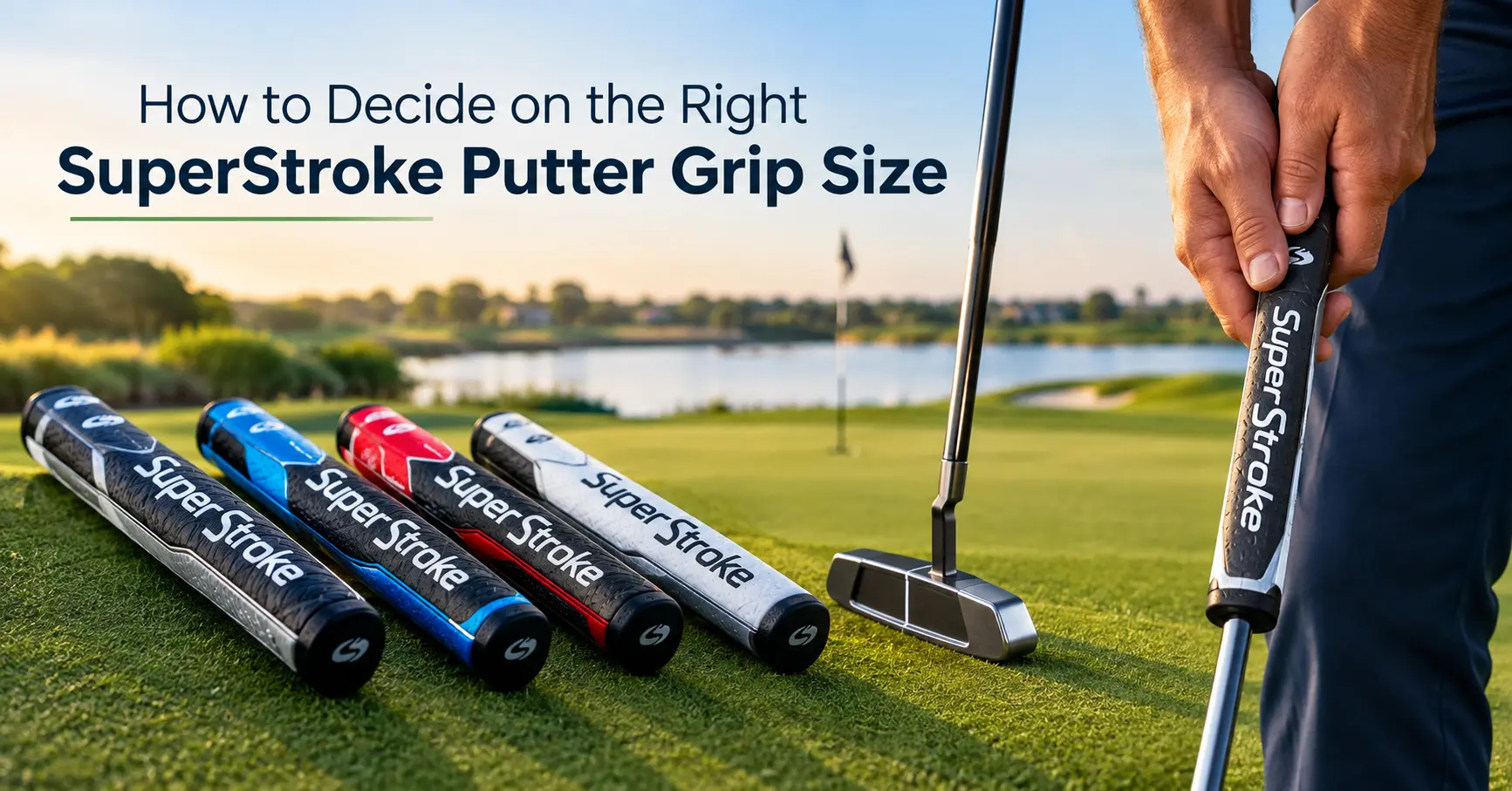
Quick Answer: Most golfers should start with the Mid Slim 2.0, which measures 1.20 inches across and sits in the middle of SuperStroke’s lineup. Golfers with an arcing stroke or smaller hands often prefer the 1.00-inch Ultra Slim 1.0, while golfers who want quieter hands and a straight-back-straight-through stroke usually move up to the 1.30-inch Slim 3.0 or the 1.67-inch Fatso 5.0. Test before you buy, since the 0.10-inch jumps between sizes feel bigger in your hands than they look on a spec sheet.
Reddit threads about SuperStroke sizing get thousands of views for a reason. Golfers keep asking “how did you decide” because SuperStroke has never published a simple inch-to-size chart on its own site, and every forum answer comes from a different guy’s hands, a different putter, and a different stroke. This guide replaces the guesswork with real diameters, real weights, and a decision framework for choosing your SuperStroke putter grip size. You’ll also get 2026 pricing, the installation steps, and the story behind why SuperStroke skipped straight from 3.0 to 5.0.
The SuperStroke Putter Grip Size Chart (Diameter, Weight, and 2026 Price)
Four numbers control almost every SuperStroke buying decision, and none of the major review sites lists all four side by side. Here’s the chart that actually matters.
| Size | Model Name | Diameter | Length | Weight | Core | Price (Traxion / Zenergy) |
|---|---|---|---|---|---|---|
| 1.0 | Ultra Slim / Tour 1.0 | 1.00″ | 10.50″ | 65g | 0.580″ | $14.99 / $34.99 |
| 2.0 | Mid Slim / Tour 2.0 | 1.20″ | 10.50″ | 50g | 0.580″ | $14.99 / $34.99 |
| 3.0 | Slim / Tour 3.0 | 1.30″ | 10.50″ | 55g-60g | 0.580″ | $14.99 / $34.99 |
| 5.0 | Fatso / Tour 5.0 | 1.67″ | 10.50″ | 90g | 0.580″ | $14.99 / $34.99 |
Every size shares the same 10.50-inch length and 0.580-inch core. Only the outer diameter and the weight change from size to size. That single fact answers half the questions buried in the Reddit thread that inspired this article, since golfers keep asking whether a bigger grip changes putter length or feel at the shaft. It doesn’t, and only the amount of material under your fingers changes.
Note the price gap. A standard Traxion Tour grip runs $14.99 at retailers like The GolfWorks, while the premium Zenergy Tour version with enhanced Spyne texturing and a Tech-Port for counterbalancing runs $34.99. Off The Truck 17-inch versions, the kind you’ll see on tour, run closer to $39.99. You’re paying more than double for texture and accessory compatibility, not for a different diameter.
Why SuperStroke Calls Its Sizes 1.0, 2.0, 3.0, and 5.0 (Not 1-2-3-4)
Nobody covers this, and it’s the single most-asked confusion point in every forum thread on this topic. SuperStroke’s original three grips launched as the Ultra Slim, Slim, and Fatso. In 2012, the company renamed them to match a new numbering system: Ultra Slim became the 1.0, Slim became the 3.0, and Fatso became the 5.0. A brand-new grip, sized between the two smallest options, filled the gap and took the name 2.0.
According to the company’s own director of marketing at the time, tour players kept asking for something thicker than the Ultra Slim but thinner than the Slim, so SuperStroke built exactly that and settled on a 1.2-inch diameter. A 4.0 was on the roadmap for the following year, but the number stuck around as a placeholder rather than a shipped product for a long time. That’s why you’ll find 1.0, 2.0, 3.0, and 5.0 grips on shelves today, with no 4.0 in the standard lineup. It’s not a typo, just a naming gap left over from a product decision made more than a decade ago.
What Actually Changes Between the SuperStroke 2.0 and the 3.0
This is the single most common size comparison SuperStroke buyers make, and it’s also the one most size-chart articles get vague about. Numbers settle it fast: the 2.0 measures 1.20 inches across, while the 3.0 comes in at 1.30 inches. That’s a 0.10-inch gap in diameter, which sounds tiny until you do the actual math.
Circumference, not diameter, is what your fingers wrap around. A 1.20-inch grip has a circumference of roughly 3.77 inches, and the 1.30-inch grip comes out to about 4.08 inches. That’s nearly a third of an inch more material for your fingers to close around on every single putt, and it’s the real reason golfers describe the jump from 2.0 to 3.0 as bigger than the spec sheet suggests.
Weight tells a similar story. The 2.0 comes in around 50 grams, while the 3.0 lands closer to 55 to 60 grams depending on which product line you buy. Slightly more mass at the top of the club changes swing weight and can make a putter feel more head-light. If your current putter already feels light in your hands, jumping to a 3.0 sometimes fixes that on its own, no lead tape required.
Measure Your Hand Before You Buy (Here’s the Honest Answer)
SuperStroke has never published a public chart that maps exact hand measurements to grip sizes. That’s not an oversight. It’s why the company built an interactive quiz on its own site instead of a static chart, since stroke type and personal feel preference override raw hand size more often than a chart alone can capture. Getting your SuperStroke putter grip size right starts with a tape measure, not a spreadsheet.
Here’s what you can measure yourself: place your hand flat on a table and measure the width across your knuckles, excluding your thumb. Golfers with narrower hands, generally under about three inches at the knuckle, tend to gravitate toward the 1.0 or 2.0, while wider hands usually settle into the 3.0 or 5.0. Treat this as a starting point, not a rule. Plenty of big-handed golfers happily game a 1.0 for the extra feel, and plenty of smaller-handed golfers can’t putt without the stability of a 3.0.
Your Stroke Type Changes the Right Size Too
Hand size gets all the attention, but stroke mechanics matter just as much, and almost nobody explains why. An arcing stroke opens and closes the putter face naturally through impact, relying on some hand and wrist rotation to square things up at contact. A thinner grip like the 1.0 or 2.0 lets that rotation happen without extra material fighting your hands.
A straight-back-straight-through stroke tries to keep the face square the entire way through, relying on the shoulders and arms instead of the hands. Thicker grips like the 3.0 and 5.0 quiet the smaller muscles in your hands and wrists, which is exactly what a straight-back-straight-through putter wants. If you already know which stroke type you use, that single fact narrows your grip choice faster than any hand measurement will.
Super Stroke Putter Grip Differences: Legacy, Traxion, and Zenergy Compared
Same size number, different generation, and the diameters genuinely shift between product lines. This trips up more buyers than anything else on this list.
The original Legacy series, also sold as the Slim series, set the numbers everyone still references: 1.00″, 1.20″, 1.30″, and 1.67″ for the 1.0 through 5.0. Traxion, the current mainline replacement, keeps those same core diameters but adds an updated surface texture called Traxion Control for better tack in wet conditions. Zenergy sits above both, adding Spyne Technology, a raised alignment ridge on the underside of the grip, and a Tech-Port that accepts SuperStroke’s CounterCore weight system.
Here’s the part that catches people out. Some Zenergy Tour 3.0 listings show a diameter closer to 1.23″ to 1.26″ rather than the classic 1.30″ Legacy number. Manufacturing tolerances and small profile tweaks between generations mean the same size label doesn’t always translate to the exact same feel across every SuperStroke product line. If you’re buying a matching replacement for a grip you already love, check the specific model name, not just the number.
The Best SuperStroke Putter Grip for Six Common Situations
There’s no single best SuperStroke putter grip size, but there is a best size for your specific situation. Here’s how I’d sort it.
Best all-around pick: the Mid Slim 2.0. It’s the size most golfers land on after trying two or three others, and it splits the difference between feel and stability better than any other size in the lineup. Full stop, it’s the safest first purchase SuperStroke sells.
Best for an arcing stroke: the Ultra Slim 1.0. Maximum feel, minimum interference, and it’s the closest SuperStroke gets to a traditional-feeling pistol grip.
Best for a straight-back-straight-through stroke: the Slim 3.0. It’s historically the most-played jumbo grip on the PGA Tour, and at just 55 grams in its newer Traxion version, it’s also the lightest jumbo grip SuperStroke makes.
Best for maximum wrist stability: the Fatso 5.0. If you’ve tried a 3.0 and still feel too much hand action, this is the next step up, not a repeat of the same fix. It isn’t for everyone. If you already play a fast, feel-based stroke, 90 grams of grip up top will fight you more than it helps.
Best for alignment-focused putters: the Flatso series. Lydia Ko games a SuperStroke Flatso grip on her Scotty Cameron Phantom 12, and the flat front surface locks your thumbs into a repeatable position at address the way a round grip can’t.
Best for chronic short-putt trouble: the WristLock, which runs three inches longer than a standard grip and locks the trail wrist through the stroke. It’s a different tool for a different problem. When a grip swap alone isn’t fixing what’s actually happening under pressure, it’s worth reading how one Tour pro solved that same problem with an entirely different piece of equipment, covered in our Lucas Glover WITB breakdown.
Super Stroke Putter Grip Counterbalance: How CounterCore Weights Work
CounterCore is SuperStroke’s back-weighting system, and almost nobody explains how it actually works. Grips with a Tech-Port, which includes most Zenergy, Traxion, and CounterCore-labeled models, accept a threaded weight that screws into the butt end of the grip. The Tour 1.0 is the one exception, since it doesn’t come with a Tech-Port at all.
Three weight options exist: 25 grams with a blue cap, 50 grams with a red cap, and 75 grams with a silver cap. Each one costs $9.99 and comes with the wrench you need to swap it. Adding mass to the butt end shifts your putter’s balance point back toward your hands, which further quiets wrist action on top of whatever the grip size itself is already doing. Golfers switching to a modern, lighter putter head sometimes lose the swing weight they were used to, and a CounterCore weight is a cheap, reversible way to get it back without regripping again.
How to Install a Super Stroke Putter Grip (Step-by-Step)
You don’t need a clubmaker for this. Here’s what actually works.
- Remove the old grip. Cut it away with a utility knife or hook blade, then peel off any leftover tape from the shaft.
- Clean the shaft. Wipe away old adhesive and grease with a rag and a bit of solvent, then let it dry completely.
- Apply new double-sided tape. Run it the length of the shaft, leave about half an inch hanging past the butt end, then twist that excess and tuck it into the shaft opening to seal it.
- Peel the tape backing. Remove the paper layer to expose the adhesive underneath.
- Coat the grip in solvent. Cover the vent hole with a finger, pour solvent inside the grip, swirl it around, then pour the excess out over the taped shaft.
- Slide the grip on fast. Solvent dries quickly, so push the grip all the way down to the butt end in one smooth motion.
- Align it before it sets. Square the SuperStroke branding and any alignment aid to your putter face while you still have a few seconds to adjust.
- Let it cure. Give it at least a few hours, though waiting the full 24 hours before you putt with it is the safer call.
The whole job takes about fifteen minutes once you’ve done it twice. Rushing step six is the only real risk, since solvent-coated tape only stays workable for a matter of seconds.
Frequently Asked Questions
How do I know what size putter grip to get?
Measure your hand width at the knuckles and think about your stroke type first. Narrower hands or an arcing stroke usually point toward a 1.0 or 2.0, while wider hands or a straight-back-straight-through stroke usually point toward a 3.0 or 5.0. Testing a demo in person still beats any chart, including SuperStroke’s own.
Which Super Stroke putter grip is best for me?
Start with the Mid Slim 2.0 if you have no strong preference yet. It’s the SuperStroke putter grip size most golfers settle on, and it gives you a useful baseline for judging whether you actually want something thinner or thicker.
What is the difference between SuperStroke 2.0 and 3.0 thickness grips?
The 2.0 measures 1.20 inches in diameter and the 3.0 measures 1.30 inches, a 0.10-inch gap that translates to roughly a third of an inch more circumference. Weight follows the same pattern, with the 3.0 landing slightly heavier, which can make a light-headed putter feel more balanced.
Do PGA Tour pros actually use SuperStroke putter grips?
Yes. SuperStroke users won 66 tournaments across golf’s major tours in 2025, including 25 PGA Tour wins worth more than $68 million in first-place money. Jordan Spieth, Justin Rose, and Patrick Cantlay are among the current tour players who game SuperStroke grips.
Can I put a SuperStroke grip on any putter?
Almost always, yes. SuperStroke grips fit any standard putter shaft using the same double-sided tape and solvent installation every other grip brand uses. The only real consideration is core size, and SuperStroke’s standard 0.580-inch core covers the overwhelming majority of putters on the market.
How much does a SuperStroke putter grip cost?
Standard Traxion Tour grips run $14.99, while premium Zenergy Tour grips with Tech-Port compatibility cost $34.99. CounterCore weights add another $9.99 each if you want to fine-tune the balance afterward.
The Bottom Line
Stop treating SuperStroke putter grip size like a mystery you have to crowdsource from Reddit. Measure your hand, figure out whether your stroke is arcing or straight-back-straight-through, and use the 2.0 as your baseline if you’re still unsure. The real differences between sizes are smaller in inches than you’d expect and bigger in feel than any spec sheet can capture, so a five-minute test at a local shop will tell you more than another hour of forum reading. If you’re rebuilding a full setup around your new grip choice, our Odyssey TRTL putter review covers how tour pros are pairing new grip sizes with entirely new putter heads this season.