
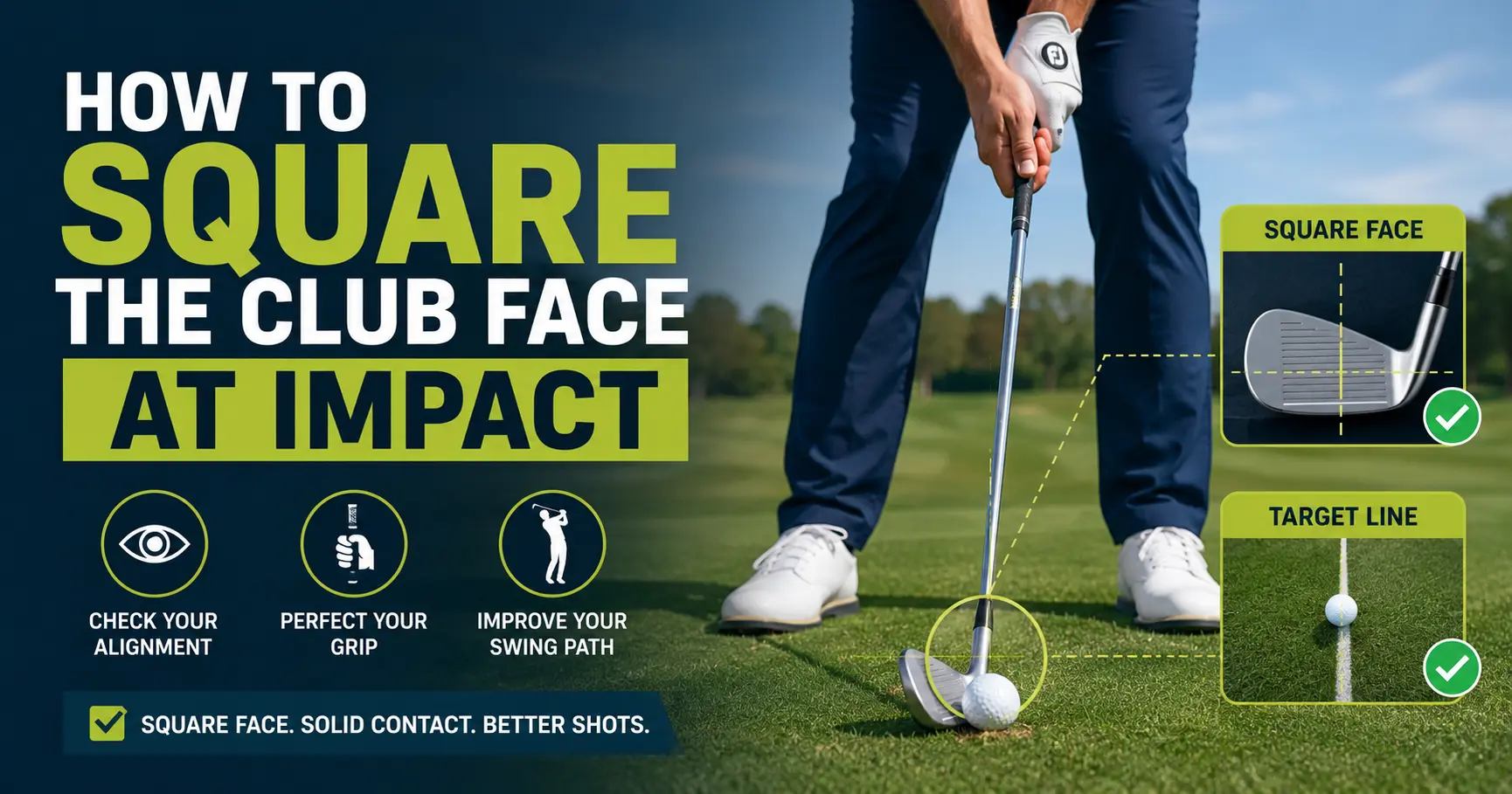
Quick Answer: A square club face at impact means the face points at your target the instant it strikes the ball. Face angle controls roughly 75 to 85 percent of your shot’s starting direction, not swing path. Stop timing a hand flip. Square the face early in the downswing, before your hands pass hip height.
Every golf instructor tells you to square the club face at impact. Almost none of them tell you exactly when to do it, and that gap is why the advice never sticks. Timing a hand flip in the last fraction of a second before contact isn’t a skill. It’s a guess, and guesses fall apart on the back nine once your grip pressure creeps up under pressure.
This guide skips the vague cues. You’ll get the specific checkpoints, the physics behind why face angle beats swing path for controlling direction, and five drills that help you square up the clubface by building it into your motion instead of bolting it on at the last second.
What “Square” Actually Means at Impact
In golf, a square club face at impact points directly down your target line the instant it meets the ball. Nothing more complicated than that. Confusion creeps in because golfers picture square at address, feet aligned, ball centered, and assume the face just needs to return to that same spot at the bottom of the swing.
It doesn’t work that way once the club starts moving. Your body rotates, your wrists hinge and unhinge, and the face changes orientation dozens of times between address and impact. The only position that actually matters is the one at the moment of separation, when the ball leaves the face. Everything before that is staging.
Trackman’s launch data settled an old argument in golf instruction. For decades, teachers taught that swing path set the ball’s starting direction and face angle only added curve. That’s backward. Face angle actually controls about 75 percent of a mid-iron’s starting direction and around 85 percent with a driver, according to Titleist’s own performance research.
Path barely gets a vote in that equation. That single fact should change how you practice. Spend an hour grooving your swing path while your face angle wanders five degrees open, and you’ll keep slicing no matter how good your path looks on a launch monitor. Fix the face first, and everything else gets easier once the ball starts where you’re aiming it.
The Real Reason You Can’t Square the Clubface
Most golfers who can’t square the clubface at impact aren’t missing strength or flexibility. They’re missing timing, and they’re trying to fix it at the worst possible moment.
The downswing lasts about a quarter of a second for most Tour pros, roughly a third of how long the backswing takes. That’s not enough time to consciously rotate your forearms, feel your hips, and square a clubface in sequence. Golfers who wait until the last instant to save the shot with their hands are gambling on a movement that has to happen faster than conscious thought allows.
Better players start the process much earlier. By the time their hands reach hip height on the way down, the toe of the club is already rotating toward the ball instead of pointing straight up at the sky. Wrist condition drives this more than grip or body rotation ever will.
A lead wrist stuck in extension, golfers usually call it cupping, keeps the face open no matter how well your hips clear. Flatten that wrist angle earlier in the transition, closer to flexed than extended, and the face arrives square without any hand manipulation at all.
Here’s the blunt version. If you’re still thinking about your hands anywhere near impact, you’ve already lost the rep. Square the face by hip height, then get out of the way and let your rotation finish the job.
How to Keep the Club Face Square on the Backswing
Most golfers never check their clubface position going back. They only think about it coming down, and that’s backward. A face that’s already twisted open at the top has to get rescued somehow on the way down, and rescues are unreliable.
The classic checkpoint says this: when the shaft reaches parallel to the ground on the backswing, the toe should point straight up. That checkpoint comes from an era of golf instruction built around a single swing plane, and it doesn’t hold up for every golfer.
Swing on a flatter, single-plane path (think Jim Hardy’s “one-plane” swing), and a toe pointing straight up at that checkpoint is actually open relative to your swing plane, not square. What matters more is whether the leading edge sits parallel to your spine angle rather than perpendicular to the ground. Stand up out of your posture with the club at that same parallel position and watch the face. A face that looks wide open once you stand tall was never square to begin with, no matter how it looked bent over the ball.
Not every golfer needs to obsess over this checkpoint. Leave your backswing alone if your ball flight is already straight and your strike is clean. This section matters most for golfers who slice consistently and have never once checked where their face points before the transition even starts.
Squaring the Face on a Driver vs. Irons
Golfers treat clubface control like one universal move. It isn’t. The setup differences between a driver and an iron change what squaring the clubface actually requires from you.
With irons, the ball sits closer to the center of your stance and the club approaches on a steeper angle of attack. Face angle controls roughly 75 percent of your starting direction here, and a slightly closed face relative to your path, a small draw bias, is often the safer miss because it usually keeps the ball in play short of the green. Squaring the clubface on irons rewards a hands-quiet release more than an aggressive one.
With a driver, everything stretches out. The ball sits forward off your lead heel, the swing arc is longer, and your angle of attack should be slightly upward rather than downward. Face angle jumps to roughly 85 percent of starting direction with a driver, and the geometry punishes small errors more than you’d expect.
A face that’s just 2 degrees open at impact starts your ball roughly 7 yards right of your target line by the time it reaches 200 yards, based on the angle alone, before any curve from swing path gets added on top. Keeping your driver head square at impact depends more on wrist condition than grip strength once the shaft gets this long, which is exactly why the same fault looks so much scarier off the tee.
If your miss is a hook with the driver but a fade with your irons, don’t assume you have two unrelated swing faults. You’re often making the same wrist error, just amplified by the driver’s longer shaft and shallower attack angle. We break down that exact pattern, including the setup fix for each club, in our guide to fixing a snap hook.
5 Drills to Square the Clubface
Skip the drills that just tell you to “feel” a square face. Feel is unreliable until you’ve built the pattern with feedback. The square club face drills below give you something to check against, not just a vibe to chase, and each one gets your club face square at impact through repetition rather than a swing thought you have to remember mid-round.
- The grip check. Take your normal grip and look down at your lead hand. You should see two knuckles, not three or four. Three or more means your grip is already strong enough to fight your face angle before you even take the club back.
- The alignment stick gate. Push two sticks into the ground just outside your clubhead width, one about six inches ahead of the ball and one behind it, both parallel to your target line. Swing through without clipping either stick. Clipping the back stick on your first few reps tells you your path runs too far in to out, which exaggerates any face issue you already have.
- The impact bag check. Hit into an impact bag or a folded towel at half speed and freeze on contact. Look down at the leading edge. A leading edge pointing anywhere other than square to your target line has found your fault in real time, instead of you guessing from ball flight after the fact.
- The split-hand drill. Take your normal grip, then slide your trail hand all the way down near the bottom of the shaft, several inches below your lead hand. Make slow half-swings and feel your trail hand actively rotating the clubhead through impact. This isolates the release your hands should feel once your body has already done its job.
- The stand-up test. From the top of your backswing, stop and stand up out of your posture without moving your arms. Look at the face. This confirms whether your backswing checkpoint from the previous section is actually square, not just square-looking bent over the ball.
Work through these in order once a week rather than trying all five in a single range session. Grooving one checkpoint properly beats half-grooving five of them. For a broader daily routine that reinforces the same feedback loop away from the range, our 6-minute swing drill routine covers three moves that build on exactly this foundation.
How to Fix a Closed or Open Clubface at Impact
If your club face is not square at impact, your ball flight already tells you which way it’s pointing. You don’t need a launch monitor to start the diagnosis, though one helps confirm it.
| Ball Flight Symptom | Likely Face Issue | First Checkpoint to Test |
|---|---|---|
| Starts left, keeps curving left (snap hook) | Face closed relative to path | Grip check (two-knuckle test) |
| Starts right, curves right hard (slice) | Face open relative to path | Hip-height wrist check |
| Starts left, fades back toward target | Face slightly closed, path more closed | Split-hand drill |
| Starts right, draws back toward target | Face slightly open, path more open | Alignment stick gate |
| Straight but weak, low flight | Face square but delofted inconsistently | Impact bag freeze check |
A closed face almost always traces back to a strong grip, a stalled lower body that forces your hands to rescue the shot, or both at once. An open face usually comes from the opposite problem, a weak grip or an upper body that outraces the lower body into impact. Test the grip first in either direction. It’s the fastest checkpoint on this list, and it rules out or confirms half of your possible causes in under a minute.
Frequently Asked Questions
How do you keep the club face square at impact?
Square the face early in your downswing, by the time your hands reach hip height, rather than trying to time a hand rotation right before contact. A neutral grip and a lower body that keeps rotating through impact do most of the work for you.
Why can’t I square my clubface at impact?
Almost always it comes down to timing, not talent. Golfers who wait until the last instant to square the face are asking their hands to make a correction in less time than conscious reaction allows. Fix the wrist condition earlier in the downswing instead.
What’s the best way to square the club face at impact?
Start earlier than feels natural. Square the face by the time your hands reach hip height on the way down, using the grip check and split-hand drill above to build the feeling, rather than manipulating your hands in the hitting zone.
How do you fix a closed club face at impact?
Check your grip first. Three or more knuckles visible on your lead hand at address means your grip is too strong and pre-sets the face closed. Rotate your hands slightly toward a neutral position and recheck.
How do you keep the club face square on the backswing?
Stop trusting the toe-up checkpoint on its own. Stand up out of your posture with the club at the parallel position and look at the face directly. A face that’s wide open once you’re upright was open the whole time.
Is squaring the clubface different for a driver than for irons?
Yes. Face angle influences roughly 85 percent of a driver’s starting direction against about 75 percent with irons, so the same face error costs you more distance offline with the longer club in your hands.
Final Word
Getting a square club face at impact isn’t a hand trick you time at the last second. It’s the result of a grip that doesn’t fight you, a wrist condition that flattens early in the downswing, and a lower body that keeps rotating instead of stalling out. Test your grip today before you touch anything else, then work through the drills above in order. If your miss shows up specifically off the tee, our full downswing framework for hitting driver straight walks through the setup and separation sequence in more depth.