
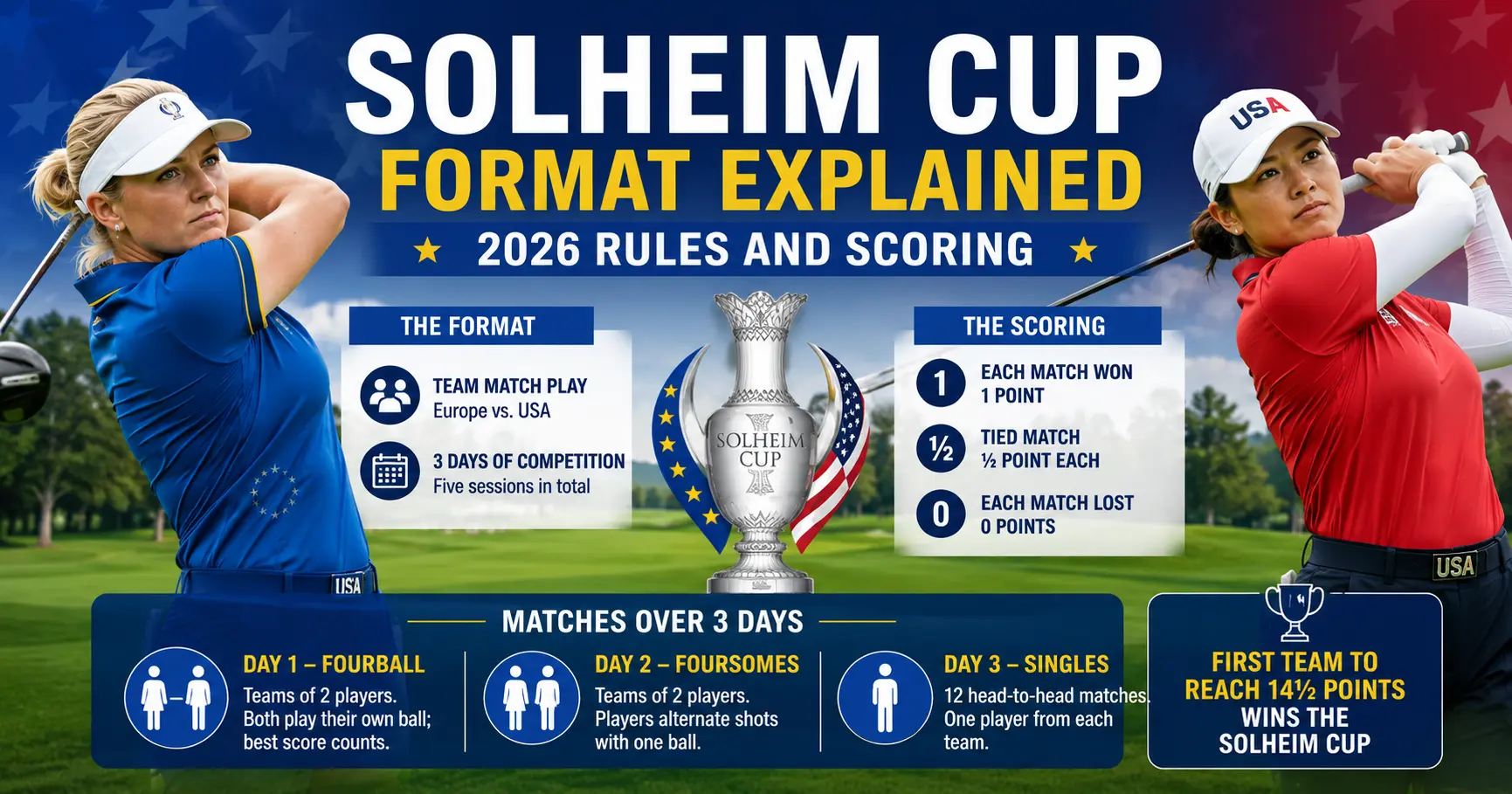
Quick Answer: The Solheim Cup is three days of match play between 12-player teams from the U.S. and Europe. Days 1 and 2 each carry a morning session of foursomes (alternate shot) and an afternoon session of fourball (better ball), eight points a day. Day 3 is 12 singles matches worth one point each, for 28 total. A team needs 14.5 points to win the Cup outright, or 14 points to retain it as the reigning champion if the match finishes tied.
Angela Stanford finalized her U.S. Solheim Cup roster on August 24. Anna Nordqvist locked in her European side a few weeks before that. In under two weeks, both teams head to Bernardus Golf in the Netherlands for the 20th Solheim Cup, and every player already knows exactly how the next three days will unfold, because the format itself hasn’t changed since 2002.
Here’s the skeleton: 12 players a side, three days, 28 points, two different pairs formats before Sunday’s singles take over. First team to 14.5 points wins outright. The defending champion only needs 14, because a tie breaks in their favor.
That’s the short version. The rest of this breaks down exactly how the sessions are built, what actually happens if the score ties, how the format got to 28 points in the first place (it wasn’t a straight line), and how the current U.S. and European teams qualified for this specific Cup.
How the Three Days Break Down
| Day | Session | Format | Matches | Points |
|---|---|---|---|---|
| Day 1 (Friday) | Morning | Foursomes or fourball | 4 | 4 |
| Day 1 (Friday) | Afternoon | Whichever format didn’t play in the morning | 4 | 4 |
| Day 2 (Saturday) | Morning | Foursomes or fourball | 4 | 4 |
| Day 2 (Saturday) | Afternoon | Whichever format didn’t play in the morning | 4 | 4 |
| Day 3 (Sunday) | All day | Singles | 12 | 12 |
Eight of the 12 players on each team take part in every foursomes or fourball session, meaning four players sit out each time. Nobody sits on Sunday. All 12 players from each team tee off in singles, whether or not the Cup has already been decided.
One detail that trips people up: the home captain decides which format goes in the morning and which goes in the afternoon, and that order can flip between Day 1 and Day 2. So a team might play foursomes first thing Friday and fourball first thing Saturday. Nothing forces the same sequence twice.
Foursomes, Fourball and Singles: What Each Match Actually Looks Like
Foursomes, also called alternate shot, pairs two golfers on one ball. They alternate every stroke, and they alternate who tees off by hole, not by who played the previous shot best. One bad tee shot and your partner is playing your recovery, whether she wants to or not.
Fourball, also called better ball, is more forgiving. Both players in the pair play their own ball all the way to the hole, and the lower of the two scores counts for the team on that hole.
Singles strips the partner away entirely. One American against one European, straight match play, no one to lean on.
All three are scored the same underlying way: whoever wins more holes wins the match, and the match ends the moment the outcome is mathematically settled, so a 3-and-2 result means the match stopped after 16 holes because one side was already unbeatable. If a match is still level after 18, it’s halved, and each team banks half a point.
Here’s an editorial note worth sitting with: alternate shot has historically been the format where Team USA has struggled hardest at this event. Entering the 2023 matches, the Americans had won the Friday morning foursomes session outright only five times in Solheim Cup history. It’s a small, specific data point, but it tells you something real. Pairing two golfers on one ball rewards a very particular kind of chemistry, and it’s not automatically the strength of whichever team has the better individual players.
Scoring, Ties, and the Difference Between Winning and Retaining the Cup
Every match is worth one point. Win it, take the point. Halve it, split the point. Lose it, get nothing. Twenty-eight matches, 28 points, no exceptions.
To win the Solheim Cup outright, a team needs 14.5 points. To retain it as the reigning champion, 14 is enough, because in the event of a 14-14 tie, the Cup stays with whoever already held it.
That rule sounds abstract until you see it play out. In 2023 at Finca Cortesin in Spain, the U.S. and Europe finished dead level at 14-14, the first tie in the event’s history. Europe kept the Cup anyway, not because they scored better on the day, but because they’d won the previous edition in 2021 and a tie changes nothing about who’s holding the trophy. The U.S. arrived at Bernardus in 2024 needing 14.5 points specifically because they were the ones trying to take the Cup away, and a tie would have done them no good at all. They got 15.5 and settled the question outright.
How the Format Has Changed Since 1990
The 28-point, three-day structure feels permanent, but it took over a decade to settle into its current shape, and it wasn’t quite a straight climb.
| Years | Foursomes | Fourball | Singles | Total Points |
|---|---|---|---|---|
| 1990 | 4 | 4 | 8 | 16 |
| 1992 | 4 | 4 | 10 | 18 |
| 1994 | 5 | 5 | 10 | 20 |
| 1996–1998 | 8 | 8 | 12 | 28 |
| 2000 | 8 | 6 | 12 | 26 |
| 2002–2024 | 8 | 8 | 12 | 28 |
| 2026 (scheduled) | 8 | 8 | 12 | 28 |
Most format explainers state that 28 points has been the number since 1996 and leave it there. It’s close, but not quite right. The 2000 matches at Loch Lomond were actually played for 26 points, with two fewer fourball matches than the surrounding years, before the format locked in permanently at 28 starting in 2002. It’s a minor footnote in the event’s history, but it’s the kind of detail that gets flattened when everyone copies the same “since 1996” shorthand without checking it against the actual scores from that year.
Worth a separate flag: the Solheim Cup’s own official results page currently lists the 1996 score as USA 9, Europe 7, which doesn’t add up to the 28-point format already in place that year and doesn’t match independent reporting of a 17-11 American win at St Pierre. We’ve used 17-11 here, since it’s the figure that’s both internally consistent with the format and corroborated elsewhere, but it’s worth knowing the two numbers don’t currently agree if you go looking at the source yourself.
How Players Qualify for the 2026 Teams
Both teams built their 12 players through the same basic shape: a points or ranking list that closes automatically, followed by captain’s picks to fill out the roster.
Team USA: nine players qualified automatically through the U.S. Solheim Cup points list and the Rolex Women’s World Golf Rankings, with the window closing after the CPKC Women’s Open on August 23. Angela Stanford added three captain’s picks the next day.
| Player | How she qualified |
|---|---|
| Nelly Korda | Automatic (points list, World No. 1) |
| Angel Yin | Automatic (points list) |
| Jennifer Kupcho | Automatic (points list) |
| Yealimi Noh | Automatic (points list) |
| Auston Kim | Automatic (points list, rookie) |
| Lauren Coughlin | Automatic (points list) |
| Allisen Corpuz | Automatic (points list) |
| Andrea Lee | Automatic (world ranking) |
| Alison Lee | Automatic (world ranking) |
| Megan Khang | Captain’s pick (5th Solheim Cup) |
| Rose Zhang | Captain’s pick (3rd Solheim Cup) |
| Lindy Duncan | Captain’s pick (rookie) |
Lilia Vu, Lexi Thompson, Lucy Li and Jenny Bae were all in the conversation but missed the final cut.
Team Europe: eight players qualified automatically through the LET Solheim Cup points list and the Rolex Rankings, with the window closing after the AIG Women’s Open. Anna Nordqvist added four captain’s picks.
| Player | How she qualified |
|---|---|
| Charley Hull | Automatic |
| Lottie Woad | Automatic |
| Maja Stark | Automatic |
| Celine Boutier | Automatic |
| Carlota Ciganda | Automatic |
| Linn Grant | Automatic |
| Esther Henseleit | Automatic |
| Nanna Koerstz Madsen | Automatic |
| Leona Maguire | Captain’s pick |
| Julia Lopez Ramirez | Captain’s pick |
| Nastasia Nadaud | Captain’s pick |
| Mimi Rhodes | Captain’s pick |
The 2026 Solheim Cup at a Glance
This year’s matches run September 11–13 at Bernardus Golf in Cromvoirt, the Netherlands, the tournament’s first visit to the country. Angela Stanford leads the defending champions after the U.S. won 15.5-12.5 in Virginia in 2024. Anna Nordqvist captains a European side trying to win the Cup back on home continent soil, and trying to do what no European team has managed since 2015: beat the Americans on European ground.
Through the 19 matches played so far, the U.S. leads the series. Most current reporting puts it at 11 wins, 7 wins, and 1 tie, which is the version used throughout this article since it’s corroborated by several independent sources and adds up cleanly against the official scores. You’ll also see the record written as “11-8” in places, including on parts of the official Solheim Cup site and Wikipedia’s summary line, a phrasing that folds the 2023 tie into Europe’s side of the ledger instead of listing it separately. Both versions describe the exact same 19 contests. It’s just a difference in how the tie gets counted, not a disagreement about what happened.
FAQs
Who is the captain of the U.S. Solheim Cup team in 2026?
Angela Stanford. This is her first Solheim Cup as captain, though she played in six of them and served as a U.S. assistant captain during the 2024 win at Robert Trent Jones Golf Club.
What are the current standings for the U.S. team in the 2026 Solheim Cup?
There’s no longer a standings race to track. The U.S. qualification period closed after the CPKC Women’s Open on August 23, 2026, and Angela Stanford named her three captain’s picks the following day. The full 12-player roster is finalized, with Nelly Korda, Angel Yin, Jennifer Kupcho, Yealimi Noh, Auston Kim, Lauren Coughlin and Allisen Corpuz qualifying through the points list, Andrea Lee and Alison Lee through the world ranking, and Megan Khang, Rose Zhang and Lindy Duncan added as captain’s picks.
What is the 3-3-3 format in golf?
It isn’t part of the Solheim Cup. “3-3-3” is a term used mainly in club and society tournaments, where an 18-hole round is split into separate segments (often in blocks of three, six or nine holes), and each segment is scored as its own standalone match or format rather than one continuous round. It’s a scorecard-management convention for member events, unrelated to the professional foursomes/fourball/singles structure covered above.
Is there a female Ryder Cup?
Yes, effectively, though there are two answers depending on the level. On the professional side, the Solheim Cup has served as the women’s equivalent of the Ryder Cup since 1990, pitting the LPGA’s best Americans against the Ladies European Tour’s best Europeans in the same three-day, match-play structure. On the amateur side, the Curtis Cup has done the same job even longer, running since 1932 between the United States and Great Britain & Ireland specifically (not the full continent of Europe), organized jointly by the USGA and The R&A.
Whatever else changes between now and September 13, the format itself won’t. Twelve players a side, three days, 28 points, and a Sunday singles session that’s decided plenty of these matches before the last group even reaches the back nine.