
| Ball condition | Typical loss | Result |
|---|
- Nothing saved yet — change an input and your history builds here.
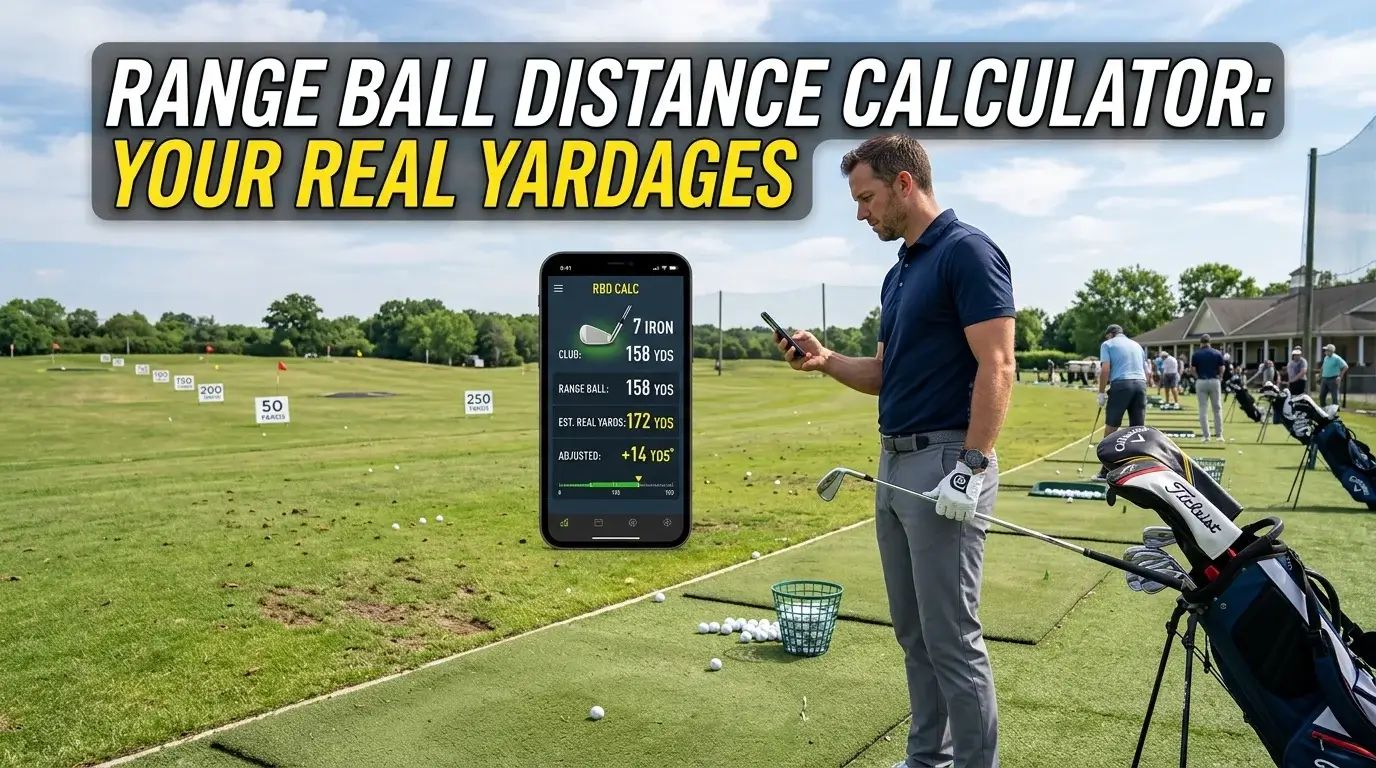
Range balls carry roughly 5% to 10% shorter than a premium urethane ball, and worn or limited-flight balls can lose 12% to 20%. A range ball distance calculator converts what you see on the range into what the ball will actually do on the course, adjusting for your club, the condition of the bucket, and the air you are playing in.
What a range ball distance calculator actually tells you
A range ball distance calculator answers one question: the ball you just hit 150 yards on the range, what would your gamer ball have done from the same swing?
That gap matters because most golfers build their yardages in the wrong place. You hit a hundred 7-irons off a mat with striped Surlyn balls, decide the club goes 150, then leave three approach shots short all summer.
Range balls are built to survive thousands of impacts and trips through a ball washer. That means a firm ionomer or Surlyn cover over a hard core, rather than the soft urethane cover and multi-layer construction of a Titleist Pro V1, TaylorMade TP5 or Callaway Chrome Soft.
The result is lower ball speed at the same clubhead speed, a lower launch angle, and more spin off the driver and long irons. Lower speed and higher spin both cost carry. If you want the fuller picture of how construction drives feel and speed, our golf ball compression chart breaks down what compression actually does to your numbers.
How the Madknows range ball distance calculator works
The tool sits at the top of this page and updates as you type. There is no submit button and no page reload.
- Direction. Convert a range number into a course number, or work backwards and predict what your on-course yardage will read on the range.
- Distance. Enter your average carry with that club, not your career-best shot.
- Club. Longer clubs lose more raw yards, so the model scales the penalty by club.
- Ball condition. Four options, from premium-brand range balls in good shape through to purpose-built limited-flight balls.
- Playing conditions. Optional altitude, temperature and wind inputs, because a 150-yard shot in Denver in August is not a 150-yard shot in Chicago in April.
You also get a comparison table showing all four ball conditions at once, a sourced tour benchmark for the club you selected, a shareable link that pre-fills every input, and a running history of your last five calculations. Switch between yards and meters with one tap.
The formula, explained step by step
Nothing here is hidden. The calculation runs in five stages.
Step 1 — Start with the base loss for the ball. Each ball condition carries a headline distance penalty drawn from published testing: 5% for premium-brand range balls in good condition, 8% for a standard range ball, 12% for old, scuffed or waterlogged balls, and 20% for limited-flight balls.
Step 2 — Scale it by club. A driver depends almost entirely on ball speed, so it takes the full penalty. Wedges are launched high and land steep, so the raw yardage swing is smaller. The club factor runs from 1.00 at the driver down to 0.85 at the lob wedge.
Step 3 — Remove the loss. Because your range number is the reduced number, the tool divides rather than multiplies: course distance = range distance ÷ (1 − working loss).
Step 4 — Apply the air. Altitude adds about 2% per 1,000 feet. Temperature shifts carry about 0.7% per 10°F away from a 70°F baseline, which is roughly the 2 yards per 10°F rule of thumb on a driver. Headwind costs about 1% per mph; tailwind gives back about 0.5% per mph.
Step 5 — Round sensibly. Distances come back as whole yards or meters, because nobody plays to a tenth of a yard.
A fully worked example
Say you are a mid-handicapper hitting 7-irons on a range in Phoenix. The bucket is standard yellow-striped range balls, the launch monitor on the bay says your average carry is 150 yards, and it is 95°F. The range sits at 1,100 feet, and there is no wind.
- Standard range ball base loss: 8%.
- 7-iron club factor: 0.90. Working loss = 8% × 0.90 = 7.2%.
- 150 ÷ (1 − 0.072) = 161.6 yards.
- Altitude of 1,100 feet adds 2.2%: 161.6 × 1.022 = 165.2 yards.
- At 95°F, you are 25 degrees above baseline, so add 1.75%: 165.2 × 1.0175 = 168 yards.
Your “150-yard 7-iron” is an 168-yard club in those conditions with your gamer ball. That is not a rounding error. That is the difference between a birdie putt and a plugged lie in the back bunker.
Now run the same shot in 45°F air at sea level and the answer drops to about 158 yards. Same swing, same club, ten yards apart. This is why a single number written on your yardage book is never the whole story something we go into in more depth in our golf club distance chart by skill level.
What launch monitor testing actually shows
The 5% to 10% figure is not folklore. It comes from repeatable testing on tracked launch monitors and on course.
GOLF.com ran range balls against premium balls on a Foresight GC Quad and recorded 168.7 mph ball speed and 298 yards with the premium ball, against 162.7 mph and 280 yards with the range ball. Launch dropped from 11.7° to 10.23°, and spin rose from 2,470 rpm to 2,628 rpm. Lower, slower, spinnier: three separate distance killers stacked on one shot.
Golf Digest tested a plus-handicap player on course and found a smaller gap, about 6 yards with the driver and a touch over 3 yards with a gap wedge. MyGolfSpy’s robot testing found range balls spun roughly 250 rpm more off the driver and between 600 and 1,800 rpm more off an 8-iron, while spinning about 800 rpm less on 55-yard wedge shots.
That last finding is the one nobody talks about. Range balls do not just fly shorter, they behave backwards around the greens: less spin on the shots where you need it most.
| Ball condition | Typical distance loss | What you notice |
|---|---|---|
| Premium-brand range ball, good condition | About 5% | Close to your gamer ball on full swings; wedge spin still reads low |
| Standard range ball | About 8% | Roughly a club short on mid-irons |
| Old, scuffed or waterlogged | About 12% | Ballooning flight, erratic dispersion, unusable for gapping |
| Limited-flight range ball | About 20% | Built to fly short; distributor specs commonly quote 80% to 90% of normal flight |
Sources: GOLF.com / Foresight GC Quad testing, Golf Digest on-course testing, MyGolfSpy robot testing, and published distributor specifications for reduced-flight range balls.
One honest caveat. Sources disagree on whether the driver or the wedge suffers the larger percentage loss. The raw yardage loss is unquestionably biggest with the driver, simply because 8% of 280 yards is far more than 8% of 100 yards. The percentage picture is muddier, and the calculator’s club factor reflects a considered middle position rather than false precision.
Benchmark carry distances by club and skill level
Use these to sanity-check whatever the calculator gives you. Every row below is a published dataset, not an estimate.
| Club | PGA Tour clubhead speed (mph) | PGA Tour ball speed (mph) | PGA Tour spin (rpm) | PGA Tour carry (yards) |
|---|---|---|---|---|
| Driver | 115 | 171 | 2,545 | 282 |
| 3-Wood | 110 | 162 | 3,663 | 249 |
| 5-Wood | 106 | 156 | 4,322 | 236 |
| Hybrid | 102 | 149 | 4,587 | 231 |
| 3-Iron | 100 | 145 | 4,404 | 218 |
| 4-Iron | 98 | 140 | 4,782 | 209 |
| 5-Iron | 96 | 135 | 5,280 | 199 |
| 6-Iron | 94 | 130 | 6,204 | 188 |
| 7-Iron | 92 | 123 | 7,124 | 176 |
| 8-Iron | 89 | 118 | 8,078 | 164 |
| 9-Iron | 87 | 112 | 8,793 | 152 |
| Pitching Wedge | 84 | 104 | 9,316 | 142 |
Source: TrackMan PGA Tour averages.
For amateurs, the 2026 Arccos Driving Distance Report puts the average male golfer at 224.1 yards off the tee, with 0 to 4.9 handicaps averaging 244 yards and 30-plus handicaps at 181 yards. Shot Scope data puts 7-iron carry at 170 to 185 yards for scratch to 4 handicaps, 145 to 165 for 5 to 14 handicaps, 125 to 145 for 15 to 24 handicaps, and 105 to 125 for 25-plus.
Those datasets do not agree with each other to the yard, and that is fine. Treat them as bands, not targets.
Who this is for, on and off the course
- Anyone building a yardage book. Convert your range numbers before you write anything down.
- Golfers checking gapping. If two clubs go the same distance on the range, they will still go the same distance on the course. The calculator tells you where those distances actually sit.
- Players at a new elevation. A trip from Florida to Colorado changes everything; run your bag through the altitude field before the first tee.
- Winter and early-spring practice. Cold air and cold balls flatter nobody. Knowing you are 8 yards down on a 7-iron stops you from re-gripping your swing for no reason.
- Anyone about to get fitted. Turn up with realistic expectations about what your numbers mean.
Seven things that change your result
1. Ball construction. Two-piece Surlyn over a hard core loses speed off the face compared with a multi-layer urethane ball. The standard golf ball size of 1.68 inches and 1.62 ounces is fixed by the rules, but what is inside the cover is not.
2. Wear. Worn dimples ruin the boundary layer that keeps a ball flying. A scuffed range ball balloons and falls out of the sky short.
3. Water. Range balls that have sat in a pond or a wet ball washer absorb moisture and go dead. This is the single biggest variable at a poorly-run range.
4. Limited-flight design. Some ranges deliberately buy balls with shallow dimple patterns or reduced compression so shots stay inside a short field. These are not comparable to anything you play.
5. Mats versus turf. Mats let a fat strike skid into the ball and flatter your distance. Compare a mat number to a fairway number and you are already lying to yourself before the ball is involved.
6. Air density. Altitude, temperature and humidity all change how much air the ball has to push through. Thin, warm air flies further.
7. Loft and setup. Modern strong lofts move distance between clubs without moving it into your bag. Our guide to golf club lofts covers why a 7-iron is not a fixed thing.
| Condition | Adjustment used by the calculator | What that means on a drive |
|---|---|---|
| Altitude | About +2% per 1,000 feet | Roughly 28 extra yards at 5,000 feet |
| Temperature | About ±0.7% per 10°F from 70°F | Roughly 2 yards per 10°F |
| Headwind | About −1% per mph | Roughly 28 yards into a 10 mph wind |
| Tailwind | About +0.5% per mph | Roughly 14 yards downwind at 10 mph |
Sources vary on these coefficients; the figures above sit in the middle of published USGA, TrackMan and Titleist guidance and are best treated as ranges.
Common mistakes golfers make with range yardages
- Using your best shot as your number. Your 7-iron distance is your average carry, not the one you flushed while nobody was watching.
- Measuring total distance instead of carry. Roll on a range field is nothing like roll on a summer fairway or a wet green surround.
- Trusting the yardage signs. Most range markers are approximate, and many are measured to the front of the target rather than the middle.
- Assuming the loss is the same across the bag. A driver can drop 20-plus yards while a sand wedge drops three.
- Judging wedge spin off range balls. Range balls spin less on short shots, so your chipping and pitching feedback is actively misleading.
- Getting fitted with range balls. Any fitting that does not use premium balls is fitting you to a ball you will never play.
How to get more out of a bucket of range balls
Practice the skill, not the number. Range balls are perfectly good for grooving strike, start line and tempo. They are poor for setting yardages and worse for judging spin.
Carry three of your own balls. Hit them at the end of the session, on the same target, and note the difference. That personal delta beats any model, including this one.
Check strike quality first. A distance problem is usually a centeredness problem. Foot spray or impact tape costs almost nothing and tells you more than any calculator.
Look at spin, not just carry. If your range monitor shows a 7-iron spinning under 5,000 rpm, that is the ball talking, not your swing.
Calibrate on the course. Two rounds of noting actual carry numbers with your gamer ball will outperform ten range sessions for building a yardage book.
Limitations, and when to see a PGA professional
This tool is a model built on published averages. It does not know your angle of attack, your smash factor, your dispersion, or the specific balls your range bought this season.
Two golfers with the same 7-iron carry can have very different spin and launch profiles, and the range ball penalty will not hit them equally. TrackMan’s launch angle data shows how much variation exists even among tour players.
See a PGA professional or a qualified club fitter if your gapping has a hole in it, if one club is wildly inconsistent, or if you are choosing between shafts. A fitting with premium balls on a quality launch monitor gives you data this page never can.
On the rules side, ordinary range balls stamped “Practice” are usually conforming and legal to play, but purpose-built limited-flight balls and X-outs often are not. The USGA’s revised ball testing guidelines set the Overall Distance Standard at 317 yards plus a 3-yard tolerance, with revised test conditions taking effect in January 2030.
Disclaimer: the figures here are estimates for practice and course-management purposes. They are not a substitute for a professional club fitting, and equipment purchases should be based on your own tested data.
Frequently asked questions
Do range balls go shorter than normal golf balls?
Yes. Launch monitor testing consistently shows range balls carrying less than premium balls from the same swing. GOLF.com’s Foresight GC Quad test recorded 280 yards with a range ball against 298 yards with a premium ball off the driver. The gap comes from lower ball speed, lower launch and higher long-club spin.
How much shorter do range balls go?
Roughly 5% to 10% for range balls in reasonable condition. Premium-brand range balls sit near the 5% end, standard striped balls around 8%, and old, scuffed or waterlogged balls can lose 12% or more. Purpose-built limited-flight balls are designed to travel only 80% to 90% of normal distance, and some far less.
Why do range balls fly lower?
Range balls have firmer covers and harder cores than premium balls, which reduces ball speed and lowers launch angle at the same clubhead speed. Worn dimples make it worse by disrupting airflow. Testing has recorded launch dropping from 11.7 degrees with a premium ball to 10.23 degrees with a range ball off the driver.
Are range balls the same as regular golf balls?
No. Most range balls are one or two-piece constructions with Surlyn or ionomer covers built for durability, not performance. Premium balls use multi-layer construction with a soft urethane cover for speed and greenside spin. Balls stamped “Practice” by a manufacturer are the exception and differ only cosmetically.
Are range balls conforming under the Rules of Golf?
Most ordinary range balls are conforming and can be played in a normal round unless there is strong evidence they are not. Balls stamped “Practice” are conforming. Limited-flight range balls, X-outs and refurbished balls are frequently non-conforming, and a committee may require play with balls from the Conforming Ball List.
Why do range balls spin more?
Firmer covers and worn surfaces increase spin on full driver and iron shots. MyGolfSpy’s robot testing measured roughly 250 rpm more driver spin and between 600 and 1,800 rpm more 8-iron spin with range balls. Extra spin on long clubs costs carry by making the ball climb rather than travel forward.
Do range balls affect the driver or the wedges more?
The driver loses the most raw yards, because a percentage loss applied to 280 yards is far bigger than the same percentage applied to 100 yards. Wedges suffer differently: range balls spin roughly 800 rpm less on short shots, so distance holds up while greenside control disappears entirely.
What are limited-flight range balls?
They are practice balls deliberately built to travel short, using shallow dimple patterns or reduced compression so shots stay inside a small range field. Distributor specifications commonly quote around 80% to 90% of normal flight, though some designs go far shorter. They are useless for setting yardages and generally non-conforming.
Should I add yards to my range numbers when setting my yardages?
Yes, but calculate rather than guess. Run each club through the range ball distance calculator above using your average carry and the actual condition of the balls. Then verify on the course with your gamer ball across two rounds. Range-derived yardages should always be treated as a starting point.
Do range balls mess up a club fitting?
Badly. Range balls produce lower ball speed, lower launch and different spin, so a fitter optimising loft and shaft around those numbers is optimising for a ball you will never play. Any credible fitting uses premium balls, ideally the model you actually game, on a quality launch monitor.
Bottom line
The bucket lies to you, and it lies consistently. A range ball distance calculator turns that consistent lie into a usable number, so the 7-iron you have been calling 150 yards gets written into your book as the 162-yard club it really is.
Run every club through the tool once, note the deltas, then confirm them on the course with your own ball. Pair that with a realistic view of where you sit against the average score for your handicap and you will stop leaving approach shots short.