
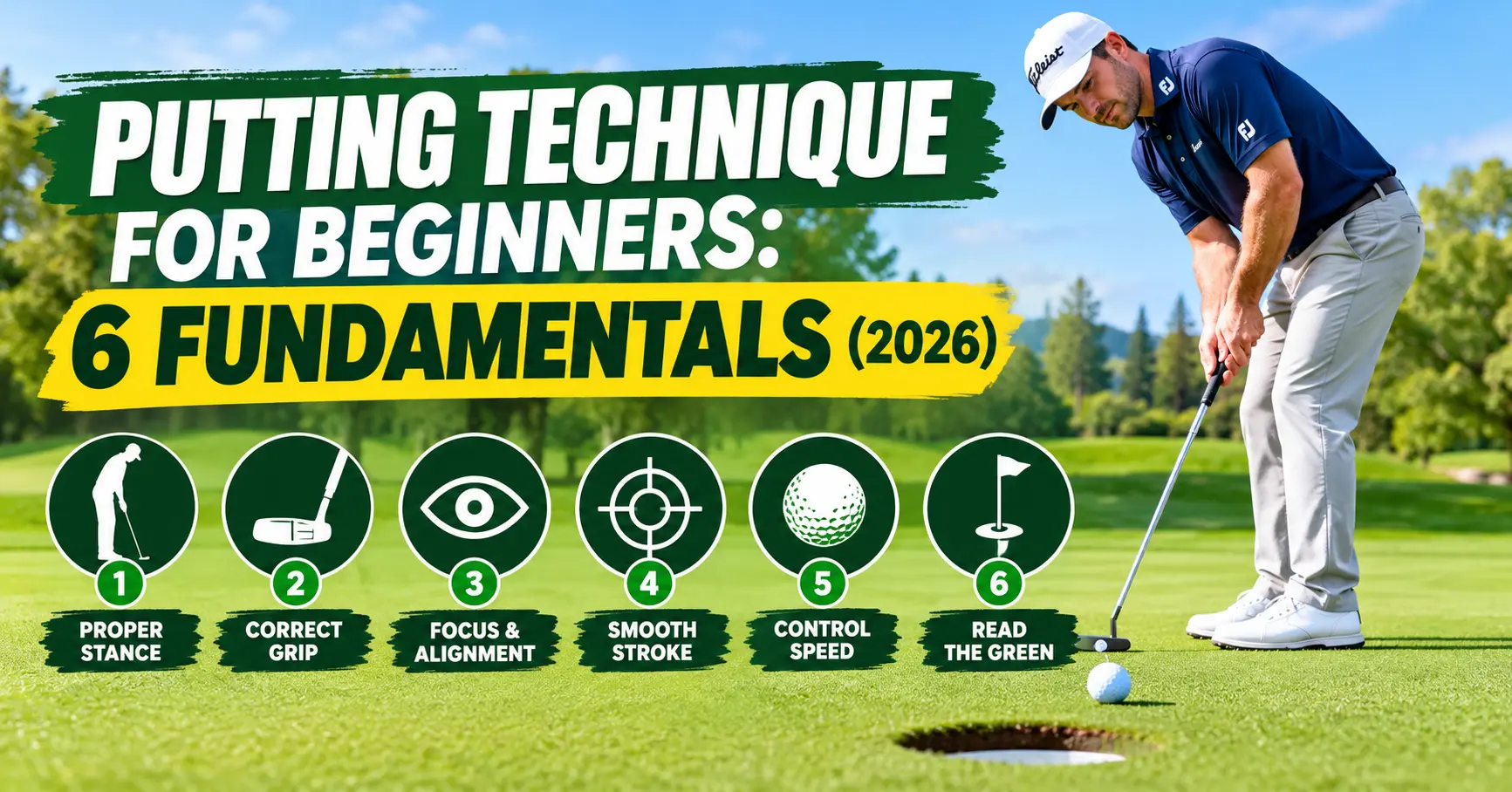
Quick Answer: The best putting technique for beginners combines four things: a light, neutral grip, eyes positioned over or just inside the ball, a shoulder-driven pendulum stroke with almost no wrist movement, and a backstroke length that matches the putt’s distance. Get those four right and three-putts drop fast.
Most beginners lose more strokes on the green than anywhere else on the course, and almost none of them know it. You can hit a decent drive and still shoot 105 because you three-putted six greens. Fix your putting technique first.
It’s the cheapest, fastest way to knock strokes off your score, and you don’t need a new set of irons or six months on the range to do it. This guide covers the putting technique for beginners that actually works: grip, stance, stroke, and drills. It also covers a few things most beginner guides skip entirely, seniors’ putting, short putts, and the actual rule on grip anchoring.
Why Putting Is the Fastest Way to Drop Strokes as a Beginner
Putting typically accounts for somewhere around 40 percent of the strokes in a full round, more than any single club in your bag gets you credit for. Skip a lesson on the driver and you might lose a few yards. Skip putting entirely and you’ll bleed four, five, six strokes a round without ever noticing where they went.
PGA Tour pros currently average under 28 putts per round, according to PGA Tour stats. Most beginners land closer to 38 to 42, and that gap has almost nothing to do with talent. It comes down to a handful of repeatable habits: grip, setup, and a stroke that doesn’t fall apart under a hint of pressure.
Here’s the part nobody tells beginners: you don’t need a better putter to close that gap. You need better technique, and that’s free. Once you’ve tightened up your putting, our guide to what counts as a good score at your level is worth a look, because putting is usually the fastest lever you can pull to move up a tier.
The Putting Grip for Beginners: 3 Legal Styles (and the One to Start With)
The best putting grip for beginners is almost always the conventional reverse-overlap, and here’s why that surprises people: most beginners grip a putter exactly the way they grip a 7-iron, which is the first mistake. A full-swing grip is built to release the clubface through impact. A putting grip does the opposite. It keeps the face dead square and takes your wrists almost completely out of the stroke.
Start with the conventional reverse-overlap grip. Place your lead hand on the grip first, thumb running straight down the top of the shaft. Set your trail hand below it, then lay the index finger of your lead hand over the pinky of your trail hand instead of interlocking. Both thumbs stay flat on top of the grip.
This is the grip most tour players use, and it’s the easiest one to build consistent feel with early on.
Grip pressure matters more than grip style. Hold the putter like you’re holding a tube of toothpaste with the cap off, firm enough that it doesn’t twist in your hands, light enough that nothing squeezes out. Too tight and you lose all feel for distance. Too loose and the putter face twists on off-center hits.
| Grip Style | How to Set It Up | Best For | USGA Legal? |
|---|---|---|---|
| Conventional (reverse overlap) | Lead hand thumb down the shaft, trail hand below, lead index finger over trail pinky | Most beginners, the most straightforward feel | Yes |
| Cross-handed (left-hand low) | Trail hand goes on top, lead hand goes below it, reversing the standard order | Golfers who push putts right or whose lead wrist breaks down at impact | Yes |
| Claw | Lead hand grips normally, trail hand pinches the grip from the side, palm facing the target | Golfers fighting the yips or too much wrist action in the stroke | Yes, as long as it isn’t braced against the body |
The claw grip looks strange the first time you try it, but for anyone who fights a jabby, wristy stroke, it’s the fastest fix in golf.
One equipment note while we’re here. Start with a mallet putter, not a blade. The larger head forgives off-center strikes far better while your stroke is still developing.
Grip pressure: how light is too light?
A useful benchmark: on a scale of 1 to 10, where 10 is a death grip, most good putters sit around a 3 or 4. If your knuckles ever turn white, you’ve gone too far. If the putter feels loose enough to wobble in your hands before you even start the stroke, you’ve gone too light.
Is the claw grip legal for beginners?
Yes, and it’s worth knowing why, because the rule surprises a lot of new golfers. USGA Rule 10.1b bans anchoring, holding the club or your gripping hand directly against your body, or bracing a forearm against your torso to create a fixed pivot point. The rule explicitly allows the claw grip, the cross-handed grip, and the standard grip, according to the USGA’s own guidance on Rule 10.1b.
What it doesn’t allow: propping the butt end of a long putter against your chest or chin, or pinning your forearm to your stomach to create a stable pivot point. Break that rule in stroke play and it costs you two strokes, every time.
Setup and Stance: Where the Ball Should Actually Sit
This is putting technique basics 101: ball position, eye line, stance width, nothing exotic. Set the ball just forward of center, roughly in line with the logo on your shirt if you’re right-handed. This lets you catch the ball on a very slight upstroke instead of hitting down on it, which produces a cleaner roll off the face.
Check your eye position with a simple test. Get into your putting stance, then drop a ball from the bridge of your nose. Wherever it lands is roughly where your eyes sit relative to the ball. For most golfers, directly over the ball or an inch inside it works best.
Here’s the honest limitation nobody mentions: dominant eye varies from golfer to golfer, and a small share of players actually putt better with their eyes slightly inside the ball rather than directly over it. Don’t force a textbook position if it makes the ball look blurry or doubled. Trust what you actually see over what a diagram says you should see.
Keep the rest simple. Feet, hips, and shoulders run parallel to your target line. Knees stay softly flexed, not locked. Weight sits evenly on both feet, not leaning toward your toes or heels.
The Putting Stroke for Beginners: Building a Repeatable Pendulum
A good putting stroke comes from your shoulders rocking back and through, not your wrists flicking at the ball. Think of the putter as the bottom of a pendulum hanging from a point between your shoulders. Your arms and the putter shaft move together as one piece.
Tuck an alignment stick or a rolled-up towel under both armpits and across your chest, then make some practice strokes. If the stick falls out, your arms have separated from your body, usually because a wrist has taken over. Keep the stick in place and you’ve found the motion you’re after.
Match your backstroke length to your forward stroke. A stroke that goes back six inches and follows through two looks like a jab, and it kills your distance control before you’ve even made contact. Keep the tempo even. Some coaches suggest counting “one” on the backswing and “two” on the strike, and it’s a genuinely useful trick for beginners who tend to rush.
This is the same shoulder-driven principle behind a solid full swing, just on a smaller scale. If you want to see how it carries over to your driver and irons, our guide on starting your backswing with a shoulder turn breaks down the same idea for the full swing.
How to Make More Short Putts (Inside 6 Feet)
Short putts decide more rounds than anyone wants to admit. These are the golf putting tips for short putts that actually move a make percentage, not just feel-good advice.
PGA Tour pros make somewhere around 99 percent of their putts from three feet, but that number falls off a cliff fast, down near 71 percent from six feet, according to tracked PGA Tour data reported by Golf.com. If the best putters in the world miss nearly 3 in 10 from six feet, you will too, and that’s fine.
The technique fix that helps most beginners: accelerate through the ball instead of decelerating into it. A putt that dies at the hole almost always comes from a stroke that decelerates through impact, and decelerating strokes miss left or right far more often than they miss long or short. Keep your backstroke short on these putts and let the putter accelerate naturally through contact.
Pick a spot a few inches in front of the ball, directly on your target line, and roll the ball over that spot instead of staring at the hole. It’s a small trick, but it narrows your focus down to something you can actually control.
Putting Tips for Seniors: What Actually Changes
Golf putting tips for seniors usually focus on comfort, not mechanics, and that’s the right instinct. The stroke fundamentals covered above don’t change with age. What often changes is grip strength, wrist mobility, and how comfortable a deep, hunched-over posture feels for an entire round.
If your hands ache from gripping a standard putter grip, try an oversized grip. Most run about 1/16 to 1/8 of an inch larger in diameter than a standard grip, and that extra surface area lets you hold the putter securely with far less squeezing. Less grip tension means more feel, which means better distance control.
Stand a little taller at address if a deep bend bothers your back or hips. You can let your eyes sit just inside the ball rather than forcing the classic directly-over-the-ball position. If reaching the ball comfortably is still a stretch, ask a fitter about a putter half an inch to a full inch longer than standard, which usually runs 33 to 35 inches off the rack.
Not every senior golfer needs any of this. Plenty of players in their seventies putt beautifully with a standard grip and a standard-length putter. Try the standard setup first, and only reach for the oversized grip or the longer putter if something about the conventional setup is genuinely uncomfortable, not because you assume you need it.
5 Best Putting Tips for Seniors, At a Glance
- Switch to an oversized grip if your hands ache during a round.
- Stand a touch taller instead of forcing a deep bend.
- Let your eyes sit slightly inside the ball if that feels more natural.
- Ask about a putter a half inch to a full inch longer than standard.
- Keep the stroke mechanics exactly the same. Age doesn’t change the pendulum.
4 Putting Drills for Beginners You Can Do in 10 Minutes
These aren’t just putting drills for beginners to kill time on the practice green. They’re putting tips to hole more putts that you’ll feel working within a week.
- The Gate Drill. Push two tees into the green about an inch and a half wider than your putter head, just in front of the ball. Putt through the gate without clipping either tee. Clip a tee and you know your face wasn’t square at impact.
- The Clock Drill. Place four balls around the hole at three, six, nine, and twelve o’clock, each about three feet out. Putt all four before you move on. This builds real confidence on the putts that actually decide your score, the short ones.
- The One-Ball, Two-Putt Drill. Drop a ball anywhere on the practice green, at least 20 feet from the hole, and try to finish the hole in two putts. This is closer to real course pressure than hitting the same putt over and over from one spot.
- The Eyes-Closed Drill. Set up over a 6-foot putt, take one last look at the hole, then close your eyes and make your stroke. Guess where the ball finished before you look. This feels ridiculous the first time you try it. It’s also one of the fastest ways to develop real touch.
Once these four feel automatic, our full putting distance control system walks through a more advanced setup checklist and three drills built specifically around lag putting and speed control.
Your First Practice Session: A 20-Minute Plan
The closest thing to the easiest putting technique ever is the plain pendulum stroke covered above, repeated until it’s automatic. There’s no easy putting technique that skips the reps entirely, but twenty focused minutes gets you further than an hour of aimless practice. Here’s exactly how to spend that first session.
- Minutes 0-5: Grip and setup. Take your grip, check your ball position, and hit 10 putts from three feet with zero focus on anything but a square face at contact.
- Minutes 5-10: The Gate Drill. Set up the tee gate and hit 15 putts through it. Don’t count makes. Count clean strikes through the gate.
- Minutes 10-15: The Clock Drill. Work the four three-foot putts around the hole. Make all four before moving on, even if it takes a few extra minutes the first time.
- Minutes 15-20: Lag putts. Hit five putts from 25 to 30 feet with one goal only: leave every single one within three feet of the hole.
Do this three times a week for a month and you’ll notice the difference on the course before you notice it in your practice stats.
5 Best Putting Tips for Beginners (Quick Reference)
Putting technique for beginners boils down to five things you can actually remember on the course.
- Grip it light. Aim for a 3 or 4 out of 10 on the pressure scale, not a death grip.
- Get your eyes over the ball. Use the nose-drop test to check, then trust what you see over the textbook position.
- Rock your shoulders, not your wrists. The putter should feel like the bottom of a pendulum, not a flick.
- Match backstroke to distance. A longer putt needs a longer backstroke at the same tempo, not a harder hit.
- Practice with a purpose. Ten minutes of the Gate Drill and the Clock Drill beats an hour of aimless putting on the practice green.
Frequently Asked Questions
What is the best putting technique for beginners?
The best technique combines a light, neutral grip, eyes positioned over or just inside the ball, and a shoulder-driven pendulum stroke with almost no wrist movement. Match your backstroke length to the putt’s distance instead of hitting harder, and you’ll control distance far better within a few sessions.
How do you grip a putter as a beginner?
Start with the conventional reverse-overlap grip: lead hand on top, thumb down the shaft, trail hand below it with your lead index finger resting over your trail pinky instead of interlocking. Keep the pressure light, around a 3 or 4 on a 10-point scale. If your stroke feels wristy or inconsistent, try the claw grip instead.
How many putts per round should a beginner expect?
Most beginners take somewhere between 38 and 42 putts per round, compared to under 28 for PGA Tour pros. That gap closes fast once you fix grip, setup, and stroke length, and it has far less to do with talent than most new golfers assume.
What is the easiest putting technique to learn?
The straight-back-and-through pendulum stroke is the easiest technique for a beginner to learn, because it only asks your shoulders to move and takes your hands and wrists almost entirely out of the equation. Most golfers build a repeatable version of it within a few practice sessions.
How can seniors improve their putting?
Seniors usually benefit most from an oversized grip that reduces hand tension, a slightly taller setup that eases strain on the back, and occasionally a putter half an inch to a full inch longer than standard. The stroke mechanics themselves don’t need to change with age.
What putting drills help beginners the most?
The Gate Drill and the Clock Drill deliver the fastest results for most beginners. The Gate Drill builds a square putter face at impact, and the Clock Drill builds confidence on the short putts that decide most amateur rounds. Ten focused minutes on each beats an hour of unstructured practice.
Putting Technique for Beginners: Where to Go From Here
Good putting isn’t complicated. It’s a light grip, a square setup, a shoulder-driven stroke, and a backstroke that matches the length of the putt. Master those four things first. Green reading, AimPoint, and tour-level speed control can all wait.
That’s the complete rundown of golf putting tips for beginners we’d actually stand behind, not just the ones that sound good in a listicle. Start with the Gate Drill and the Clock Drill this week, and once the fundamentals feel automatic, dig into our full putting distance control system for the next level of speed and lag-putt control.