
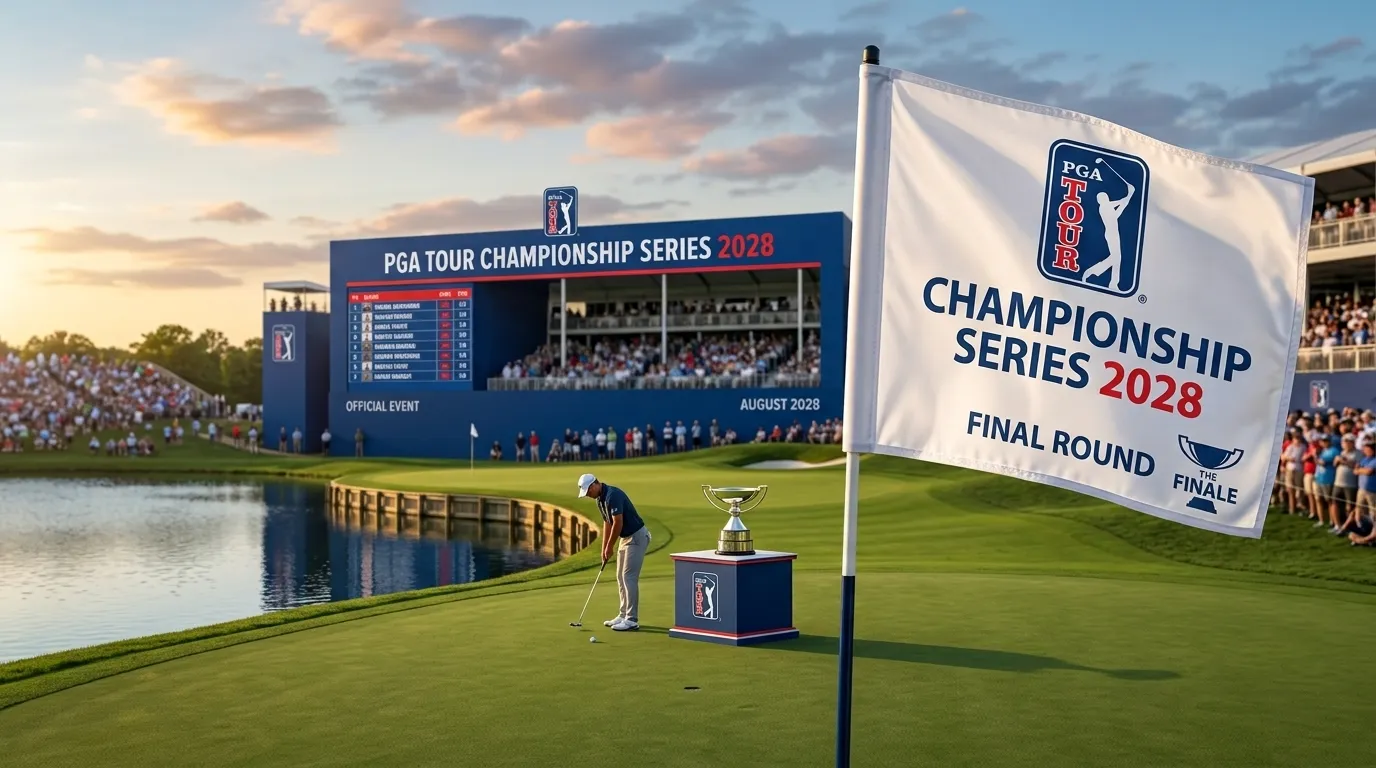
Quick Answer: The PGA Tour Championship Series launches in 2028 as the tour’s new top tier: roughly 23-24 events, 120-player fields, $20 million minimum purses, and a 36-hole cut to the top 65. The top 90 finishers keep their card each year; everyone else risks relegation to the Challenger Series below them.
I’ve had the Tour Championship blocked out on my calendar every Labor Day weekend for more than a decade, so when the PGA Tour announced it was tearing up that entire format, I spent the better part of a week reading every press release, staff FAQ, and policy-board transcript I could find. Starting in 2028, the tour splits into two tiers, and where a player lands depends entirely on how he played the year before. No sponsor exemptions. And no favors.
No gray area, in other words and that’s the whole point of the redesign. This piece pulls together everything confirmed as of July 2026, flags what’s genuinely still unresolved, and answers the questions I had myself the first time I read the announcement.
What Is the PGA Tour Championship Series?
The PGA Tour Championship Series is the new top competitive tier of the PGA Tour, replacing today’s single-tour model starting with the 2028 season. The PGA Tour’s policy boards approved it in June 2026, acting on recommendations from the Future Competition Committee the group that also included Tiger Woods and former Chicago Cubs executive Theo Epstein and it sits above a second tier called the PGA Tour Challenger Series.
Roughly 130 players will hold Championship Series status in a given year, playing a full slate of $20 million-purse events with 120-player fields and a 36-hole cut. CEO Brian Rolapp, who becomes full PGA Tour commissioner on January 1, 2027 when Jay Monahan steps down, put it bluntly: golf’s “amazing tradition of meritocracy” had slipped, and the tour built this model specifically to restore it.
That’s not just marketing language it’s an actual design constraint. Every mechanism in the new system, from removing sponsor exemptions to eliminating Monday qualifiers on the top tier to the hard cutoff at 90 players, exists specifically to make status something a player earns with a scorecard, not a phone call. It’s worth remembering just how far above recreational golf that scorecard sits our guide to what a golf handicap actually means explains why a Rory McIlroy or Scottie Scheffler would carry something like a +8 to +10 index if the tour bothered to calculate one, a tier under 1% of golfers ever reach.
How the New Two-Tier System Actually Works
Picture three columns side by side: where the tour stands today, and where the two new tiers land once 2028 arrives. That comparison is the one thing missing from every official release the tour has put out so far, so here it is, sourced straight from the numbers the tour has already confirmed.
| Category | Current PGA Tour | Championship Series (2028+) | Challenger Series (2028+) |
|---|---|---|---|
| Regular-season events | ~35, split signature/full-field | 15 regular season + majors, Players, Tour Champ., team event | 20+ |
| Field size | 120-156, varies by event | ~120, no alternate list | ~144, adjustable for daylight |
| Minimum purse | Signature events ~$20M, others far lower | $20 million every event | $4 million every event |
| 36-hole cut | Yes, most events, top 65 and ties | Yes, top 65 and ties | Yes, top 65 and ties |
| Sponsor exemptions | Several per event | None | None (Monday qualifiers remain) |
| Points system | Single FedExCup points list | Separate, series-only points | Separate, series-only points |
| Path to the other tier | N/A one tour | Locked out of Challenger events entirely | Up via 2 wins in a season or a major title |
| Season shape | Jan-Aug regular season + playoffs | ~Feb-Aug | Concurrent, incl. ~7 events in Championship Series off-weeks |
Two rows are worth sitting with. First, purses aren’t just higher on the Championship Series they’re uniform. Every single regular-season event pays a minimum of $20 million, which erases the two-class system that’s existed on tour for years between signature events and everything else.
Second, the points systems don’t talk to each other anymore. A win on the Challenger Series earns Challenger Series points, full stop it doesn’t nudge a player’s Championship Series status unless that win is one of two in a season, or unless it happens at a major. That’s a much harder wall than the flexible priority-ranking system the tour runs today.
The 2028 Schedule: What’s Locked In and What’s Still a Guess
The tour has already locked in ten of the expected fifteen regular-season Championship Series events, according to its own release. The other five are open, and the tour has been explicit about where it’s looking.
Boston, Denver, New York, Philadelphia, San Francisco, Seattle, and Washington, D.C. make up the seven markets the official announcement names outright. ESPN’s Mark Schlabach later reported Chicago is in the mix too, which tracks given the market’s size and its total absence from the current signature-event rotation.
Sentry has already signed on as title sponsor at Torrey Pines outside San Diego, an early signal of how sponsors are pricing in the new $20 million purse floor. Layer in the four majors, THE PLAYERS Championship, the Ryder Cup or Presidents Cup (alternating years), and the reimagined TOUR Championship, and the season stretches to 23-24 events between February and August. The tour also bolts on the Men’s Olympic Golf Competition for 2028 specifically, since it’s an Olympic year.
I’d bet on the tour opening 2028 with a marquee West Coast venue in primetime. Pebble Beach or Riviera both fit the profile the tour has telegraphed so far.
Which new markets are actually in play?
The tour hasn’t locked any of this in. It has said publicly it’s still finalizing which five events fill the final regular-season slots, and it has promised the complete 2028 schedule for the first quarter of 2027, not this year. Treat any single new-market prediction, including mine, as informed guessing rather than fact until that schedule drops.
Promotion and Relegation, Explained Like You Already Understand Relegation
If you’ve ever followed European football, you already understand the shape of this system. Rory McIlroy’s public reaction after the announcement centered on “putting the fans first” no small thing from arguably the sport’s biggest star, signing off on a structure that could just as easily send him down a tier in a bad year.
Finish outside the top 90 in Championship Series points, and the tour pulls that player’s card. Finish inside the automatic promotion line on the Challenger Series (a minimum of 20 spots), and the tour grants that player Championship Series status. There’s no committee vote, no board discretion, no priority-ranking spreadsheet with fifteen categories. A hard number decides the outcome each year.
Mid-season promotion still exists, but the tour narrowed it to two specific triggers. Win multiple Challenger Series events in the same season, and a player jumps up immediately. Win a major championship as a Challenger Series member, and the same thing happens.
Everything else waits until the fall. Players who miss the top-90 cutoff, or Challenger Series players who miss the automatic-promotion bar, get one more shot in a four-to-six-event “last chance” series the tour plays every October and November, before it finalizes next year’s Championship Series field.
Here’s the honest part nobody at the tour is saying out loud: this system isn’t built for every career path. A journeyman who’s spent a decade surviving on partial status, sponsor invites, and the occasional Monday qualifier has no real equivalent under this model. That gray area is being deliberately engineered out, and some careers that used to work simply won’t anymore.
Why This Is Happening Now: The LIV Golf Backstory Nobody’s Connecting to This
None of the tour’s own materials mention LIV Golf by name, and neither does most of the coverage that followed the June 23 announcement. But the timing isn’t a coincidence, and ESPN’s Paolo Uggetti got closest to saying so directly: the PGA Tour is reshaping its entire product while its Saudi-backed rival fights for survival.
Saudi Arabia’s Public Investment Fund confirmed in April 2026 that it would stop funding LIV Golf’s operations once the 2026 season ends. PIF has put roughly $5 billion into the league since 2022, reportedly burning close to $100 million a month, and LIV has since gone looking for $250-350 million in outside capital just to keep operating past this year.
That backdrop changes how I read the Championship Series. Rolapp isn’t just building a better product he’s building the anti-LIV, in almost every specific way. Guaranteed money and team formats over there; win-it-or-lose-it meritocracy over here. A chaotic ownership shake-up over there; a commissioner succession plan locked in years ahead over here, with Rolapp taking over from Monahan on January 1, 2027.
If LIV folds or shrinks further before 2028, the Championship Series becomes the only realistic stage left for the sport’s best players to compete on. That’s the quiet stakes sitting behind Tuesday’s announcement, and it deserves more attention than it’s gotten so far.
Who’s Actually on the Bubble?
Nobody can name the exact 90 players who’ll hold Championship Series cards in 2028, because that field depends on 2027 season points, and the 2027 season hasn’t even started. But the profile of a bubble player is easy to sketch, and it’s worth doing because it’s the single most human part of this whole redesign.
Picture a player ranked somewhere between 70th and 110th in this year’s FedExCup standings: a handful of career wins, not quite a signature-event regular, the guy who needs a solid back nine on a random Sunday in October just to keep his card. That’s not a hypothetical. That describes most of the middle third of any given PGA Tour season.
Take a player like Chris Gotterup. He’s a five-time PGA Tour winner sitting sixth in this year’s FedExCup standings, which puts him nowhere near a bubble conversation right now our full breakdown of his game and career covers how fast that changed for him. Rewind two years, though, and that version of Gotterup sat outside the top 150 with a single win to his name. That earlier version is exactly the player type this new cutoff exists to sort: keep the top 90, send the rest back down to prove it again.
What Changes for International and Casual Fans
Every official release so far reads like it’s aimed squarely at a domestic U.S. audience, which makes sense given Rolapp’s stated priority of winning back attention in a crowded American sports market ahead of the tour’s media-rights renewal in 2030. But most people reading this piece aren’t waking up in Ponte Vedra Beach, so here’s what actually changes for the rest of us.
Broadcast contracts aren’t part of this announcement at all. Sky Sports still covers the tour in the UK and Ireland, and nothing here touches that deal directly. But a leaner, higher-stakes 23-24 event calendar with a genuine regular-season champion is, structurally, an easier product to sell internationally than the current 35-event season with three separate playoff legs bolted onto the end.
The bigger international story is the fall international series. The tour has confirmed a DP World Tour partnership will deliver a handful of elevated national opens in the fall, and reporting has pointed to events like the Irish Open and a possible move of the RBC Canadian Open into that window, alongside an already-announced elevation of the Australian Open. For fans in the UK, Ireland, and Australia specifically, that’s a bigger deal than one more signature event in Denver. Nobody has confirmed dates or a broadcaster for any of this yet, so treat every specific tournament name here as a strong rumor rather than a locked schedule.
The Postseason and Match Play Tour Championship: Where Might It Go?
The tour has confirmed match play. It hasn’t confirmed a venue, and that gap is where the speculation has been most fun to read. Rolapp has described the goal as prestigious courses the tour rarely visits, rotating year to year instead of parking permanently at East Lake the way the tour has since 2004.
ESPN’s Schlabach and Uggetti floated a real list worth repeating: Cypress Point, Pine Valley, Bandon Dunes, The Lido, Chambers Bay, and TPC Harding Park all came up in that reporting as the kind of course that fits Rolapp’s description.
My money’s on Pebble Beach or Riviera getting first crack at it, purely because both venues already run flawless TV production for the AT&T and the Genesis. The tour’s first year of a brand-new postseason format is not the year to also debut a made-for-TV operation at a private club that’s never hosted a tournament camera crew before. Getting a place like Cypress Point or Pine Valley to say yes to hosting is one thing. Getting them to say yes to grandstands, hospitality tents, and a cut-in TV tower is an entirely different negotiation, and it’s the kind of detail that never makes the press release.
What’s Still Unresolved
Here’s the honest state of play, in one list:
- The final five 2028 regular-season event locations and sponsors
- The complete 2028 schedule and dates (promised for Q1 2027)
- Exact eligibility criteria beyond the top-90/20-promoted framework
- The specific match-play bracket format for the new Tour Championship
- Which venue, or venues, host the reimagined postseason
- How the Korn Ferry Tour, PGA Tour Americas, and Q-School feed into Challenger Series eligibility
- Whether “Championship Series” and “Challenger Series” survive as final names — Rolapp has called both “working titles”
- Broadcast and streaming arrangements tied to the new structure, especially outside the U.S.
That’s a long list for something that already has boards-level approval behind it, and it’s worth sitting with the honest version of where this stands: golf has a framework right now, not a finished product. PGA Tour policy board chairman Joe Gorder told players as much directly in a Tuesday meeting, and longtime pro Lucas Glover said afterward that the framework still needs real fine-tuning before 2028 arrives.
Frequently Asked Questions
When does the PGA Tour Championship Series start?
The Championship Series begins with the 2028 season, running roughly February through August. The tour hasn’t released the full detailed schedule yet; that’s expected in the first quarter of 2027.
How many players are in the PGA Tour Championship Series?
Around 130 players hold Championship Series status in a given year: at least 90 retained from the prior season’s points list, a minimum of 20 promoted from the Challenger Series, and the remainder filled through mid-season promotions, medical extensions, and other exemption categories the tour still has to finalize.
What happens if a player misses the top 90 in the Championship Series?
The tour relegates that player to the Challenger Series for the following season, with one more chance to fight back through the fall “last chance” series before that relegation locks in.
How does a player earn promotion from the Challenger Series to the Championship Series?
Two automatic mid-season paths exist: winning multiple Challenger Series events in the same year, or winning a major championship. The tour decides everything else at year’s end through the points list and the “last chance” series.
What is the PGA Tour Challenger Series?
It’s the new second tier sitting below the Championship Series: at least 20 events a year, roughly 144-player fields, and a $4 million minimum purse, serving as the primary pathway up to the top tier.
Will the Championship Series have sponsor exemptions?
No. The tour has confirmed there will be no sponsor exemptions and no alternate list for Championship Series events. Every spot comes from the points list, promotion, or a small number of exemption categories the tour hasn’t fully defined yet.
What happens to the Korn Ferry Tour?
It keeps running as part of the development pipeline, but the tour hasn’t yet detailed exactly how Korn Ferry Tour graduates flow into the new Challenger Series structure.
Is the new Tour Championship match play?
Yes. The reimagined postseason finale will use a match-play format for the first time, rotating among prestigious courses instead of staying at East Lake, though the tour hasn’t released the exact bracket structure.
What does this mean for LIV Golf players hoping to come back?
Nothing has officially changed about LIV-to-PGA-Tour reinstatement rules specifically. But a smaller, harder-to-enter, no-exemptions Championship Series makes an already difficult return path tighter for any player who left.
The Bottom Line
The PGA Tour Championship Series is real, it’s coming in 2028, and the broad strokes already have boards-level approval behind them: 120-player fields, $20 million purses, a hard cutoff at 90 cards, match play at the finale. What the tour hasn’t nailed down yet is basically everything that makes a schedule fun to argue about: which five markets get the last regular-season slots, which course hosts that first match-play Tour Championship, and how the international calendar actually shakes out for fans outside the U.S.
I’ll update this page the moment the tour releases the full 2028 schedule in early 2027. Until then, if you want to see what “hard cut, no favors” already looks like at the major-championship level, our 2026 U.S. Open predictions at Shinnecock Hills is a good place to start.