
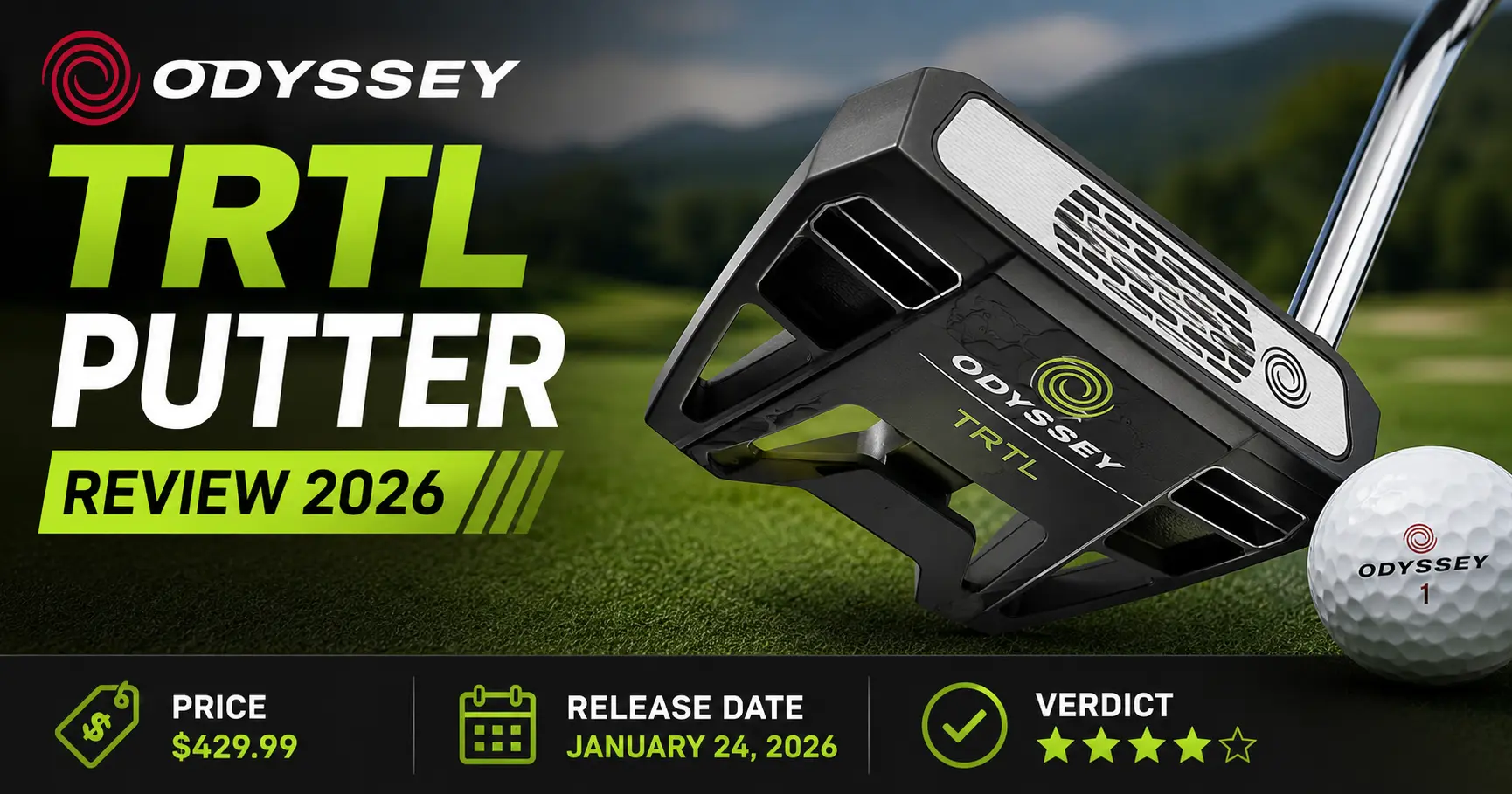
The Odyssey TRTL putter is a turtle-shell-shaped, high-MOI mallet that launched in Korea on July 15, 2026, and in Japan on August 7, 2026, priced from roughly $295 to $465. Callaway hasn’t confirmed a US release date yet. Min Woo Lee, Si Woo Kim, and Sam Burns have already gamed it on tour.
I’ve gamed an Odyssey 2-Ball for six seasons now, so when a putter shaped like an actual turtle shell started turning up in PGA Tour bags this spring, I paid closer attention than usual. The Odyssey TRTL putter is real, and it’s already for sale in two countries.
It is not yet for sale in the one where most of you reading this actually live, though. This guide covers exactly when the TRTL is likely to land in the US, what it costs right now, and the full spec sheet across all four models. You’ll also get an honest opinion on whether it’s worth the wait or the import hassle.
What Is the Odyssey TRTL Putter?
“Turtle” isn’t a marketing stretch. Flip the head over and you’ll see it immediately: a hexagonal shell-shaped body sits at the center of the sole, with four stubby extensions at the corners standing in for legs. Callaway carries that motif through the headcover, the shaft band, and the grip pattern.
Odyssey calls the TRTL its fifth icon, joining the 2-Ball, the #7, the Rossie, and the Jailbird as a genuinely new mallet shape. That’s a real claim, not a marketing throwaway. Odyssey hasn’t released a structurally new mallet since the TEN series in 2021. Everything since then has been an insert swap or an alignment update on an existing head.
The TRTL breaks that pattern with a shape built from the ground up, and the engineering idea behind it is simple: push as much weight to the perimeter as possible without turning the head into a dinner plate.
That matters because moment of inertia, or MOI, is the number that determines how much a putter face twists on an off-center hit. Higher MOI keeps a heel or toe miss rolling close to your intended line instead of squirting sideways. Big mallets like the TaylorMade Spider have chased MOI for a decade by simply growing the head. The TRTL takes a different path.
Its central body is lightweight aluminum, and four adjustable weights at the corners do the heavy lifting, which keeps the footprint compact while the stability numbers climb.
Odyssey TRTL Release Timeline: Korea, Japan, and the US
The TRTL putter’s 2026 rollout has been unusual from the start, and the order matters more than you’d think.
| Market | Announced | On Sale | Models Available |
|---|---|---|---|
| Korea | Not separately announced | July 15, 2026 | CH, DB, S, S2S ZT |
| Japan | July 24, 2026 | August 7, 2026 | CH, DB, S, S2S |
| USA | Not yet announced | Not yet available | None confirmed |
Korea got it first, quietly, through Callaway Golf Korea on July 15. Japan followed with an actual press push on July 24 and a nationwide retail date of August 7. As of this writing in mid-August, Callaway hasn’t said a word about a US date. Odyssey’s own US site still doesn’t list the TRTL anywhere, either.
When Will the TRTL Release in the USA?
If you’ve been googling when this putter is coming to the US, the honest answer is that nobody outside Callaway’s product team knows for certain yet. The pattern is still worth reading, though. Equipment brands frequently seed new gear on tour and in Asian markets months ahead of a US retail launch. We’ve tracked the same setup with Srixon’s unreleased ZXi RKT driver, which showed up in Lucas Glover’s bag with zero announced launch date or price.
Callaway tends to run a similar playbook with JDM-first putters. My best guess: a US TRTL release lands sometime this fall, most likely September or October, timed either around the FedEx Cup Playoffs wrapping up or ahead of the holiday buying season. That’s not a confirmed date. It’s a read on the pattern, and I’ll update this page the moment Callaway makes it official.
Why Is Odyssey Taking Its Time With the US Launch?
Tour feedback matters here more than usual. A brand-new head shape with a brand-new insert benefits from a full season of pro data before it hits a market as competitive as the US mallet category, where the Spider franchise has dominated tour counts for years. Launching in Korea and Japan first lets Odyssey collect real strokes-gained data and fine-tune the four-weight system before betting on a wider release.
Odyssey TRTL Price: What It Costs Now (and What to Expect in the US)
If you’ve been searching for the TRTL putter price or Korea pricing specifically, here’s what’s actually confirmed so far, converted to USD for reference.
| Market | Model | Local Price | Approx. USD |
|---|---|---|---|
| Korea | S2S TRTL ZT | ₩407,000 | ~$295 |
| Japan | DB / CH / S | ¥53,900 | ~$360 |
| Japan | S2S | ¥69,300 | ~$465 |
| USA | All models | Not yet priced | Est. $399–$499 |
Individual Korea pricing for the standard DB, CH, and S models hasn’t shown up in any source we could find, only the zero-torque S2S figure. Japan gives a clearer picture: ¥53,900 for the three standard neck options, ¥69,300 for the S2S.
Neither of those numbers will be the US price. Currency conversion isn’t retail pricing, and Odyssey typically prices US mallets above the JDM equivalent once distribution and tariffs get factored in. For context, the current Ai-DUAL mallet lineup runs $299.99 to $449.99 in the US, with the Square 2 Square models sitting at the top of that range around $399.99. Given that Odyssey is positioning the TRTL as a flagship rather than a mid-tier refresh, I’d expect US pricing closer to $399.99 for the standard necks and $449.99 to $499.99 for the S2S Zero Torque version.
The Tech Inside the Shell
Four-Weight Sole System
This is the real headline. The Odyssey Golf TRTL putter is the first Odyssey putter with four adjustable sole weights, sitting at the corners of the hexagonal body. Standard DB configuration runs roughly 10 grams up front and 15 grams in back, on each side, which biases the center of gravity deep for maximum stability.
Move the weights around and you change the head’s personality: front-heavy for more feel and shot-shaping manipulation, heel-biased if you fight a push, toe-biased if you’re transitioning from a blade. Odyssey sells extra weights separately, so you get a genuine fitting tool inside a single head purchase rather than a locked, fixed-weight casting.
The Ai-STAR Insert
The face uses a new two-layer insert Odyssey calls Ai-STAR, a urethane striking surface over an aluminum backer. Odyssey tuned it firmer than the Ai-DUAL insert on the current 2-Ball and #7 lines, with a crisper sound at impact and better ball-speed consistency across the face. It keeps the forward-roll behavior that made Ai-DUAL popular, but it trades some of that soft White Hot character for something closer to a solid tour feel.
Dual Track Alignment and FRD Grooves
Two bold sightlines run from the face to the back of the head, paired with FRD grooves angled at 19 degrees that reduce hop off the face and get the ball rolling forward almost immediately. If loft is a topic you haven’t thought much about, our putter loft breakdown covers why 3 degrees on a standard neck and 5 degrees on the S2S model aren’t interchangeable numbers, and why that gap actually matters at impact.
TRTL vs 2-Ball vs Spider: Where It Fits in Your Bag
Search interest around Odyssey TRTL 2-Ball comparisons spiked the moment tour photos leaked, and for good reason: these two putters solve different problems, and so does the Spider most of your regular foursome already carries.
| Attribute | Odyssey 2-Ball | TaylorMade Spider | Odyssey TRTL |
|---|---|---|---|
| Alignment approach | Visual, two discs frame the ball | Wings plus sightline | Structural, Dual Track plus shell shape |
| MOI strategy | Perimeter mass via elongation | Full-size wing mallet | Four-weight adjustable system |
| Head footprint | Mid-to-full mallet | Large, wide-body | Compact, close to Jailbird Mini |
| Adjustability | Fixed weighting | Some models tour-adjustable | Four interchangeable sole weights |
| Best miss to fix | Alignment and aim errors | Heel or toe mishits on a bigger stroke | Face rotation and inconsistent strike |
| Approx. US price | $249–$399 | $349–$449 | Est. $399–$499 |
The short version: the 2-Ball helps you aim, the Spider helps a bigger, more athletic stroke stay stable, and the TRTL splits the difference with a compact head that still posts high-MOI numbers. If you already putt lights-out with a 2-Ball or a Spider, nothing here forces a change. If you’ve been chasing forgiveness without wanting a head the size of a hockey puck, the TRTL is worth a look once it reaches US shelves.
The Four TRTL Models: DB, CH, S, and S2S Zero Torque
Here’s how the TRTL stacks up against the rest of the current Odyssey putters lineup, model by model, once you get past the marketing copy.
| Model | Neck | Loft | Lie | Lengths | Shaft | Sole Weights |
|---|---|---|---|---|---|---|
| TRTL DB | Double Bend | 3.0° | 70.0° | 32–34″ | 90g Stroke Lab | Front 10g×2 / Back 15g×2 |
| TRTL CH | Crank Hosel | 3.0° | 70.0° | 33–34″ | 90g Stroke Lab | Front 5g×2 / Back 10g×2 |
| TRTL S | Short Slant | 3.0° | 70.0° | 33–34″ | 90g Stroke Lab | Front 5g×2 / Back 15g×2 |
| TRTL S2S | Zero Torque | 5.0° | 72.0° | 32–34″ | 120g Stroke Lab | Front 10g×2 / Back 15g×2 |
DB is the safest starting point if you currently play a 2-Ball, a #7, or a face-balanced Spider. It suits a straight-back-straight-through stroke and doesn’t ask you to change anything about your setup. CH adds a touch of toe hang for players who fight a push, and it’s the one I’d try first if my miss tends to leak right under pressure.
S is the closest thing to a player’s putter in the lineup, with more toe hang for golfers who’ve arced their way around greens with a blade for years. S2S is the outlier: heavier shaft, forward-shifted weighting, genuine zero-torque behavior. Don’t buy the S2S on a whim. Try the zero-torque concept on something you already own first, because it changes your setup more than any neck bend does.
Min Woo Lee and the Pros Already Playing the TRTL
Min Woo Lee earns most of the credit for this putter’s tour buzz, and rightly so. He gamed a TRTL S prototype at Pebble Beach, finished T2, and ranked 2nd in the field in Strokes Gained: Putting that week. His tour-spec build runs 2 degrees of loft, 70.75 degrees of lie, 33.125 inches long, D3.2 swingweight, and 530.4 grams total, with 5 grams up front and 15 grams in back on the sole weights. He pairs it with a SuperStroke Zynergy 2.0PT grip rather than the stock TRTL Tour Pistol.
Other pros followed his lead fast. Si Woo Kim gamed a TRTL at the Arnold Palmer Invitational. Sam Burns, the PGA Tour’s best putter over a rolling three-year Strokes Gained window, tested one at the Travelers Championship. Mark Hubbard and Nicolai Hojgaard both put TRTLs in play the same week.
On the Korn Ferry Tour, Ryo Ishikawa surprised everyone by gaming a TRTL Short Slant, opening with a 65 and ranking 11th in Strokes Gained: Putting for the round. Callaway’s tour reps confirmed his build swaps in a White Hot insert and adjusted loft, though, a reminder that tour gamers are rarely stock.
How to Get a TRTL Putter Right Now
If you’re hunting for a TRTL putter for sale outside Korea and Japan, here’s what actually works right now, and none of the three options are perfect.
- Import from a Japan-market retailer. Specialist shops that already stock JDM golf clubs can usually get you a TRTL, though you’ll pay Japan retail plus shipping and, depending on your state, sales tax on arrival. Expect a two-to-three-week wait and no US warranty coverage.
- Wait for the official US launch. This is the boring answer, but it’s also the one that gets you a US warranty, US fitting support, and a price you can actually budget for ahead of time.
- Buy a tour-issue or gray-market unit secondhand. These show up occasionally on golf forums and resale sites once early importers decide to flip theirs. Verify the seller, confirm the model and specs match what’s advertised, and understand you’re on your own if anything’s wrong with the head.
Honestly, unless you’re the kind of golfer who needs new gear before anyone else in your foursome, option two is the right call for most people.
Is the TRTL Worth Waiting For? My Honest Take
Consider this an early TRTL putter review, built from tour data, full spec analysis, and years gaming Odyssey’s other mallets, since nobody outside Callaway’s own tour trailer has a US retail unit to test yet. Here’s my genuinely unhedged opinion: the four-weight sole system is the most interesting thing to happen in mallet putter design this year, and nothing else at this price point lets you tune CG bias without buying a whole new head. That’s not hype. That’s a real fitting tool built into a stock purchase.
Second opinion, and this one’s a little more contrarian: most golfers who try the TRTL lineup should end up in the S2S, not the DB everyone will default to because it looks the most familiar. Zero-torque putters are not a gimmick anymore, and a compact zero-torque head is a genuinely rare thing in this category.
Now the honest limitation, because every putter guide owes you one. If you already roll it well with a Spider X or a 2-Ball and your putting stats back that up, the TRTL doesn’t solve a problem you actually have. Don’t buy new gear to fix something that isn’t broken. Save the $400-plus and put it toward lessons or a fitting instead.
Frequently Asked Questions
When is the Odyssey TRTL putter coming out?
It’s already out in Korea (July 15, 2026) and Japan (August 7, 2026). Callaway hasn’t announced a US release date. Based on Callaway’s usual rollout pattern, a fall 2026 US launch is the most reasonable expectation right now.
When is the Odyssey TRTL putter release date in Japan?
August 7, 2026, nationwide, following a July 24 announcement from Callaway Golf Japan.
Is the TRTL replacing the Odyssey 2-Ball?
No. The 2-Ball stays in the lineup with the Ai-DUAL insert and current Sightline variants. Odyssey positions the TRTL as an additional flagship mallet alongside it.
What is the Ai-STAR insert and how is it different from Ai-DUAL?
Ai-STAR is a new dual-layer insert Odyssey built specifically for the TRTL, urethane over an aluminum backer. It keeps Ai-DUAL’s forward-roll behavior but plays firmer, with a crisper sound and tighter ball-speed consistency across the face.
Which pros use the Odyssey TRTL?
Min Woo Lee, Si Woo Kim, Sam Burns, Mark Hubbard, Nicolai Hojgaard, and Ryo Ishikawa have all gamed a TRTL on tour, along with more than ten additional pros on the JGTO in Japan.
Can I adjust the TRTL’s sole weights?
Yes. Four sole weights sit at the corners of the head, and you can reposition them front-to-back or heel-to-toe to change CG bias, MOI, and feel. Odyssey sells additional weight masses separately.
What neck options are available?
Four: Double Bend (DB), Crank Hosel (CH), Short Slant (S), and Square 2 Square (S2S) zero torque.
How much does the Odyssey TRTL putter cost?
Japan pricing is ¥53,900 (about $360) for the standard necks and ¥69,300 (about $465) for the S2S. Korea’s zero-torque model runs ₩407,000 (about $295). Callaway hasn’t announced US pricing yet, but expect somewhere between $399.99 and $499.99 based on where comparable Ai-DUAL mallets currently sit.
Final Verdict
This putter earns the hype. A genuinely new head shape, a real adjustable-weight system, and tour validation from players like Min Woo Lee and Sam Burns don’t happen together very often. What it doesn’t have yet is a US release date, and until Callaway makes that official, everything here beyond the confirmed Korea and Japan facts is an informed read, not a guarantee.
Bookmark this page. We’ll update it the moment that changes. If you’re deciding what else belongs in your bag while you wait, our Odyssey putter breakdown is a good place to start.