
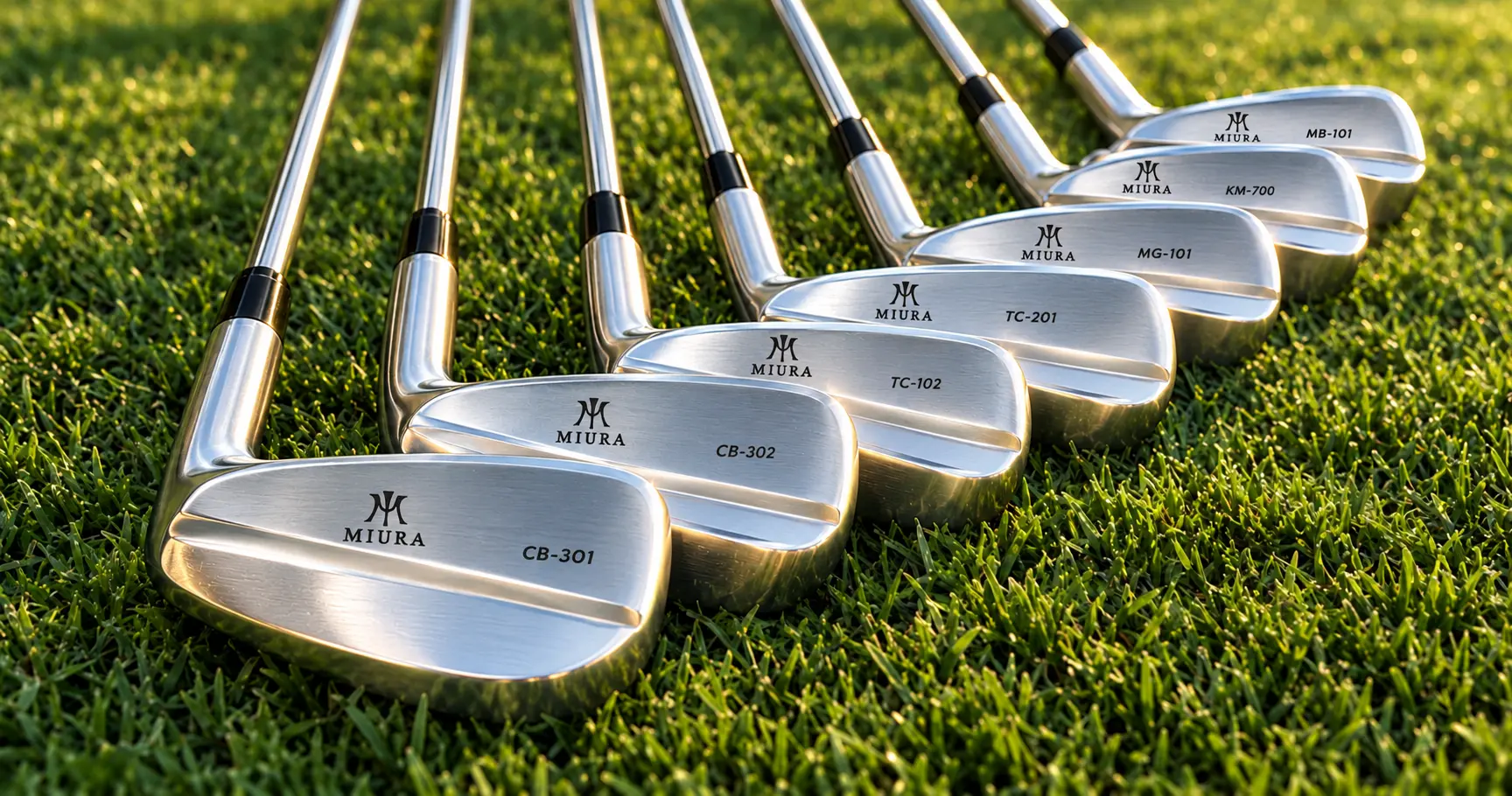
Miura’s 2026 iron lineup offers seven distinct models, from compact blades designed for precise ball-striking to modern distance irons intended to make difficult shots more manageable.
The Japanese equipment manufacturer has established a reputation for craftsmanship, forged feel and traditional clubhead design. However, its current range is more varied than golfers might expect.
Models including the MB-101 and MC-502 prioritize control and workability, while the CB-302, IC-602 and PI-402 provide increasingly forgiving alternatives.
The TC-202 and KM-700 sit between those categories, offering different approaches to balancing precise shot-making with stability.
So which Miura iron should you consider in 2026?
Here is a comparison of all seven principal models using the manufacturer’s published specifications, design information and fitting recommendations.
Miura Irons 2026: All Seven Models Compared
| Model | Category | 7-iron loft | Main strength |
|---|---|---|---|
| MB-101 | Muscle-back blade | 34° | Precision and feedback |
| MC-502 | Muscle cavity | 33° | Workability with added stability |
| KM-700 | Precision players iron | 33° | Feel and distinctive weighting |
| TC-202 | Players cavity back | 33° | Control and forgiveness |
| CB-302 | Forged cavity back | 32° | Stability and launch |
| IC-602 | Hollow-body iron | 31° | Ball speed and distance |
| PI-402 | Players-distance iron | 30° | Forgiveness and easy launch |
These lofts matter because a stronger-lofted iron can produce additional distance without necessarily being more forgiving.
Golfers comparing Miura models should consider launch angle, ball speed, spin, descent angle and shot dispersion rather than relying on carry distance alone.
1. Miura MB-101: Best for Traditional Blade Players
The MB-101 represents Miura’s classic muscle-back design philosophy.
Its compact profile, minimal visual distractions and traditional shaping are intended for golfers who consistently find the center of the clubface.
The 34-degree 7-iron loft reflects a relatively traditional approach compared with modern distance-focused irons.
Miura positions the MB-101 at the highest end of its workability scale but the lowest end of its forgiveness scale.
That trade-off is important.
A skilled golfer might value the feedback and control offered by the design. Someone who regularly misses the center of the face could find it more demanding than a cavity-back alternative.
Best suited to: Accomplished ball-strikers who prioritize feedback, precision and traditional blade shaping.
Consider before buying: The MB-101 is not designed to compensate significantly for mishits.
2. Miura MC-502: Blade Looks With Additional Stability
The MC-502 offers a more forgiving interpretation of a traditional players iron.
Its muscle-cavity construction redistributes mass to improve stability without abandoning the appearance and feedback preferred by stronger golfers.
The model has a 33-degree 7-iron and a compact profile.
Miura describes the MC-502 as having some forgiveness-enhancing design features, but it remains closer to the demanding end of the company’s lineup.
For golfers who enjoy blade-like shaping yet want slightly more help on imperfect strikes, it offers a potential middle ground.
It can also work as part of a combination set, providing additional stability in longer irons when paired with more traditional short irons.
Best suited to: Lower-handicap players seeking a compact, workable iron with modest additional forgiveness.
3. Miura KM-700: A Distinctive Option for Precision Golfers
The KM-700 is one of the more unusual designs in Miura’s collection.
Developed over several years by Katsuhiro Miura, it uses distinctive head shaping, sole geometry and weight placement intended to promote a stable strike.
Although its appearance appeals to players who like traditional forged irons, it was also designed with some forgiveness in mind.
The KM-700 has a 33-degree 7-iron loft and relatively little offset.
Miura’s own comparison places it above the MB-101 for forgiveness but below the TC-202.
That distinction is useful because the KM-700 should not automatically be treated as a conventional game-improvement iron.
Its primary appeal remains a balance of feedback, control and a distinctive address profile.
Best suited to: Confident golfers who value precise shot-making but want to explore a different approach to stability and turf interaction.
4. Miura TC-202: A Strong All-Round Players Iron
The TC-202 is among the most versatile models in the current range.
Introduced as an evolution of the TC-201, it combines players-iron shaping with a cavity-back structure.
A defining feature is its T-shaped weight bar, which allows Miura to vary mass distribution throughout the set.
The long irons are designed to provide greater launch assistance, while the shorter irons emphasize trajectory and distance control.
Miura has also refined the leading edge with its Y-Grind sole design to improve interaction with the turf.
The standard 7-iron loft is 33 degrees.
For golfers who strike the ball reasonably consistently but do not want the demands of a full blade set, the TC-202 deserves serious consideration.
Best suited to: Better players and improving mid-handicappers seeking control with a practical level of forgiveness.
5. Miura CB-302: A Forgiving Forged Cavity Back
The CB-302 moves farther toward forgiveness while retaining a forged construction.
Its cavity shape and weight distribution are designed to help stabilize the clubhead through impact.
A relatively wide sole and additional offset can also provide greater confidence at address.
The standard 7-iron loft is 32 degrees.
One important design feature is the Y-Grind sole, which incorporates leading- and trailing-edge relief to help the club move through different turf conditions.
Compared with the TC-202, the CB-302 offers a more forgiving profile and greater emphasis on accessible launch.
It is particularly interesting for golfers who appreciate traditional forged feel but need more help with consistency.
Best suited to: Mid-handicap players and improving golfers who want a forgiving premium cavity-back iron.
6. Miura IC-602: Hollow-Body Distance and Forgiveness
The IC-602 takes a different approach from Miura’s traditional solid-body players irons.
Its hollow-body construction is designed to increase ball speed and improve forgiveness while retaining a compact appearance.
The 31-degree 7-iron loft reflects its distance-oriented design.
Miura’s own comparison gives the IC-602 high marks for distance and forgiveness, although it ranks below the PI-402 for overall forgiveness.
This model may appeal to golfers who want stronger performance in the longer and middle irons without choosing an especially large clubhead.
However, distance alone should not determine whether the IC-602 is the right choice.
Golfers should confirm that its launch, spin and landing angle allow approach shots to hold greens reliably.
Best suited to: Golfers seeking additional distance and ball-speed assistance from a premium iron.
7. Miura PI-402: The Most Forgiving Model in the Range
The PI-402 is positioned at the most forgiving end of Miura’s current iron comparison.
Introduced in 2026, it replaces the PI-401 with updated construction and a more refined appearance.
Its design combines a thin Chromoly steel face with strategically positioned tungsten weighting.
Miura states that 35 grams of tungsten are positioned low behind the impact area to assist launch and stability.
Another major feature is the Kissaki Sole, which uses additional camber intended to improve turf interaction across different swing types.
The standard 7-iron loft is 30 degrees, the strongest of the seven models compared here.
That combination makes the PI-402 particularly relevant to golfers who want launch assistance, distance and greater protection against imperfect strikes.
Best suited to: Golfers who prioritize forgiveness and easy distance over maximum shot-shaping control.
Should You Choose a Miura Combo Iron Set?
Golfers do not necessarily need to select the same model for every iron.
Miura offers a combination-set builder that allows different designs to be blended.
The idea is straightforward: use more forgiving heads in the longer irons and more precise models in the scoring clubs.
Miura suggests several combinations, including:
- CB-302 long irons with TC-202 short irons.
- MC-502 longer irons with MB-101 scoring irons.
- PI-402 long irons with either CB-302 or TC-202 shorter irons.
A blended set can help address specific weaknesses, but the loft progression between models requires careful attention.
The transition should produce sensible carry-distance gaps rather than simply following a preferred appearance.
How Much Do Miura Irons Cost in 2026?
Miura irons occupy the premium end of the golf equipment market.
As of October 2026, the manufacturer’s U.S. website lists standard individual clubs at approximately $310 for the MB-101, $400 for the KM-700 and $350 for several other models.
Those figures are product-page starting prices, not complete-set quotations.
Final costs depend on the number of irons, shafts, grips, selected finish, fitting specifications and retailer.
Special-edition finishes can also carry higher prices.
At this level of investment, a professional fitting is strongly recommended.
A fitting should establish which head actually produces the best balance of ball speed, carry distance, spin, launch and consistency for the individual golfer.
Which Miura Iron Is Best for Your Handicap?
Handicap can offer a starting point, but it is not a complete fitting tool.
Two golfers playing off the same handicap can have very different iron swings.
One might strike the ball consistently but lose strokes around the greens. Another might have an excellent short game while struggling with contact.
As a general guide, golfers prioritizing forgiveness should begin their comparison with the PI-402, IC-602 or CB-302.
Players seeking a balance of control and stability may prefer the TC-202.
More accomplished ball-strikers interested in traditional shaping could compare the KM-700, MC-502 and MB-101.
The final decision should follow real launch-monitor testing rather than assumptions based solely on handicap.
Final Verdict: Which Miura Iron Should You Choose in 2026?
Miura’s range is broad enough that different models can serve distinctly different golfers.
The PI-402 offers the strongest emphasis on forgiveness, while the IC-602 provides a hollow-body distance alternative.
The CB-302 is an appealing option for golfers seeking a forgiving forged cavity back, and the TC-202 balances control with stability.
The KM-700 and MC-502 cater to players who value traditional shaping, while the MB-101 offers the most uncompromising blade experience.
For most golfers, the best Miura iron is not necessarily the most expensive or most traditional model. It is the one that delivers the most consistent performance for their actual swing.
Editorial methodology: This comparison is based on Miura’s official product specifications, manufacturer descriptions and fitting guidance. MadKnows has not independently tested the seven models or measured their performance on a launch monitor.