
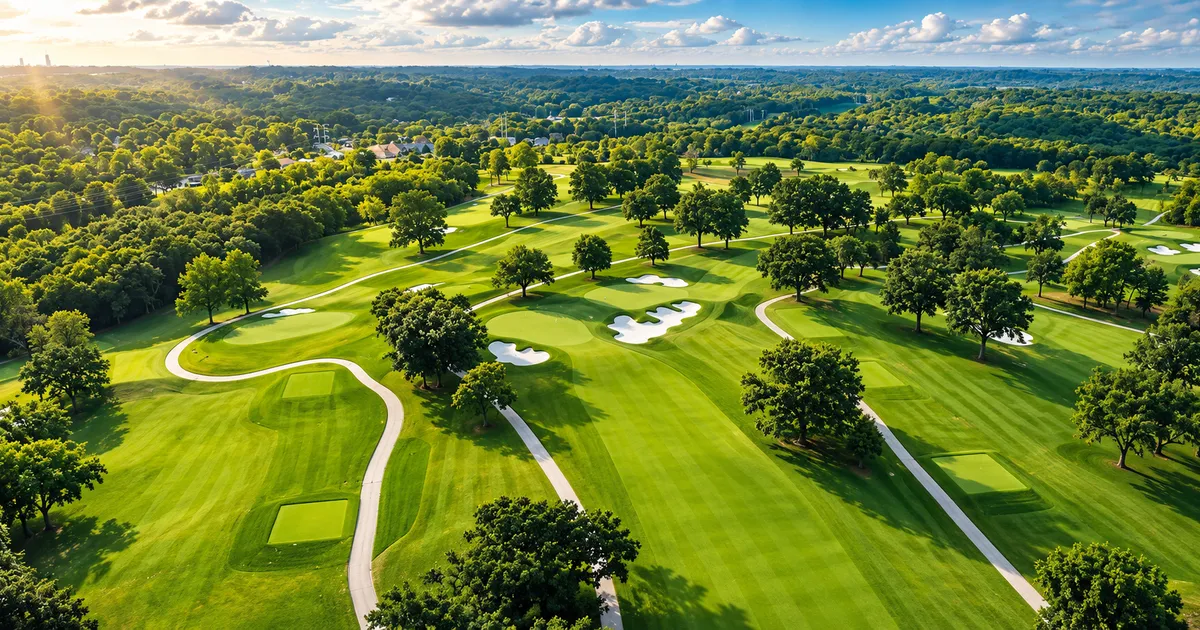
Kansas City has long been home to some of America’s distinctive golf architecture, but the restoration of Swope Memorial Golf Course is giving everyday golfers a new opportunity to experience a historic A.W. Tillinghast design without joining a private club.
KANSAS CITY, Missouri — A major restoration has returned one of Kansas City’s most historic public golf courses to the spotlight, strengthening the region’s reputation as a destination for classic American golf architecture.
Swope Memorial Golf Course reopened to public play in summer 2026 following approximately 18 months of construction aimed at restoring important elements of its original design.
The municipal course, located in Swope Park, underwent extensive improvements to its greens, bunkers, teeing areas, cart paths and irrigation infrastructure.
But the project was about more than updating aging facilities.
Its central objective was to recover the architectural character established by A.W. Tillinghast, the legendary designer associated with some of America’s most celebrated championship courses.
The result gives Kansas City something particularly valuable: a restored historic layout that remains accessible to the public.
Swope Memorial Returns to Its Tillinghast Roots
Swope Memorial’s connection to Tillinghast is central to its identity.
Golf has been played at the property for more than a century, but Tillinghast’s redesign in the 1930s established the characteristics that course officials sought to recover.
The restoration was led by Todd Clark and Brent Hugo of CE Golf Design, with historical guidance from golf architecture specialist Ron Whitten.
Their work focused on preserving the strategic qualities of the historic layout while addressing the practical demands of modern golf.
The project included reconstructed putting surfaces, restored bunkering, improved tees and a comprehensive irrigation upgrade.
Those changes were intended to improve both playability and long-term maintenance.
Large, contoured greens and strategically placed hazards are important features of Tillinghast’s design philosophy. Rather than relying exclusively on distance, his courses frequently challenge golfers to consider angles, approach positions and the consequences of missed shots.
At Swope Memorial, the rolling terrain of Swope Park adds another dimension.
Wooded surroundings, significant elevation changes and distant views toward downtown Kansas City give the layout a setting that distinguishes it from more conventional municipal courses.
A Public Course With PGA Tour History
Swope Memorial’s importance extends beyond its architecture.
The course hosted the 1949 Kansas City Open, an event on the PGA Tour schedule, establishing a connection with the history of professional golf.
Kansas City Parks and Recreation identifies Swope Memorial as the only public course in the immediate area to have hosted a PGA Tour event.
The venue has also been associated with notable figures including Ben Hogan and Sam Snead.
That history makes the restoration especially significant.
Many courses designed by America’s most influential early golf architects are now located within exclusive private clubs, limiting opportunities for the wider public to experience their designs.
Swope Memorial offers a different model.
Its historic layout is maintained as a municipal facility, allowing golfers to book regular rounds rather than requiring private club membership.
According to the course’s published rate schedule, standard weekday walking rounds are listed at $51, while weekend rounds are listed at $84. Actual availability and pricing may change.
The course therefore offers access to a piece of American golf history at publicly advertised rates.
Kansas City’s Private Clubs Preserve Their Own Architectural Heritage
The region’s reputation for traditional golf extends well beyond Swope Memorial.
Across the Kansas City metropolitan area, established private clubs continue to preserve layouts shaped by influential course architects.
Indian Hills Country Club, founded in 1919, is another local course with a direct connection to Tillinghast.
The club developed its present property in the 1920s, employing the architect to create a layout that incorporated the site’s hills, valleys, streams and wooded surroundings.
Its history provides an interesting comparison with Swope Memorial.
Both properties carry the influence of the same designer, but their approaches to access are fundamentally different.
Indian Hills operates as a private club, while Swope Memorial is available for public play.
Nearby Mission Hills Country Club offers another example of the region’s architectural heritage.
Founded in 1914, the private club features a course originally designed by Tom Bendelow, another prominent figure in American golf’s early development.
Its 6,454-yard, par-70 layout was renovated by Keith Foster in 2007, with work intended to strengthen the greens and improve the course while respecting its original setting.
Together, these clubs demonstrate the variety of traditional golf architecture found around Kansas City.
They also show why restoring an established municipal course is important: significant historic architecture need not be limited to members-only facilities.
Why the Swope Memorial Restoration Matters
The restoration of Swope Memorial highlights an important question for municipal golf operators across the United States.
How can an aging public course preserve its architectural identity while meeting modern expectations for course conditions and maintenance?
At Swope Memorial, the answer involved investing in infrastructure without abandoning the historic layout’s underlying design principles.
The improvements included a new irrigation system, upgraded drainage and rebuilt playing surfaces.
These elements may attract less attention than dramatic bunkering or redesigned greens, but they are essential to maintaining reliable playing conditions.
The project also illustrates the financial commitment required to preserve older golf properties.
Published cost estimates have differed, with Golfweek describing a project of approximately $8 million and later local reporting placing the broader investment at around $10 million.
City officials have said the work was financed through golf operations revenue and related funding arrangements rather than general taxpayer contributions.
Whether the restoration produces a lasting increase in participation and revenue will be determined over time.
For now, the project has returned a historically important public course to use.
A New Chapter for Kansas City Golf
The reopening of Swope Memorial adds another dimension to the Kansas City golf landscape.
Private institutions such as Indian Hills and Mission Hills continue to represent the region’s longstanding club traditions.
Swope Memorial, meanwhile, offers public golfers an opportunity to experience architecture connected to the same important era of American course design.
That distinction is what makes the project notable.
The course’s significance does not depend on being the longest, most expensive or most exclusive facility in the region.
Instead, its appeal lies in the combination of historic architecture, public accessibility and the substantial effort made to preserve its original character.
With its restoration complete and regular play resumed, Swope Memorial has an opportunity to introduce a new generation of Kansas City golfers to a course shaped by one of the game’s most influential designers.