
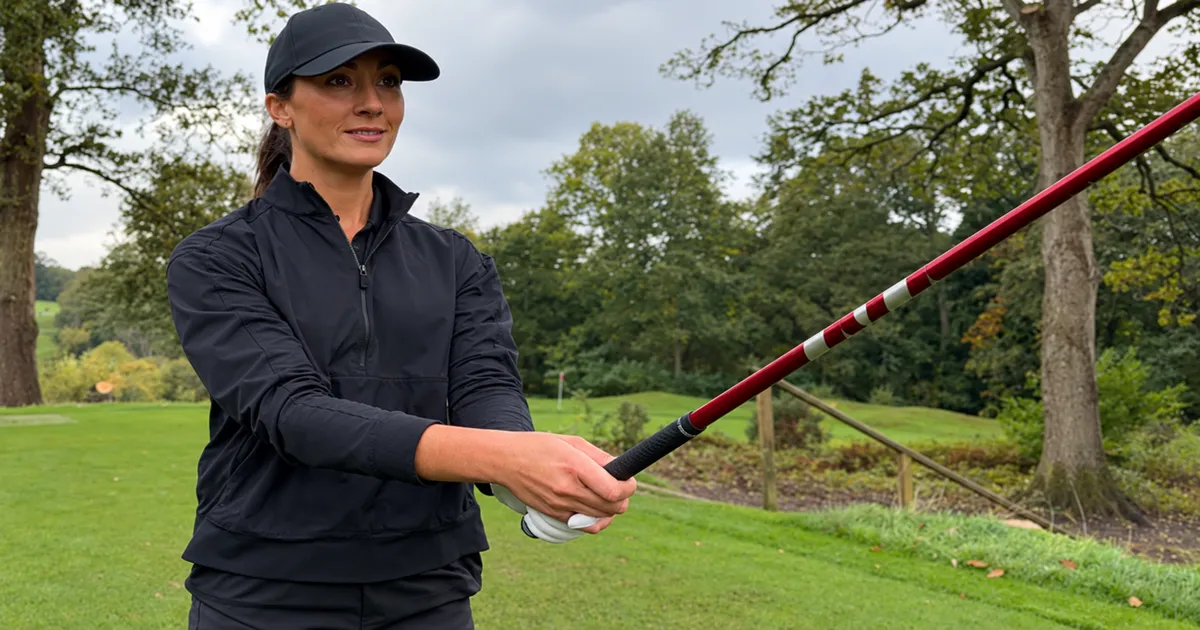
Amateur golfer and Golf Monthly contributor Jess Ratcliffe has revealed how a change in her approach to scoring helped her reach the lowest handicap of her career during the 2026 season.
Rather than setting a target for a new personal-best round or concentrating on reducing her Handicap Index, Ratcliffe focused on making her poorest rounds more manageable.
The results were encouraging. Her Handicap Index fell from 6.9 at the beginning of the year to 4.4, an improvement of 2.5 points.
In an article published by Golf Monthly on October 22, Ratcliffe explained how analyzing costly mistakes, improving course management and developing more reliable recovery skills changed her perspective on golf improvement.
Her experience offers an interesting lesson for recreational players who measure their progress primarily through their handicap.
Jess Ratcliffe Changes Her Approach to Golf Improvement
Ratcliffe is no stranger to significant improvement.
Earlier in her golfing journey, she reduced her handicap from 34 to 9 within a year, establishing herself as a dedicated amateur player.
However, her objectives changed for 2026.
Instead of attempting to produce increasingly impressive rounds, she wanted to reduce the variation between her best and worst performances.
The reasoning was straightforward: a round featuring several birdies can still produce a disappointing score if it also contains costly double bogeys or worse.
Ratcliffe began examining the mistakes responsible for those difficult holes rather than concentrating exclusively on creating more scoring opportunities.
Her approach involved identifying recurring problems and deciding which parts of her game needed attention.
Why Double Bogeys Became the Main Target
One of Ratcliffe’s discoveries was that her most expensive holes frequently began with trouble from the tee.
An inaccurate drive might finish behind trees, in a bunker or somewhere that made the next shot difficult.
The initial mistake was not always disastrous.
However, attempting an ambitious recovery or failing to return the ball to a manageable position could turn one poor shot into several.
That pattern helped Ratcliffe recognize the importance of decisions made after a mistake.
Her aim became keeping tee shots in playable positions and avoiding unnecessary risks when recovering.
Rather than attempting a spectacular shot to erase an error immediately, she placed greater emphasis on protecting the score.
For golfers who regularly struggle with large numbers on their cards, the approach provides an alternative to concentrating exclusively on swing mechanics.
A Competition Round Without a Double Bogey
Ratcliffe highlighted one competitive round as an important moment in her season.
Despite struggling with her tee shots, she completed the round without recording a double bogey.
Her performance was not built around exceptional driving or a long series of birdies.
Instead, effective putting, recovery shots and course management prevented mistakes from escalating.
She finished with 31 putts, avoided three-putting and successfully got up and down on five occasions.
The result was a score close to her lowest competitive round, even though she was dissatisfied with much of her ball striking.
The experience reinforced her belief that strong scoring does not always require a golfer’s best technical performance.
It also demonstrated the importance of maintaining a clear strategy when shots do not go according to plan.
Three Areas Helped Ratcliffe Identify Lost Shots
To understand why she was dropping strokes, Ratcliffe examined three aspects of her performances: ball striking, shot selection and recovery play.
Ball striking involved assessing whether she executed her intended shot.
Shot selection concerned whether she made the right strategic decision for the situation.
Recovery play focused on how effectively she responded after missing a target or getting into trouble.
The distinctions helped her separate technical problems from mistakes in course management.
For example, a drive that finished in trouble might be caused by poor execution.
Attempting an unnecessarily difficult recovery could then represent a separate strategic mistake.
Failing to save the hole with a chip or putt might expose another area requiring practice.
Identifying these different problems gave her a clearer idea of where improvements were needed.
Why a Lower Handicap Does Not Tell the Whole Story
Ratcliffe’s experience also highlights an important distinction between improving golf performance and watching a Handicap Index change.
Under the World Handicap System, a golfer with at least 20 recorded scores generally has their Handicap Index calculated using the eight best Score Differentials from their most recent 20 rounds, subject to applicable adjustments.
That means one good or bad round does not necessarily produce an immediate change to the index.
The calculation reflects demonstrated playing ability rather than the score from a single outing.
Ratcliffe’s approach was therefore to assess the aspects of her game she could influence directly.
Keeping the ball in play, making better recovery decisions and avoiding unnecessary mistakes provided more immediate indicators of progress.
Her handicap improvement followed during the season, although an individual golfer’s results will depend on their own game and circumstances.
How Amateur Golfers Can Apply the Lessons
Recreational players interested in improving their scoring consistency can begin by examining their recent rounds.
Rather than focusing only on the final score, they can identify where the largest numbers occurred and what caused them.
A player who regularly loses balls from the tee might benefit from improving accuracy or choosing a safer club.
Someone who frequently takes three putts could place greater emphasis on distance control.
Another golfer may need to improve recovery decisions after missing fairways or greens.
The key is to identify a recurring weakness and work on it systematically.
Tracking simple statistics, such as penalty strokes, three-putts and double bogeys, can reveal patterns that are not obvious from the final score alone.
This process does not guarantee a lower handicap, but it can make practice more focused and provide a clearer way to evaluate improvement.
Ratcliffe Sets Her Next Golf Improvement Goal
Despite reaching a career-low Handicap Index of 4.4, Ratcliffe believes there are still important areas to improve.
Her next priority is approach-shot accuracy, particularly on par-3 holes.
Analysis of her performances showed that hitting greens in regulation remained an area where she could make progress.
She also identified a recurring tendency to miss high and right with her irons, providing another focus for technical practice.
Ratcliffe plans to address those weaknesses during the winter while maintaining the course-management habits that helped her scoring consistency.
Final Thoughts
Jess Ratcliffe’s 2026 season illustrates how golf improvement can involve more than hitting longer drives or chasing personal-best rounds.
By studying the reasons behind her poorest holes, she developed a strategy for reducing costly mistakes and managing difficult situations more effectively.
Her handicap subsequently improved from 6.9 to 4.4, demonstrating progress even though lowering that number was no longer her primary objective.
For amateur golfers, the broader lesson is to look beyond the final score and identify the mistakes that are most frequently costing them strokes.
Better decisions, more reliable recovery play and focused practice may provide a more sustainable path toward improved scoring than constantly chasing the perfect round.