
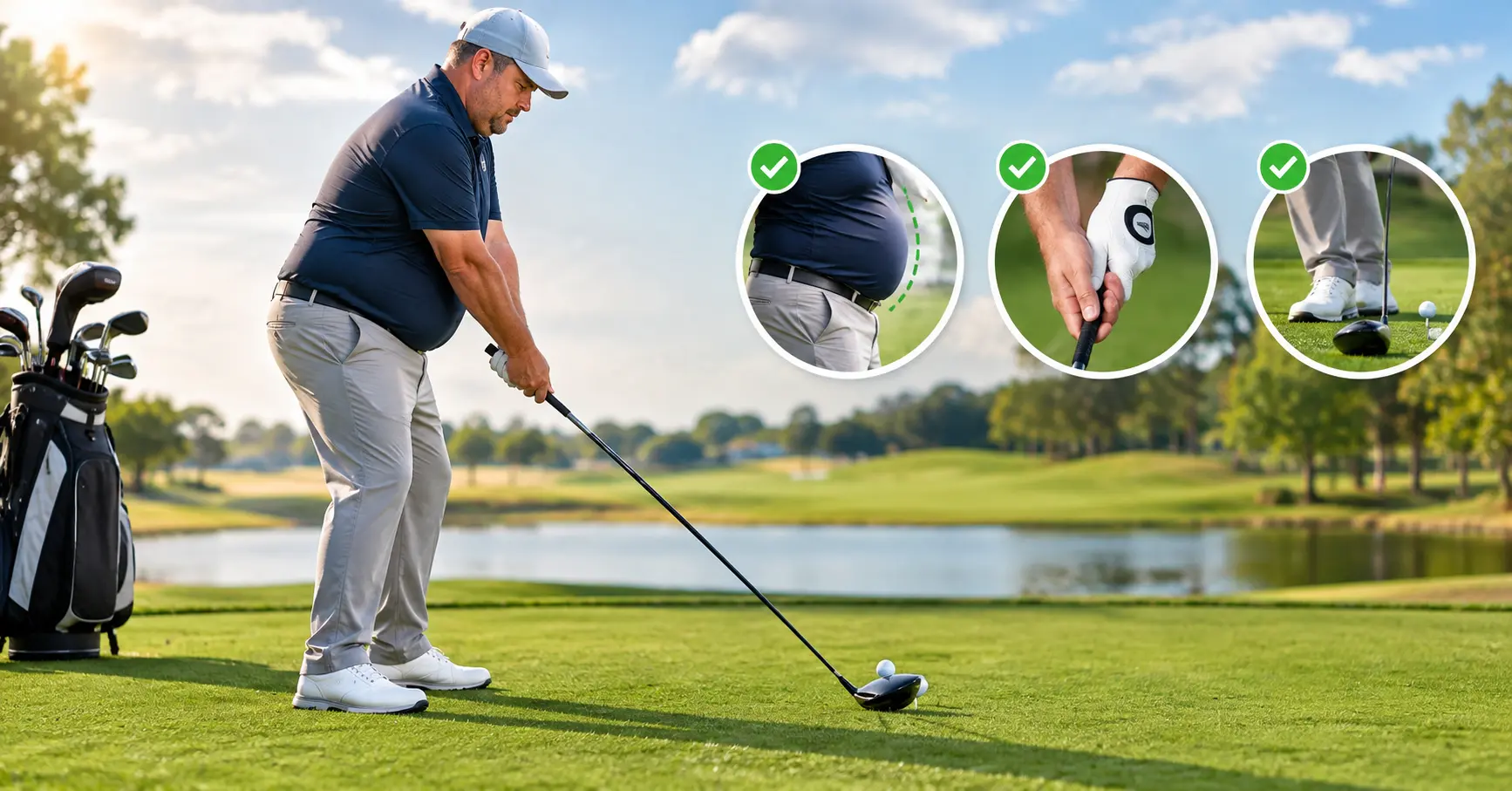
Quick Answer: A bigger belly does not have to wreck your golf swing. Widen your stance about two inches, stand slightly farther from the ball, and let your torso start the downswing instead of your arms. Most amateurs with this build lose distance from an over-long, arm-lifted backswing, not from their body type.
Extra weight around the middle changes how far your arms can travel before your body runs out of room. It does not change your ability to make a good golf swing. Most of the golfers who struggle here are not fighting their belly. They are fighting a setup and a backswing built for a body they do not have anymore.
Why a Bigger Belly Changes Your Swing
A bigger midsection takes up space your arms used to swing through. When you try to make the same length backswing you made twenty pounds ago, your arms have nowhere to go but up and away from your body. That disconnect is the real problem, not the weight itself.
Once the arms separate from the torso, you trap the club behind you on the way down. Most players react by throwing the club over the top to get back to the ball, which produces the pull, the slice, or the weak fade that brings a lot of bigger-bodied golfers into a pro shop asking for help. Fix the disconnect and the ball flight usually straightens out on its own.
Fix Your Setup Before You Touch Your Backswing
Start with three changes before you ever swing a club.
Widen your stance by about two inches on each side. A wider base gives you room to rotate without your hips running out of turn early.
Stand half an inch to an inch farther from the ball than you’re used to. This keeps your arms from jamming against your ribs on the way down, one of the most common power leaks for bigger players.
Flare your lead foot open by 10 to 15 degrees. That small change lets your hips clear through impact instead of stalling out, which matters more here than in a slimmer golfer’s setup because a bigger midsection restricts hip turn more.
None of these adjustments are dramatic. Two inches of stance width will not look strange to anyone watching you play. It just gives your body the room it needs.
Turn Your Body, Don’t Lift Your Arms
Once your setup is right, the swing itself gets simpler. Think of your arms as passengers, not drivers. Your torso turns back, your arms come along, your torso turns through, and your arms come along again. The moment your arms start doing independent work, you lose the connection that a wider frame needs to hit the ball solidly.
A short backswing beats a long one here. Trying to get the club across the line at the top almost always means your arms disconnected from your turn somewhere on the way up. Stop your backswing when your left shoulder (right shoulder for lefties) gets under your chin, not when your arms feel fully stretched.
Try this: tuck a small towel or a headcover under each armpit before you practice. If it falls out during your swing, your arms separated from your body. This drill sounds basic, and it is, but it works because it gives you instant feedback instead of a swing thought you have to remember mid-shot.
Stop the Over-the-Top Move Before It Starts
A restricted turn on the way back often shows up as an over-the-top move on the way down. Your hands and shoulders throw the club outside the target line, and the clubface has to work hard to square up in time. The result is a pull, a slice, or both on different swings.
You have two realistic options. Spend months rebuilding your flexibility and turn so the club drops into a better slot, or accept a slightly out-to-in path and let the clubface stay a touch open to it. The second option produces a controlled fade instead of a big miss, and it’s the faster fix for most weekend golfers.
To feel this in practice, start your downswing by bumping your lead hip toward the target before your hands move. That single change delays the arms and shoulders just long enough for the club to drop into a better position, which cuts down on the over-the-top move without you needing to think about your swing plane at all.
This isn’t for everyone. If a shoulder or back injury already limits your turn, see a PGA instructor in person before changing your downswing sequence on your own. A drill that helps most players can aggravate an existing injury if you apply it blind.
The Setup Fix That Also Stops Fat Chip Shots
A bigger belly changes chipping too, and most instruction never mentions it. When your midsection is your center of mass, letting your weight hang back on your trail foot is an easy habit to fall into, and it’s the single biggest cause of a fat chip shot, where the club hits the ground before the ball.
Set up with roughly 70 percent of your weight on your lead foot and keep it there through the whole motion. Narrow your stance for chips, since a wide base here works against the descending strike you actually want. If you catch yourself falling back onto your trail foot at any point during your practice swings, that’s your fix. Everything else is secondary.
Your Clubs Probably Need Adjusting Too
Here’s what almost nobody tells bigger golfers: your posture at address is different from a slimmer player’s, and your clubs should reflect that.
A larger midsection usually pushes you to stand a bit more upright at address, which changes the angle your clubhead sits at relative to the ground. That’s a lie angle problem, and an off lie angle sends the ball left or right no matter how good your swing gets. A proper fitting checks this in ten minutes.
Grip size matters more here too. Hands tend to grip a touch more actively when the arms don’t have full extension room, and an undersized grip makes that worse by encouraging even more hand action. Going up a grip size or adding wraps of tape under it is a cheap fix that a surprising number of bigger golfers never try.
Shaft length is the one adjustment I would leave alone. Standard length works for most builds regardless of midsection size, and a longer shaft mostly just makes the club harder to control. A few fitters push it anyway, and it’s worth saying directly that I wouldn’t recommend it.
Body Type Was Never the Real Limiter
If you need proof that body type is not the ceiling on your golf game, look at the record book instead of the mirror.
Craig Stadler won the 1982 Masters with a build that earned him the nickname The Walrus, and he did it with a compact, efficient swing rather than a long, athletic one. Colin Montgomerie built a record eight European Tour Order of Merit titles on a similarly stocky frame and one of the most repeatable swings of his generation. Neither man got there by fighting his body. They got there by building a swing that worked with it.
John Daly is the exception worth mentioning, not copying. His backswing is one of the longest and loosest in pro golf history, and it works for him because of timing and flexibility most weekend golfers, heavy or not, simply don’t have. Watching Daly’s highlight reel is not a swing plan. The compact, connected model above will get you further.
Common Questions
How do you swing a golf club if you’re overweight?
Widen your stance, stand a touch farther from the ball, and let your torso lead the swing instead of your arms. Your weight doesn’t change the mechanics. The room your body has to work in does, and your setup needs to account for that.
How do you stop fatting chip shots?
Keep roughly 70 percent of your weight on your lead foot through the whole chip, and narrow your stance. Weight that drifts back onto your trail foot is the most common cause of hitting the ground before the ball.
What’s the 70/30 rule in golf?
It refers to weight distribution, most often around chipping and pitching. Roughly 70 percent of your weight sits on your lead foot and 30 percent on your trail foot at setup, and it stays that way through the strike. Some instructors apply looser versions of the same idea to full-swing weight shift, though the numbers move around more there.
The Bottom Line
A bigger belly is a setup problem before it’s a swing problem. Fix your stance width, your distance from the ball, and your grip size, and most of the shot pattern that’s been bothering you cleans up on its own. For more on dialing in your stance and alignment from the ground up, see our golf setup fundamentals guide.