
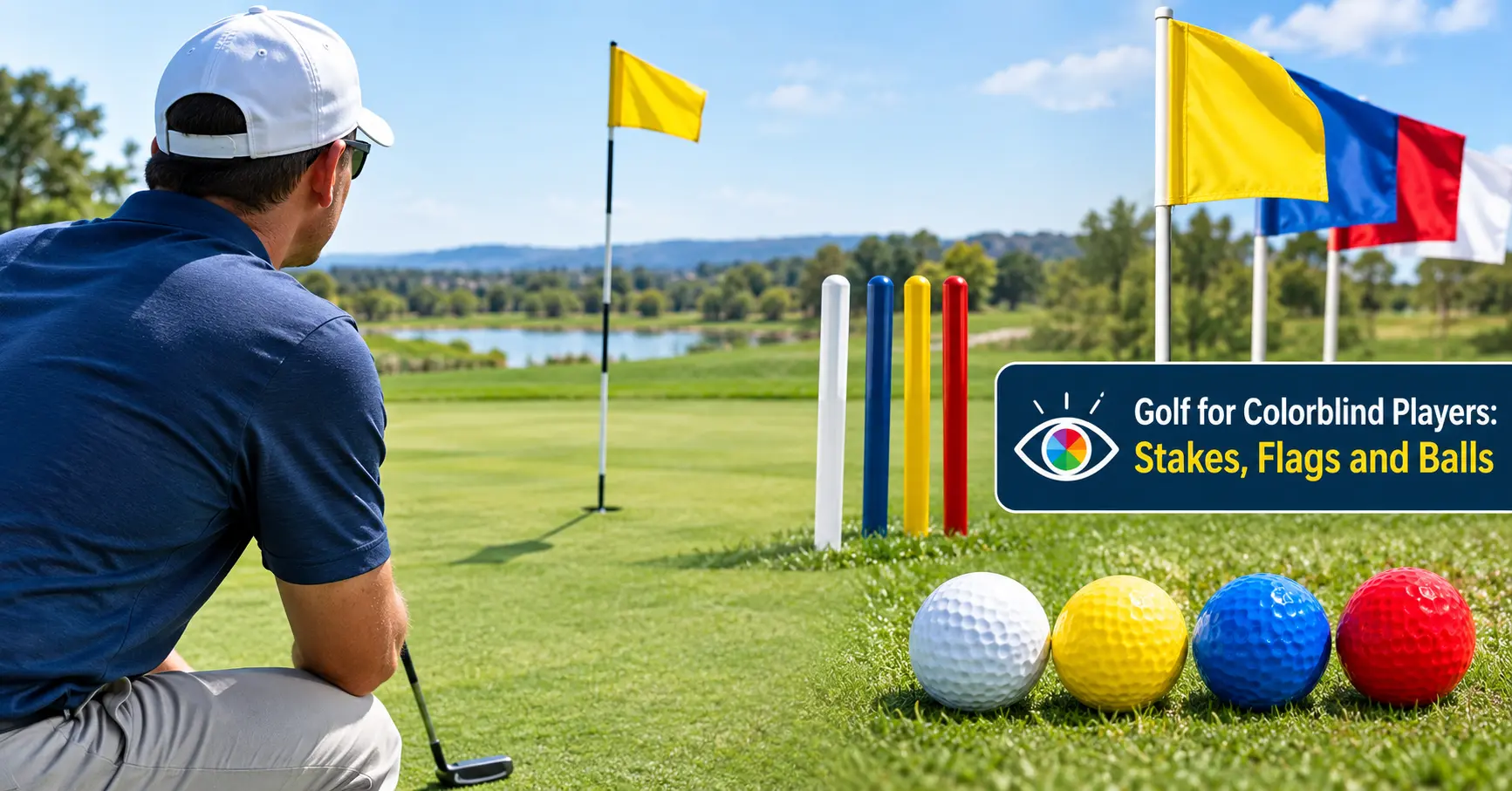
Quick Answer: Start with an optic yellow or white ball, then give every color cue on the course a second way to read. Red, orange, and pink balls vanish against grass for most red-green colorblind golfers. Stakes, pin flags, tee markers, and slope maps all lean on color, so confirm each before you tee off.
Roughly 1 in 12 men of Northern European descent has red-green color blindness, and about 1 in 200 women does. In a foursome of those men, the odds that at least one player sees red and green differently come out near 29 percent. Golf for colorblind players needs better advice than “buy a yellow ball.”
Ball color matters, and I cover it below. It’s also the easy part. Red-green color blindness causes bigger trouble where most players never notice color-coding: the stakes that set your relief options, the flags that show pin position, the tee markers, and the slope maps in your GPS app.
My fix for all of it is the same: give every color cue a second way to read. A black mark identifies your ball, a yardage identifies your tee, an arrow replaces a red patch, and a playing partner confirms a stake.
This guide covers red-green color blindness, the most common type. If you can’t track the ball in flight whatever its color, you’re dealing with low vision, and that needs a different plan.
What red-green color blindness changes on the course
Red-green color blindness means your red or green cones work differently from the standard, so reds, greens, browns, and oranges blur together. You still see color. NIH’s explainer says the differences between certain colors look less obvious to you than they do to other people.
Three pairings cause most of the trouble on a golf course: red against green, orange against green, and brown against green. World Rugby’s guidance for colorblind players warns that red, orange, pink, and dark grey training cones can disappear against green and brown surfaces. Grass doesn’t care which sport you play.
Rugby and football bodies publish this kind of guidance for coaches. I couldn’t find an R&A or USGA equivalent for golf, which leaves you to build your own system.
Which golf ball color should a colorblind golfer play?
Optic yellow is the safest first choice for most red-green colorblind golfers, and white is the fallback when yellow disappears against fallen leaves or sand. Red, orange, and pink balls fail most often, because red-green color blindness blends those hues into the grass. Test two colors on your own course before you commit.
Golfers with red-green color blindness say the same thing on forums. They lose red, orange, and pink balls, they track white and yellow reliably, and one GolfWRX poster warns playing partners on the first tee that no help is coming in a search for those colors.
Sources split on yellow, though. Caddie’s ball guide calls yellow almost always the safest color for colorblind golfers. Broughty Golf Club’s guide argues that white can beat yellow for some red-green players, and a Golf Monthly poster says a colorblind playing partner struggles with yellow on cloudy days. My take: carry a sleeve of each and let your own eyes settle it.
| Ball color | Works best | Fails when | Red-green risk | My call |
|---|---|---|---|---|
| Optic yellow | Overcast days, deep rough, dusk | Fallen yellow leaves and sand, and on cloudy days for some players | Low | Start here |
| White | Sunny days against green, dark trees, and brown dirt | Overcast sky, glare, white flowers, goose feathers | Low | First backup, or first pick if yellow fails your test |
| Neon green | Mixed light, because it sits near the eye’s peak sensitivity | Lush green grass | Split | Test before you trust it |
| Orange | Autumn rough and bright sun | Green grass and clay, where it blends in | High | Skip unless it passes your test |
| Pink | Against sky and dirt | Green grass, where many red-green players lose it | High | Skip |
| Red | Nowhere you can count on | Grass and low light | Highest | Avoid |
A matte cover cuts glare, and both Caddie and Golf Sidekick favor matte balls for visibility. Volvik, which launched the first matte-finish ball in 2016, lists a dozen Vivids at $29.99 on its site (price as of October 2, 2026). At that price a sleeve costs $7.50, so test before you buy a full dozen.
A ball test that counts failures
Tracking a ball in the air and finding it in the grass are two different jobs, and a color can win one and lose the other. Test both with the same ball model in three colors: white, optic yellow, and one alternative that looks strong to your eyes. One model keeps performance differences out of the result.
- Set each ball 20 to 30 yards away, partly down in rough. Look away, turn back, and note which one your eyes find first. Repeat with the sun in a different position.
- Hit five or six shots with each color and watch the descent. The last part of the flight decides whether you find the ball, because that’s where you pick up the landing spot.
- After each ball lands, look away for two seconds and find it again. That step separates tracking from finding.
- Count failures for each color and keep the one with the fewest. A color you lose once in ten shots beats one you lose four times in ten, whatever any chart says.
- Repeat when the season or the light changes, because a color that wins on lush summer grass can lose on dormant turf.
Mark your ball so color doesn’t have to identify it
Every colorblind golfer needs a second way to identify the ball. Rule 6.3 suggests putting an identifying mark on your ball, and playing the wrong ball costs two penalty strokes in stroke play under Rule 6.3c.
A thick black line or three large black dots does the job. You read the mark at a glance, so you don’t have to judge a hue. Skip small initials, because you’ll never read them on a ball half-buried in rough. It matters most when a playing partner plays your model and number.
How do you tell red penalty stakes from yellow ones?
Sometimes you can’t, so plan around it. Both colors give you stroke-and-distance relief and back-on-the-line relief, and only red adds lateral relief within two club-lengths. If you can’t read the color, take one of the shared options and you stay inside the Rules.
The color matters because Rule 17 defines every penalty area as red or yellow, and the color sets your options. Take lateral relief from a yellow area and you’ve played from a wrong place. Rule 14.7a adds two penalty strokes in stroke play and costs you the hole in match play. If the breach is serious, you must also replay from the right place before you tee off on the next hole.
I’d rather give up the lateral option than gamble two strokes on a color I can’t read.
Position gives you a clue. Red areas usually run along the side of a hole, and yellow areas usually cross the line of play where you have to carry water. The R&A and USGA want committees to mark most penalty areas red, so expect red stakes more often than yellow.
Then ask. Rule 10.2 lets you ask anyone for public information, including the position of penalty areas and what the Rules say, so a playing partner or the starter can tell you the stake color without a penalty. Where a penalty area changes color, committee guidance recommends a red stake and a yellow stake side by side, which gives you a spot to double-check.
Pin flag colors are a code, and every course writes its own
Many courses use flag color to show where the hole sits on the green. Golf News Net describes the common setup as red for the front third, white for the middle, and blue for the back. Other courses run red, yellow, and white, and forum posts describe layouts that flip the order, so a red flag means front at one club and back at the next.
A red flag against trees adds a second problem. A red-green colorblind poster on the Golf Monthly forum says red flags against bushes and trees are hard to pick out.
Look for the position cue. Many flagsticks carry a small indicator flag that slides up for a back pin and down for a front pin, and some courses hand out a pin sheet. Ask at check-in which system the course uses. If you can’t confirm it, aim at the middle of the green, because I’d take a center target over a guess at a flag color every time.
Slope maps and putting apps lean on red
Green-map screens in golf apps paint slope in colors. TheGrint’s maps run from gray for flat up to red for slopes steeper than 9 percent, and Arccos says warmer colors mark steeper sections. Those scales ask you to rank reds, oranges, and pinks by eye, and that’s the exact job red-green color blindness makes hard.
Arccos gives you separate toggles for slope shading and break arrows, so you can switch the colors off and read the arrows alone. Its Green Maps also include Red and Green Zones that mark good and bad misses, which is one more red-green code to check. I couldn’t confirm a colorblind palette in any of these apps. Check your settings before you trust the colors.
Pick arrows or printed numbers over color in whatever app you use. A slope percentage tells you the same thing as a red patch, with no hue to decode.
Green reading when color isn’t the clue
Slope shows up in shape, light and dark shading, and what your feet feel. Golfers with red-green color blindness split on how much trouble that causes. One golfer who wrote to the American Academy of Ophthalmology said contours give some trouble but less than tracking the ball does, and GolfWRX posters describe losing subtle shade changes between greens.
Color matters most on mixed-turf greens. A Golf Club Atlas poster with mild red-green color blindness said greens that mix several grass types made short putts hard to line up. Grain, the direction the blades lean, shows as shine and shade, which depends on where the sun sits.
Here’s how I’d teach it. Read the big slope from 100 yards in, because the land around the green shows it before the green’s color does. Read the putt from the low side, where the slope shows against the horizon, and walk the slope beside your line to confirm it with your feet.
Pick your speed before your line. A feet-based system such as AimPoint reads slope through your soles, so it doesn’t lean on color.
Pick your tee box by its yardage
Tee marker colors have no universal meaning. One Golf Monthly poster describes a club that changed from red, yellow, white, and blue tees to silver, green, blue, white, and black. Match the tee name and total yardage on the scorecard to the marker, and ask the starter if paint is the only label on the box.
The three-minute clock on a lost ball
Rule 18.2 calls your ball lost if you don’t find it within three minutes after you or your caddie begins searching. Three minutes goes fast when the ball’s color vanishes into the grass on the way down.
Pick a fixed landmark near the landing area before you walk, such as a tree, the edge of a bunker, a yardage post, or a sprinkler head. Search outward from that point. “Two sprinkler heads past the 150 post” gives you a search area, and “somewhere on the right” doesn’t.
Tell your group what you lose. “I lose it on the way down, so watch the last third of the flight” hands a partner a job, and “watch my ball” hands them nothing.
If you think you’ve lost the ball outside a penalty area or out of bounds, play a provisional ball and say the word “provisional” before you hit it. Skip the announcement and the second ball goes into play under stroke and distance. If the only place the ball can hide is a penalty area, the Rules don’t allow a provisional.
Do colorblind glasses help on the course?
The research conflicts. University of Granada researchers tested EnChroma’s Cx-65 lenses and found no improvement on standard color vision tests, and EnChroma replies that its lenses aren’t designed to change those scores. EnChroma cites a 2022 study of 13 people with red-green deficiency who wore the lenses for 11 to 14 days and showed better color discrimination. EnChroma also says the lenses suit partial red-green deficiency, which it puts at about 4 in 5 cases.
Plain tinted lenses have a simpler case. The American Academy of Ophthalmology’s golf Q&A recommends brown or gray lenses with polarization and says brown works better for distance, and Golf Sidekick’s reviewer prefers brown for contrast on grainy greens.
Test a $7.50 sleeve of yellow balls before you spend a dollar on glasses. If you try EnChroma, use its 60-day money-back guarantee and run the shot test above with and without the lenses. A showroom can’t reproduce a red flag against a tree line.
A five-minute check before you tee off
Run this at check-in and you’ll cover every color code above.
- Ask the pro shop which penalty areas on this course are yellow, and where any area changes color mid-hole.
- Ask what the flag colors mean, and whether the flagsticks carry an indicator flag.
- Match your tee to the scorecard by name and yardage, and read the local rules for any color-coded rule.
- Mark every ball in your bag with the same black line or dots.
- Tell your group on the first tee which colors you lose and which part of the flight to watch.
- Switch your GPS app to arrows or printed numbers instead of slope colors.
- Set your default relief now: stroke-and-distance or back-on-the-line, unless someone confirms the stakes are red.
Where this advice runs out
This isn’t for everyone. Red-green color blindness runs from mild to strong, and no article can tell you which ball you’ll find, which is why the test matters. Blue-yellow deficiency changes the advice, and an eye care professional can tell you which type you have.
Most red-green color blindness comes from your parents’ genes, so it’s present from birth. If colors that used to look right start looking wrong, book an eye exam before you change a single ball.
If you lose the ball in flight in every color, you’re dealing with low vision. The United States Blind Golf Association runs clinics and tournaments for golfers with visual impairments.
Questions about golf for colorblind players
Can colorblind people play golf?
Yes. The Rules of Golf set no color vision requirement, and the stroke is the same for everyone. What changes is the color-coded information around the shot, which the sections above cover.
What color golf ball is best for color blind players?
Yellow and white lead the evidence, with yellow first for most players and white when yellow blends into leaves or sand. Pink, orange, and red rank last. A failure-count test on your own course beats any ranking, including this one.
Do colorblind golfers have trouble reading greens?
Some do and some don’t. Slope reading leans on shape and shading, so many players read lines fine, while mixed-turf greens and subtle shade shifts trip up others. Read from the low side, pick speed first, and try a feet-based method such as AimPoint.
Are colored golf balls legal?
Yes. The Rules of Golf have never set a ball color. In a competition, confirm your model appears on the Conforming Golf Ball List, because the Committee can require it.
Can I mark my golf ball with a black marker?
Yes. Rule 6.3 suggests an identifying mark, and a bold black line works when color can’t separate two balls. Use the same mark on every ball in your bag.
Do EnChroma glasses work for golf?
They change how colors look for people with partial red-green deficiency, and the research on whether that improves performance conflicts. If you try a pair, wear them on the course, because that’s where you’ll see whether the flag stands out from the trees.
Before your next round
In golf for colorblind players, stake color is the one detail that costs strokes without warning, so read our guide to penalty area relief options before you play a course with water. Then ask the pro shop one question at check-in: which penalty areas here are yellow? The answer takes ten seconds and settles the biggest rules risk on the card.