
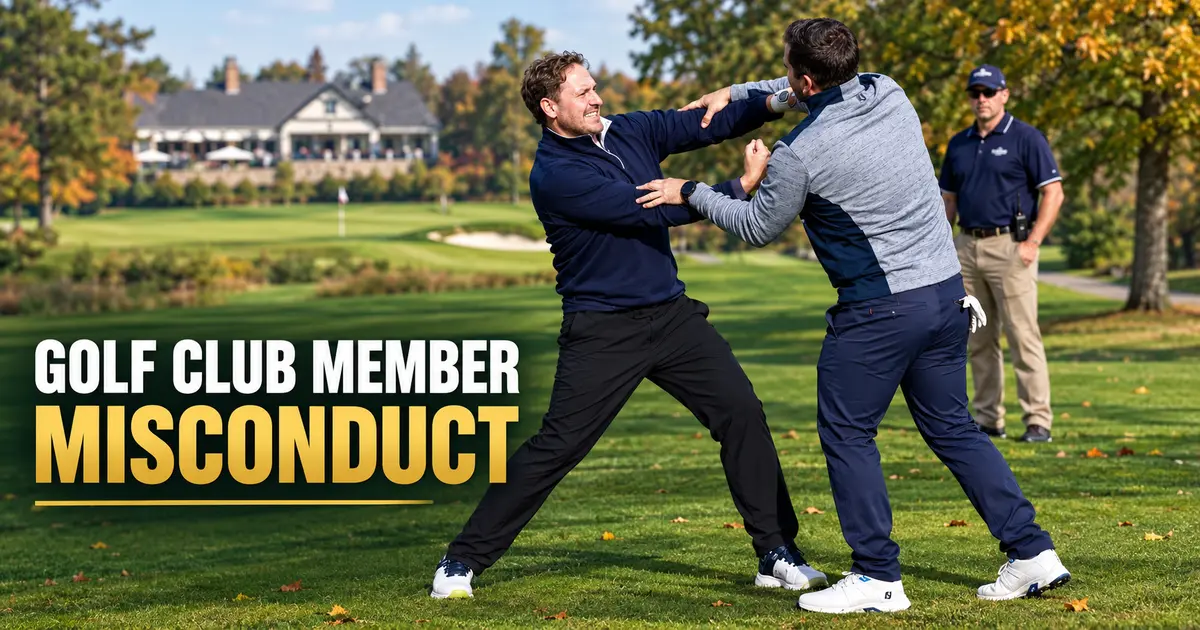
Golf clubs across Great Britain are confronting a growing challenge beyond rising operating costs and course maintenance: an increase in member disciplinary disputes involving aggressive behaviour, harassment, cheating allegations and online misconduct.
The National Golf Clubs’ Advisory Association (NGCAA), which provides legal guidance to golf clubs, reports that disciplinary issues have overtaken employment law as the most common reason clubs seek its advice.
In an interview published by Golf Monthly on October 23, 2026, NGCAA chief executive Alistair Smith described a particularly sharp increase in misconduct concerns over the previous six to 12 months.
The trend raises questions about how clubs manage relationships between members, investigate allegations and maintain standards of behaviour while ensuring everyone involved receives fair treatment.
Member Discipline Becomes Biggest Legal Concern for Golf Clubs
For many years, employment law was the leading reason golf clubs contacted the NGCAA for advice.
According to Smith, approximately 65% to 70% of the association’s enquiries before the COVID-19 pandemic related to employment matters.
That pattern has now changed.
Disciplinary issues involving club members have become the largest category of legal advice requests.
Smith told Golf Monthly that the increase had become especially pronounced during the past year, following an earlier rise after golf resumed from pandemic restrictions.
The NGCAA handles more than 1,600 legal enquiries annually from proprietary and private members’ clubs across Great Britain, according to the Golf Club Managers’ Association (GCMA).
However, that total covers all categories of legal assistance.
It should not be interpreted as the number of misconduct incidents or disciplinary proceedings.
The available reports also do not provide an exact national percentage increase in bad behaviour.
Nevertheless, the shift in the subjects of legal enquiries suggests that managing member relationships has become a more demanding responsibility for some golf club committees and managers.
What Types of Misconduct Are Golf Clubs Reporting?
The concerns extend well beyond disagreements about etiquette or slow play.
The NGCAA has identified a variety of situations prompting requests for assistance, including verbal confrontations, physical aggression, harassment of staff and members, alleged cheating in competitions and possible manipulation of golf handicaps.
Disputes between members can also develop into formal complaints requiring investigation.
Some cases involve incidents inside the clubhouse, while others arise during competitive or recreational rounds.
The breadth of these concerns is significant because clubs may have to address behaviour that falls under different policies or responsibilities.
A disagreement about pace of play is not equivalent to an allegation of harassment or violence.
Each situation requires an appropriate response based on its seriousness, the available evidence and the club’s governing rules.
It is also important to distinguish allegations from established misconduct. A complaint alone does not prove that a member has violated club regulations.
WhatsApp and Social Media Create New Disciplinary Challenges
Another emerging issue involves behaviour away from the golf course.
Golf club managers are increasingly seeking advice about inappropriate communications in WhatsApp groups and on social media.
Members may communicate regularly through digital groups that are not directly operated by their clubs.
When disagreements become abusive or involve other members and staff, questions can arise about whether a club should intervene.
These situations can be difficult because the conduct may have occurred outside an official club event or communication channel.
The club must consider the relationship between the alleged behaviour and its rules, as well as applicable privacy and legal obligations.
Online messages may also become part of an investigation, creating a need to handle evidence carefully and protect confidential information.
The growing importance of digital communication means that traditional golf club governance policies may need to address circumstances that were less common when those rules were written.
Are New Golfers Responsible for the Rise in Complaints?
One possible explanation for increasing disputes is that golf has attracted more participants since the pandemic.
Higher demand for memberships and tee times may increase pressure on club facilities and create more opportunities for disagreements.
However, Smith cautioned against assuming that newer members are responsible for the problem.
The disciplinary matters reaching the NGCAA involve both established members and people who joined more recently.
They also involve golfers of different ages and genders.
No clear demographic pattern has been identified in the information presented.
That makes it difficult to attribute the rise to any particular category of golfer.
Changing social expectations, competition for access and the way clubs handle disputes may all be relevant considerations, but the available evidence does not establish a single cause.
The distinction matters because addressing misconduct requires dealing with specific actions rather than making assumptions about the people joining the sport.
Why Disciplinary Procedures Matter More Than Ever
For golf club managers, the response to alleged misconduct can be as important as the original incident.
The NGCAA has warned that clubs may face costly disputes if disciplinary decisions are made without following their own procedures or basic principles of fairness.
A member facing an allegation should know what behaviour is being investigated and have a reasonable opportunity to respond.
The people assessing the matter should be impartial, and any decision should be supported by evidence.
Clubs should also explain their conclusions and provide an appropriate appeals process where required by their rules.
These safeguards protect both the individual member and the organisation.
A poorly documented decision may become difficult to defend if challenged, even when club officials believe they acted for legitimate reasons.
The GCMA has therefore urged committees and managers to review their constitutions, disciplinary policies and related procedures before a serious dispute arises.
Waiting until a complaint has already escalated can expose gaps that are much harder to correct during an active investigation.
Artificial Intelligence Is Entering Golf Club Disputes
One particularly interesting development involves the use of artificial intelligence by members facing disciplinary proceedings.
Smith told Golf Monthly that some members have submitted lengthy defence documents prepared with AI tools.
These documents may challenge how a club conducted its investigation or whether the correct procedure was followed.
The use of AI is not itself evidence of wrongdoing. Members are entitled to understand and challenge allegations through the processes available to them.
However, the development adds another layer of complexity for club officials who may need to respond to extensive written arguments.
It also reinforces the importance of applying established rules consistently.
A clear and well-documented investigation is more likely to withstand scrutiny than an informal decision based on incomplete records.
Clubs should assess the substance of complaints and responses rather than making assumptions about whether AI was used to prepare them.
What Do the Official Rules of Golf Say About Player Conduct?
The Rules of Golf already establish expectations for how players should behave during competition.
Under Rule 1.2, administered by The R&A and USGA, golfers are expected to act with integrity, show consideration for others and take care of the course.
A competition committee can disqualify a player for serious misconduct that violates the spirit of the game.
Committees can also introduce a Code of Conduct as a Local Rule, setting out standards and appropriate penalties for particular breaches.
However, these competition rules are not identical to the procedures governing a private golf club’s membership.
A member dispute involving harassment, online conduct or an incident in the clubhouse may need to be handled under the club’s own constitution and disciplinary regulations.
Understanding the difference between tournament penalties and membership sanctions is essential.
How Golf Clubs Can Reduce Disciplinary Problems
The recent warnings offer several practical lessons for golf club officials.
First, clubs should maintain written standards explaining acceptable behaviour on the course, in the clubhouse and in communications connected to club activities.
Second, members and staff should have a clear way to report incidents without unnecessary confrontation.
Third, allegations should be investigated consistently, with appropriate attention to evidence, confidentiality and the rights of everyone involved.
Fourth, club committees should ensure that disciplinary decisions are made by suitable individuals who are not personally involved in the dispute.
Finally, clubs should review their rules regularly and obtain qualified legal guidance when handling complex allegations.
The objective is not simply to impose more sanctions.
It is to build a fair and predictable system that can resolve disagreements early while responding appropriately to serious behaviour.
Does the Rise in Complaints Mean Golf Has a Behaviour Problem?
The NGCAA’s findings raise legitimate concerns, but they should not be treated as evidence that misconduct is widespread among all golfers.
The association’s figures relate to requests for legal advice, and greater willingness to report incidents may also influence the number of enquiries.
More complex disciplinary procedures or an increased likelihood of members challenging decisions could contribute to the workload.
Without comprehensive data covering the total number of incidents, club memberships and disciplinary outcomes, the scale of any nationwide behavioural change cannot be measured precisely.
What is clear is that clubs contacting the NGCAA are spending more attention on member discipline than they did previously.
That alone is significant for organisations that depend on cooperation, trust and respect between members.
Final Thoughts
The rise in golf club disciplinary enquiries represents an important governance challenge for the sport in 2026.
From disagreements on the course to harassment allegations and disputes involving online communications, clubs are dealing with situations that can have lasting consequences for members, employees and the wider organisation.
The NGCAA’s central warning is that golf clubs need clear policies and fair procedures before problems escalate.
For golfers, the lesson remains straightforward: respect fellow players, follow the rules and recognize that conduct away from the fairways can affect the wider club community.
For club managers, strong governance may be just as important as maintaining high-quality playing conditions.
As participation and expectations continue to evolve, addressing misconduct fairly will remain an essential part of protecting golf’s reputation and the experience of its members.
Reporting sources: Golf Monthly’s October 23, 2026 interview with NGCAA chief executive Alistair Smith; the Golf Club Managers’ Association’s September 14 disciplinary guidance; and The R&A’s Rules of Golf, Rule 1.2.