
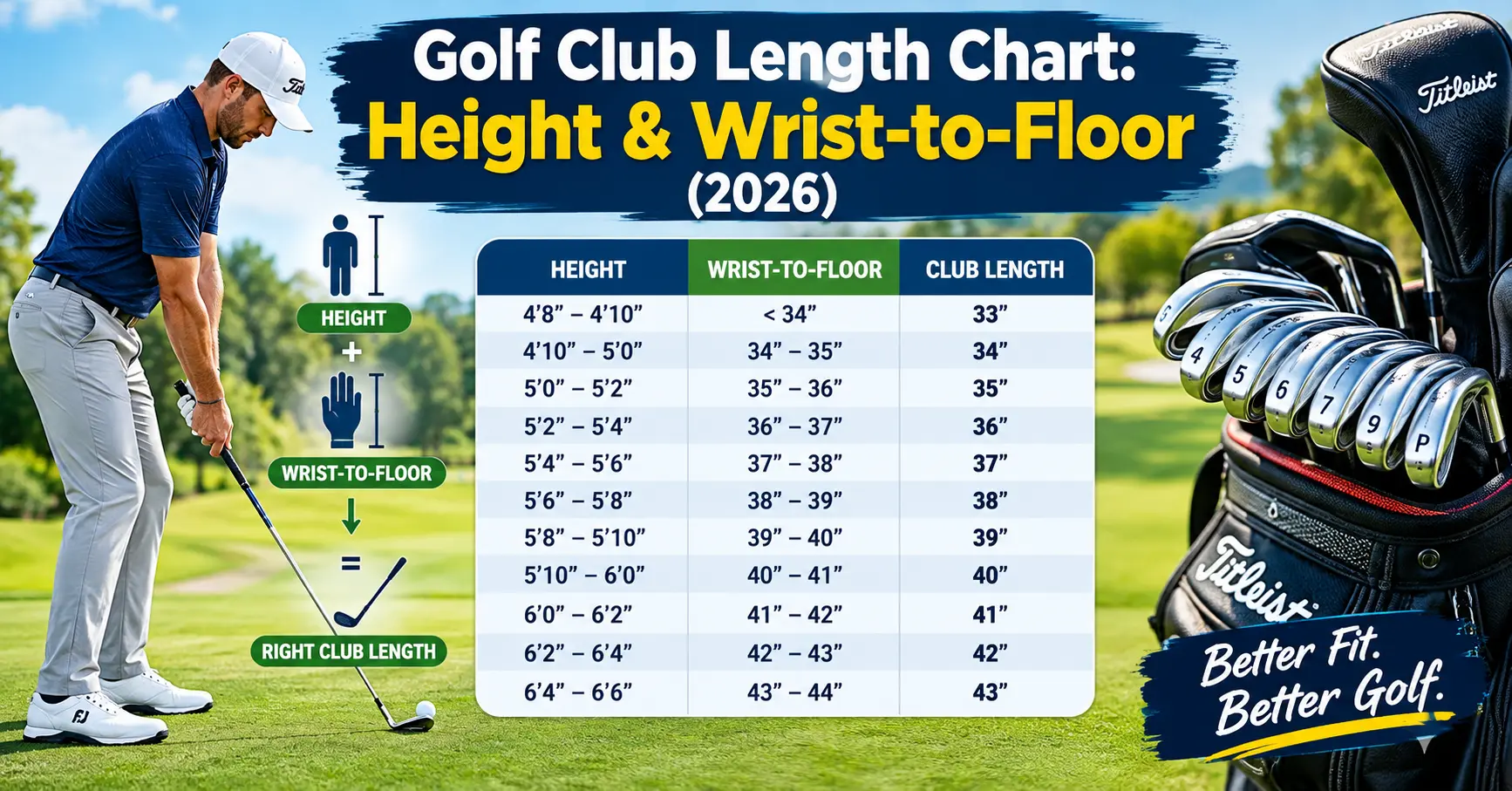
Quick Answer: A standard men’s 7-iron measures 37 inches (94 cm), and that length fits golfers with a wrist-to-floor measurement of 34 to 36 inches, roughly 5’7″ to 6’0″ tall. Shorter arms need clubs ½ to 1 inch shorter. Longer arms need ½ to 1 inch more. Measure wrist-to-floor before you trust any height chart.
Pull up three golf club length charts and you’ll get three different answers for the same golfer. A 5’2″ player reads a 1½-inch cut on one chart and a 1-inch cut on another. That gap separates a set that fits from a set that fights you.
This data gives you one working golf club length chart built on wrist-to-floor, plus standard lengths for every club in inches and centimeters. Women, kids, and Ping fitting each get their own section. You’ll also get the lie angle and swing weight math most charts skip, and a home test that settles the close calls.
Why Every Golf Club Length Chart Gives a Different Answer
Charts disagree because they define “standard” differently. Lynx says standard men’s sets fit golfers around 5’9″ to 5’10”. Golf Monthly’s zero-adjustment band, as GolfSupport reproduces it, runs from 5’9″ to 6’0″. Hireko starts its standard band lower, at 5’7″. Move the starting line and every adjustment below it moves too.
Golf club length chart by height: the same golfer on three published charts (iron length change vs. men’s standard)
| Golfer height | Golf Monthly | Hireko | Lynx | Spread between charts |
|---|---|---|---|---|
| 5’2″ (157 cm) | -1½” | -1″ | -½” to -1″ | 1″ |
| 5’5″ (165 cm) | -1″ | -½” | -½” to -1″ | ½” |
| 5’8″ (173 cm) | -½” | Standard | Near standard | ½” |
| 6’1″ (185 cm) | +½” | +½” | Near standard | ½” |
| 6’5″ (196 cm) | +1″ | +1″ | +½” to +1″ | ½” |
Every chart lands close together at the tall end. A 6’5″ golfer gets about an inch of extra length no matter who’s counting. The short end is where they split, by up to a full inch, and that’s the gap between a 7-iron at 36 inches and one at 37.
Hireko’s own tables don’t agree with each other. Its first table tells a 5’2″ golfer to cut 1 inch, while its second table, the one that adds wrist-to-floor, says minus ½ inch for that height band. That’s what happens when height does a job that arm length should do.
Height alone is the weakest way to pick a club length. Wrist-to-floor measures what height only guesses at, which is how far your hands hang from the ground at address. Use height to sanity-check the result, then let wrist-to-floor decide.
Golf Club Length Chart by Height and Wrist-to-Floor
Here’s the working golf club length chart for men, and it’s the base for every other chart in this guide. It measures against men’s standard length, so women should read the women’s section after this one. Find your wrist-to-floor row first, then check the height beside it. If the two disagree, wrist-to-floor wins.
Working chart: iron length change by wrist-to-floor and height
| Wrist-to-floor | Wrist-to-floor (cm) | Typical height | Iron length change | Change (cm) | Your 7-iron, steel (in / cm) |
|---|---|---|---|---|---|
| Under 30″ | Under 76 | Under 5’0″ | -1″ | -2.5 | 36.0 / 91.4 |
| 30″ to 32″ | 76 to 81 | 5’0″ to 5’3″ | -1″ to -½” | -2.5 to -1.3 | 36.0 to 36.5 / 91.4 to 92.7 |
| 32″ to 34″ | 81 to 86 | 5’4″ to 5’7″ | -½” | -1.3 | 36.5 / 92.7 |
| 34″ to 36″ | 86 to 91 | 5’7″ to 6’0″ | Standard | 0 | 37.0 / 94.0 |
| 36″ to 38″ | 91 to 97 | 6’0″ to 6’4″ | +½” | +1.3 | 37.5 / 95.3 |
| Over 38″ | Over 97 | Over 6’4″ | +1″ | +2.5 | 38.0 / 96.5 |
The chart rests on the wrist-to-floor bands that Hireko and Lynx publish, which agree within about an inch. We removed the overlapping edges so every golfer lands in exactly one row. The adjustments apply to irons and wedges. Drivers get their own rules later, because every credible source treats them differently.
How to Measure Wrist-to-Floor for Golf Clubs
- Stand tall on a hard, flat floor in flat-soled shoes, feet shoulder-width apart and eyes level.
- Let your arms hang loose. If your shoulders feel tight, shake them out for five seconds first.
- Have someone else measure from the crease of your lead wrist, the one under your glove, straight down to the floor.
- Measure twice. If the two readings differ by more than ¼ inch, reset your posture and repeat.
- Write the number down in inches and centimeters.
Don’t reach for the floor with your fingers, and don’t stand at attention with your shoulders pinned back. Either move changes the number.
When Height and Wrist-to-Floor Disagree
Try a 6’2″ golfer with a 35-inch wrist-to-floor. Golf Monthly’s height bands and Hireko’s height table both say add ½ inch. The wrist-to-floor row says standard. Trust the 35 inches, because it measures where the hands hang, and the club has to meet the ground from there.
The reverse happens too. A 5’10” golfer with a 32-inch wrist-to-floor has arms on the short side, so the wrist-to-floor row asks for a ½-inch cut that height would never suggest. When the two numbers land a full row apart, go with wrist-to-floor and settle the rest with the tape test later in this guide.
Standard Golf Club Length Chart for Every Club (Inches and cm)
Standard length is a manufacturing baseline, not a fitting result. Golfworks says it sets standard lengths so swing weights land in a normal range at standard head weights, and it tells buyers to custom fit playing length to each player. Read every number below as a starting point that a fitter adjusts. Each table works as a golf club length chart in cm as well as inches.
Sources also measure length differently. The Rules of Equipment measure woods and irons with the sole against a 60-degree plane, from where the two planes meet to the top of the grip. Golfworks measures to the end of the shaft with the head sitting at its designed lie, and it warns that grip cap thickness varies by maker. Expect small gaps between sources, and ask which method a shop uses.
Golf Club Length Chart for Irons
Every adjustment in this guide measures against the steel columns. Golfworks builds graphite irons a half inch longer than steel in every slot. The reason is swing weight, since a lighter shaft needs extra length to keep the head feel in range. Order graphite at its own standard length after a chart says “standard,” and you’ve quietly added half an inch.
Standard iron and wedge lengths, steel and graphite (source: Golfworks standard length sheet, cm converted by madknows.com)
| Club | Men, steel (in) | Men, steel (cm) | Men, graphite (in) | Women, steel (in) | Women, steel (cm) | Women, graphite (in) |
|---|---|---|---|---|---|---|
| 4-iron | 38.5 | 97.8 | 39.0 | 37.5 | 95.3 | 38.0 |
| 5-iron | 38.0 | 96.5 | 38.5 | 37.0 | 94.0 | 37.5 |
| 6-iron | 37.5 | 95.3 | 38.0 | 36.5 | 92.7 | 37.0 |
| 7-iron | 37.0 | 94.0 | 37.5 | 36.0 | 91.4 | 36.5 |
| 8-iron | 36.5 | 92.7 | 37.0 | 35.5 | 90.2 | 36.0 |
| 9-iron | 36.0 | 91.4 | 36.5 | 35.0 | 88.9 | 35.5 |
| Pitching wedge | 35.5 | 90.2 | 36.0 | 34.5 | 87.6 | 35.0 |
| Gap wedge | 35.5 | 90.2 | 36.0 | 34.5 | 87.6 | 35.0 |
| Sand wedge | 35.25 | 89.5 | 35.75 | 34.25 | 87.0 | 34.75 |
| Lob wedge | 35.25 | 89.5 | 35.75 | 34.25 | 87.0 | 34.75 |
Each iron steps a half inch from its neighbor, and the wedges compress at the bottom. Pitching and gap wedges share 35.5 inches, and sand and lob wedges share 35.25. Long irons keep the same step, with a 3-iron at 39 inches in steel. Women’s irons run exactly 1 inch shorter than men’s in every slot. Hireko’s 37-inch men’s 7-iron matches the Golfworks number, so two suppliers agree on the anchor.
Driver, Fairway Wood and Hybrid Lengths
Standard wood lengths by shaft weight (source: Golfworks standard length sheet, cm converted by madknows.com)
| Club | Men, 64 g or lighter (in) | Men, 64 g or lighter (cm) | Men, 65 g or heavier (in) | Women, 64 g or lighter (in) | Women, 64 g or lighter (cm) | Women, 65 g or heavier (in) |
|---|---|---|---|---|---|---|
| Driver | 45.5 | 115.6 | 45.0 | 44.5 | 113.0 | 44.0 |
| 3-wood | 43.25 | 109.9 | 43.0 | 42.75 | 108.6 | 42.25 |
| 5-wood | 42.5 | 108.0 | 42.0 | 41.75 | 106.0 | 41.25 |
| 7-wood | 42.0 | 106.7 | 41.5 | 41.25 | 104.8 | 40.75 |
| 9-wood | 41.5 | 105.4 | 41.0 | 40.75 | 103.5 | 40.25 |
Lighter shafts add a quarter to a half inch again. Hybrids follow loft instead of club number. On Golfworks’ sheet, men’s steel hybrids run 40.5 inches at 17 to 18 degrees and shrink to 38.5 inches at 28 to 29 degrees. Women’s run 38.5 inches at 22 to 24 degrees and 37.5 inches at 27 to 29 degrees. Hireko’s 40, 39.5, and 39 inches for the 3, 4, and 5 hybrids line up with those numbers. Because length rides on loft, check your gaps with our golf club lofts guide before you order a hybrid to fill a slot.
Putters break the pattern. Golfworks lists 34 inches (86.4 cm) for men and 33 inches (83.8 cm) for women, and Hireko says most golfers fit between 33 and 35 inches depending on posture and stroke. Putters are also the one club the 48-inch cap doesn’t cover.
Driver Length: Play It Shorter Than the Rack Says
Off-the-rack drivers run long. Callaway’s 2026 driver guide puts the standard men’s driver at 45.5 to 45.75 inches and the women’s at about 44. The same guide lists the PGA Tour average at roughly 44.5 inches, a full inch under retail.
Tour players swing faster than any amateur, and they still shorten the shaft. They give up a little leverage to gain center contact. Most golfers should do the same, and it isn’t close. A center strike with a 44.5-inch driver beats a toe strike with a 45.5-inch one for nearly every amateur.
Starting driver lengths by height (lanes from Lynx’s roundup of published fitting charts)
| Golfer height | Starting driver length (in) | Starting driver length (cm) | Cut from a 45.5″ retail driver |
|---|---|---|---|
| Under 5’7″ (170 cm) | 43″ or shorter | 109 or shorter | 2½” or more |
| 5’7″ to 6’1″ (170 to 185 cm) | 44″ to 44.5″ | 112 to 113 | 1″ to 1½” |
| Over 6’1″ (185 cm and up) | 44.5″ to 45″ or longer | 113 to 114 or longer | ½” to 1″ |
Treat those lanes as a place to start testing, not a prescription. A shorter driver also plays lighter, because swing weight drops as length falls, so buy one built short instead of cutting a stock shaft. Callaway says some models ship in a 44-inch build. After you settle on a length, set your tee height to match, and our golf tee height chart lists exact measurements for every club.
Length limits matter if you compete. The Rules of Equipment cap any club except a putter at 48 inches. The USGA notes that a Committee can adopt Model Local Rule G-10, which drops that ceiling to 46 inches for elite events. Check the terms of competition before you build a 47-inch driver for the club championship.
Golf Club Length Chart for Women
Women’s sets run about an inch shorter than men’s across the bag. Golfworks’ steel 7-iron measures 36 inches for women against 37 for men, and its driver measures 44 against 45. Callaway’s retail figures stretch the driver gap to about 1½ inches.
The wrinkle is that most charts measure against men’s standard. Callaway’s fitting guide handles it with one line of arithmetic. Take the chart’s adjustment and add 1 inch, because a woman’s club already starts an inch shorter. A woman who reads a 1-inch cut on a men’s chart needs no cut at all in a women’s set.
Golf club length chart for women: iron length by height (our arithmetic from Golf Monthly’s height bands and Callaway’s add-1-inch rule)
| Height | Height (cm) | Change on a men’s chart | Change in a women’s set | Women’s steel 7-iron (in / cm) |
|---|---|---|---|---|
| 4’9″ to 5’0″ | 145 to 152 | -2″ | -1″ | 35.0 / 88.9 |
| 5’0″ to 5’3″ | 152 to 160 | -1½” | -½” | 35.5 / 90.2 |
| 5’3″ to 5’6″ | 160 to 168 | -1″ | Standard | 36.0 / 91.4 |
| 5’6″ to 5’9″ | 168 to 175 | -½” | +½” | 36.5 / 92.7 |
| 5’9″ to 6’0″ | 175 to 183 | Standard | +1″ | 37.0 / 94.0 |
| 6’0″ to 6’3″ | 183 to 191 | +½” | +1½” | 37.5 / 95.3 |
That table is our math, not a manufacturer’s chart. Use it to find a starting row, then confirm with the tape test.
Two examples show why the distinction matters. A 5’4″ golfer with a 28-inch wrist-to-floor reads minus 1 inch on the working chart. If her irons run men’s standard, they’re about an inch long for her. If they run women’s standard, they fit. Check which standard your set follows before you cut anything.
Taller women land on men’s lengths. A 5’10” golfer sits in the men’s standard band, so a women’s set runs an inch short for her.
Golf Club Length Chart for Kids
Buy junior clubs by height, not age. Age tells you little about arm length, and clubs only care about how far the hands sit from the ground. Fairway Jockey’s junior chart sizes a full bag from 48 to 66 inches of height, and it makes a strong reference for junior golf club size by height.
Golf club length chart for kids: driver, 7-iron, and putter by height (source: Fairway Jockey junior chart, cm converted by madknows.com)
| Child’s height | Height (cm) | Driver (in) | Driver (cm) | 7-iron (in) | 7-iron (cm) | Putter (in) |
|---|---|---|---|---|---|---|
| 48″ (4’0″) | 122 | 33.5 | 85.1 | 29.0 | 73.7 | 26.0 |
| 51″ (4’3″) | 130 | 35.0 | 88.9 | 30.5 | 77.5 | 27.0 |
| 54″ (4’6″) | 137 | 37.0 | 94.0 | 32.0 | 81.3 | 28.5 |
| 57″ (4’9″) | 145 | 39.0 | 99.1 | 33.5 | 85.1 | 30.0 |
| 60″ (5’0″) | 152 | 41.0 | 104.1 | 35.0 | 88.9 | 32.0 |
| 63″ (5’3″) | 160 | 42.0 | 106.7 | 36.0 | 91.4 | 33.0 |
| 66″ (5’6″) | 168 | 43.0 | 109.2 | 37.0 | 94.0 | 34.0 |
Read the 7-iron column and a pattern jumps out. Every inch of height adds half an inch of club. A child who grows 2 inches over the winter needs a 7-iron a full inch longer by spring.
The chart also shows where junior sizing hands off to adult sizing. At 63 inches, the junior 7-iron measures 36 inches, the same as a women’s standard steel 7-iron. At 66 inches it reaches 37, the men’s standard.
Don’t buy a size up so a child can grow into it. Extra length forces a kid to stand upright and swing with the hands, and solid contact gets rare fast. Lynx suggests watching the finish. A child who can’t hold balance for two seconds after the swing is swinging a club that’s too long or too heavy.
Ping Golf Club Length Chart: How the Color Code Chart Works
Ping’s color code chart is the best-known golf club length chart in iron fitting, and plenty of golfers misread what it does. You plot your height against your wrist-to-floor measurement, and the chart returns two things: a color code for lie angle and a recommended length. Ping calls the output an initial recommendation, and its fitters refine both numbers in a dynamic fitting.
The color is the lie angle. Retailer guides describe ten codes running from 4 degrees flat to 5 degrees upright in 1-degree steps, each marked by a colored dot on the clubhead. The system covers golfers from 5’0″ to 6’7″, according to TGW, and golfers between 5’7″ and 6’0″ fall into the standard length segment. That standard zone matches the 5’7″ to 6’0″ band in the working chart above.
Three rules keep you out of trouble. First, treat the chart as an iron tool, since Ping aims the dot system at irons and adjustable drivers and woods handle lie through settings. Second, if you land between two colors, use your typical ball flight as the tiebreaker, which is what Ping’s guidance points to. Third, don’t order a full set on the chart alone. A quick fitting check beats a set built to the wrong lie.
What Changes When You Change Length: Lie Angle and Swing Weight
Length never travels alone. Two other numbers move with it, and both change how the club feels and where the ball starts.
Start with lie angle. A higher hand position, from longer arms or a taller build, calls for a more upright lie. Extra shaft length with the same hands calls for a flatter one. That tug of war is why Ping’s chart returns a color and a length together.
Add length without changing your posture and the toe tends to rise at address, which points the face left for a right-hander. Cut length and the toe tends to drop, which points the face right. Both effects show up as start-line misses that look like swing flaws. Tall golfers who suddenly hook a new set of longer irons often have a lie problem, not a swing problem.
Swing weight moves too. Clubmakers work from two rules of thumb. A half inch of length shifts swing weight about 3 points, and 1 point equals about 2 grams of head weight. Cut a half inch off a 7-iron and you lose about 3 points, which roughly 6 grams of head weight replaces. Some sources put a full inch nearer 3 to 5 points, so a fitter’s scale beats the arithmetic.
What a length change does to lie, swing weight, and head weight (rules of thumb, confirm on a swing weight scale)
| Length change | Swing weight | Lie angle at address | Head weight to restore feel |
|---|---|---|---|
| -1″ | About 6 points lighter | Toe tends to sit down, face points right | About +12 g |
| -½” | About 3 points lighter | Toe tends to sit down | About +6 g |
| +½” | About 3 points heavier | Toe tends to sit up | About -6 g |
| +1″ | About 6 points heavier | Toe tends to sit up, face points left | About -12 g |
Don’t cut shafts before you finish the choke-down test below. It costs nothing, and it tells you whether the club is really the problem.
How to Test Your Proper Golf Club Length at Home
You can run a useful pre-fit without a launch monitor. You need a 7-iron, a roll of masking tape or a can of face spray, a hard hitting mat, and a friend with a phone.
- Stick a strip of masking tape across the sole, and mark the face with spray or impact tape.
- Hit 10 shots with your normal grip and setup. Note where the marks land on the face and where the sole scuffs.
- Choke down ½ inch and hit 10 more, with the same target and ball position.
- Choke down a full inch and hit 10 more.
- Film one swing face-on. Look for hands jammed high, locked knees, or reaching arms.
Now read the results. Score the pattern, not your best swing.
How to read the tape test
| What you see | What it usually means | Cheapest fix |
|---|---|---|
| Marks drift toward the toe, shots come out thin, and you stand tall through impact | Club runs long | Play it choked down, then shorten in ½-inch steps |
| Marks drift toward the heel and you feel crowded at address | Club runs short | Test a longer demo club before you extend anything |
| Shots start left and the sole scuffs on the heel side | Lie is too upright | Flatten the lie by 1 degree |
| Shots start right and the sole scuffs on the toe side | Lie is too flat | Make the lie 1 degree more upright |
| Marks sit near the center and the start line stays tight | Length is fine | Leave the club alone |
Choking down beats a chart because it uses your swing instead of your measurements. If it helps, you can keep the club and play it gripped down. If you’re stuck between two sizes, pick the one that gives you the more athletic posture. You can choke down a long club, but you can’t choke up a short one.
When to Skip the Chart and Book a Fitting
A chart can’t see your posture. Two golfers with the same wrist-to-floor number play the club at different heights if one stands tall and reaches while the other hinges deep and lets the arms hang. That’s the limit of any static method, and it’s why Ping frames its own chart as a starting point.
Some golfers sit outside what a chart can handle. Golf Monthly’s bands stop at 4’9″ and 7’0″, and Ping’s chart covers 5’0″ to 6’7″. Outside those ranges, you’re in fitting territory. The same goes if your wrist-to-floor row and your height row sit two steps apart.
Here’s the honest limit of this whole guide. If you already sit in the 34-to-36-inch row, hit the center of the face, and hold your start lines, close this tab. A chart that says minus ½ inch isn’t a reason to saw a shaft off a set that works.
Bring numbers when you do book. Your height, your wrist-to-floor, your current 7-iron length and lie, and your driver length give a fitter a head start.
Frequently Asked Questions
What length golf clubs do I need for my height?
Standard men’s length fits golfers between 5’7″ and 6’0″ with a wrist-to-floor of 34 to 36 inches. Below that range, expect to cut ½ to 1 inch. Above it, expect to add ½ to 1 inch. Confirm with wrist-to-floor, because two golfers at 6’2″ can land in different rows.
How do I know what size golf clubs I need?
Measure your height and your wrist-to-floor, find your row in the working chart, and run the tape test with a 7-iron. If contact and start line hold, keep the club. If they don’t, change length in ½-inch steps and recheck lie angle after any change bigger than that.
What is the standard length of golf clubs?
Men’s steel irons run from 38.5 inches for the 4-iron down to 35.5 inches for the pitching wedge, with the 7-iron at 37 inches (94 cm). Women’s irons run exactly 1 inch shorter in every slot. Retail men’s drivers measure 45.5 to 45.75 inches, and women’s measure about 44.
What is the standard driver length for men?
Callaway lists 45.5 to 45.75 inches off the rack. The PGA Tour average sits near 44.5 inches. The Rules of Equipment cap drivers at 48 inches, and a Committee can lower that to 46 inches with Model Local Rule G-10.
Are women’s golf clubs shorter than men’s?
Yes, by about 1 inch across the bag. Golfworks’ 7-iron runs 36 inches against 37, and its driver runs 44 against 45. Height decides the final call, and a woman around 5’9″ to 6’0″ fits men’s standard length.
Is height or wrist-to-floor more important for golf club length?
Wrist-to-floor. It captures arm length and posture, which height can’t. Use height as a cross-check, and go with wrist-to-floor when the two disagree.
What happens if golf clubs are too long?
Too-long clubs push contact toward the toe and pull you upright through impact, which produces thin shots. The toe also sits up at address, and that points the face left for a right-hander. Choke down ½ to 1 inch and watch whether contact and start line improve.
What size golf clubs does my child need?
Pick by height, not age. A 48-inch child plays a 7-iron near 29 inches, and every extra inch of height adds about ½ inch of club. Use the junior chart above, and skip the size up for growth.
Your Next Step
A golf club length chart gets you to the right row, and the tape test gets you to the right club. Your proper golf club length comes down to two measurements and one test. Change length in half-inch steps, and check lie angle and swing weight whenever you move more than that. Once your clubs fit, put real yardages to them with our golf club distance chart.