
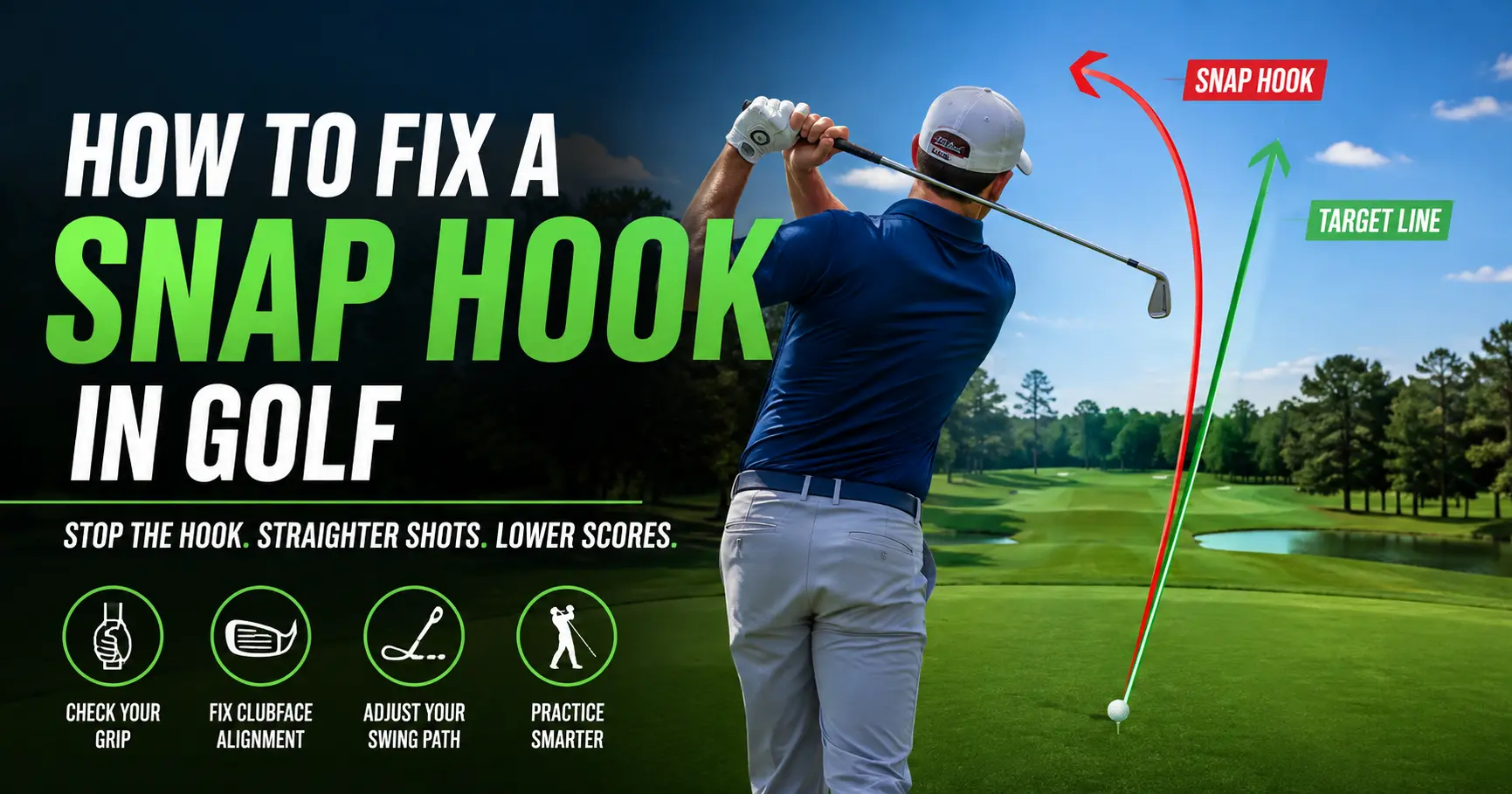
Quick Answer: A snap hook comes from your clubface closing hard relative to your swing path at impact, not from swinging too fast. Check your grip first. A neutral grip with a swing path that isn’t wildly in-to-out fixes most snap hooks in one range session. Driver and irons need slightly different fixes, both covered below.
You stripe three drives down the middle. Then the fourth one starts left of the flag and keeps diving before your follow-through even finishes. That’s a snap hook, and it’s one of the ugliest misses in the game.
Most articles blame it on swinging too hard or “flipping your hands.” Neither explanation is specific enough to fix anything. A snap hook comes down to two numbers, your clubface angle and your swing path at impact, and how far apart those two numbers sit. Fix that gap and the shot disappears, whether you’re hitting driver off the tee or a mid-iron into a green.
What a Snap Hook Actually Is (And Why It’s Not a Duck Hook or a Pull)
Golfers use “snap hook,” “duck hook,” “hook,” and “pull” like they’re interchangeable. They aren’t, and that confusion is a big reason so much advice on this exact topic points the wrong way.
A pull starts left and flies fairly straight. A hook starts near or right of target and curves left, but it still gets some height. A snap hook, also called a duck hook, starts left of target and keeps diving further left, low and hard, like someone yanked it out of the air. For nearly every golfer searching for a fix, “snap hook” and “duck hook” describe the exact same shot.
Here’s how the common misses actually break down:
| Shot | Starting Direction | Curve | Typical Trajectory |
|---|---|---|---|
| Pull | Left of target | Minimal | Normal height |
| Slice | At or left of target | Hard right | Often high, weak |
| Fade | At or right of target | Gentle right | Normal |
| Draw | Right of target | Gentle left | Normal |
| Hook | Right of target | Moderate to strong left | Normal to high |
| Snap hook / duck hook | Left of target | Severe left | Low and diving |
One widely shared instructional article on this exact topic gets its own example backward. It walks through swing numbers for what it labels a snap hook, but its readers point out in the comments, correctly, that a path already left of target with a face just slightly more closed than that path describes a pull hook, not a true snap hook. A real snap hook usually starts from an in-to-out path, right of target, with a face shut down hard relative to that rightward path. Getting the diagnosis backward sends the fix in the wrong direction too, which is exactly why this distinction matters before you touch anything else.
What Causes a Snap Hook in Golf
A snap hook happens when your clubface is closed relative to your swing path at the moment of impact. An in-to-out path combined with a clubface shut relative to that path is the classic recipe. Grip, alignment, and how your body sequences through the downswing are what you actually need to correct a snap hook in golf, more than any single swing thought.
Three things push those two numbers apart in almost every case:
A grip that’s too strong is the most common root cause, full stop. When your hands rotate too far to the right on the handle, for a right-handed golfer, the clubface wants to return closed no matter how clean your path is.
Aim matters more than most golfers give it credit for. Line up too far right of target and your brain compensates by pulling the swing path even further inside, which sets up the exact in-to-out path a snap hook needs.
A stalled lower body finishes the job. When your hips and torso stop rotating through impact, your hands and arms have nowhere to go but flip the clubhead shut. That’s the “flip” every teaching pro references, and it’s the difference between a controlled draw and a low screamer heading for the trees.
If your miss is a mild draw that occasionally runs too far, expect to fix this in a session or two. If you’ve fought a full snap hook for a while, you’ve probably built compensations around it, like aiming way right or death-gripping the handle, and those take longer to unwind than the original fault did. Be patient with that part.
The 2-Minute Grip Check That Fixes Most Snap Hooks
Before you touch your swing path, check your grip. It takes less time than a bathroom break.
- Take your normal grip and look down at your lead hand. You should see two knuckles, not three or four. Three-plus means your grip is too strong and closing the face before you’ve even started the takeaway.
- Check where the “V” formed by your thumb and index finger points. It should land somewhere between your chin and your trail shoulder, never outside it.
- Rotate your hands slightly toward target until both checks line up, then hit five slow half-swings before building back to full speed.
- Repeat the two-knuckle check cold, before every range session, until it stops needing a check at all.
This single adjustment is often all it takes to fix a snap-hooking golf swing that’s been getting worse for months.
How to Fix a Snap Hook With Your Driver
What causes a snap hook with a driver is usually the same clubface-to-path gap, just amplified by how much faster the club is moving. A snap hook driver miss feels scarier than the same fault with an iron because ball speed off a tee is so much higher, and the clubhead has more time to close before impact.
Start with the equipment, not the swing. Most drivers built since the mid-2010s let you open the face a touch through an adjustable hosel setting, which buys you margin while you rebuild your path. We break down exactly how that setting works in our Ping G430 LST driver review, including which setting to use when your miss is a hook rather than a fade.
Widen your stance about an inch past normal and slow your transition down. A driver swing gives your hands more time to get handsy through impact than a shorter club does, and a wider base limits how much your lower body can slide and stall. That stall is what causes the flip in the first place. Whether you’re calling it a snap hook or just a hook off the driver, the checklist above is the fix.
How to Fix a Snap Hook With Your Irons
Irons rarely get their own advice for this miss, which is a mistake, because the cause is often different from what’s happening with a driver.
With irons, a snap hook usually comes from a steep, handsy release rather than a body that slides and stalls. You’re hitting down through a shorter shaft, so any extra hand rotation closes the face faster than it would with a driver’s longer shaft and shallower angle of attack.
Ball position slightly forward of center gives your hands less time to flip before contact. Move it forward an inch from your normal spot and feel like your chest finishes facing the target, not stalled out over the ball. That one change quiets down a surprising number of iron hooks without touching your grip at all.
The Gate Drill: A Fast Way to Feel a Better Path
Put two tees or alignment sticks in the ground just outside the width of your clubhead, one about six inches in front of the ball and one about six inches behind it, both roughly parallel to your target line. Swing through without clipping either one.
If you’re a true snap hooker, you’ll catch the back tee almost every time on your first few tries. That’s your inside-out path showing up in real time, not a theory.
Hit slow half-swings first. Speed exposes the flaw faster than you can control it, so earn a clean pass at half speed before adding power back in. For more feel-based work aimed specifically at your driver path, our driver drills guide has a few more variations worth trying.
When Your Snap Hook Is Actually an Overcorrected Slice
Here’s an honest one. Plenty of golfers who show up with a “snap hook” spent years fighting a slice and simply overcorrected the fix. You strengthen your grip to kill a slice, it works, and then it keeps working past the point you needed it to.
If that sounds like you, you don’t need a whole new swing. You need to walk your grip back toward neutral by a few degrees and stop there instead of continuing toward stronger. Our full breakdown on strong versus weak grip covers exactly how much rotation separates a fade-producing grip from one tipped into hook territory, and it’s a smaller window than most golfers assume.
Frequently Asked Questions
What’s the difference between a snap hook and a duck hook in golf?
There isn’t one. Most golfers and teaching pros use “snap hook” and “duck hook” to describe the identical shot, a low, hard hook that starts left of target and keeps curving further left. Fixing a duck hook in golf and fixing a snap hook use the exact same checklist.
What causes a snap hook in golf?
A clubface closed relative to your swing path at impact, usually paired with an in-to-out path. A grip that’s too strong, aim that’s too far right, and a lower body that stalls through impact are the three most common reasons those numbers get out of line.
How do you fix a snap hook with a driver?
Check whether your driver’s hosel has an adjustable setting that opens the face slightly, widen your stance, and slow your transition so your body keeps rotating instead of stalling and handing the job to your hands.
How do you fix a snap hook with irons?
Move the ball slightly forward in your stance and focus on finishing with your chest facing the target. Iron snap hooks come more from a steep, handsy release than the body-stall pattern that shows up with a driver.
Does a strong grip really cause a snap hook?
Yes, more often than any other single factor. A grip rotated too far to the right pre-sets the clubface to close, and no swing path fix fully overcomes that if the grip stays the same.
Can adjusting your driver settings fix a snap hook?
It helps, but it isn’t a complete fix. Opening the face a touch through your driver’s adjustable hosel buys you margin while your path and grip improve. It won’t cure a severe snap hook on its own.
Final Word
A snap hook feels like a mystery until you stop treating it like one. Check your grip, look honestly at your path, and stop assuming the fix for your driver works the same way for your irons. Most golfers who commit to the grip check and the gate drill stop a snap hook within a couple of range sessions. If you’re still fighting it after that, work through our driver drills guide next and build the path change into your full-speed swing, not just your slow-motion reps.