
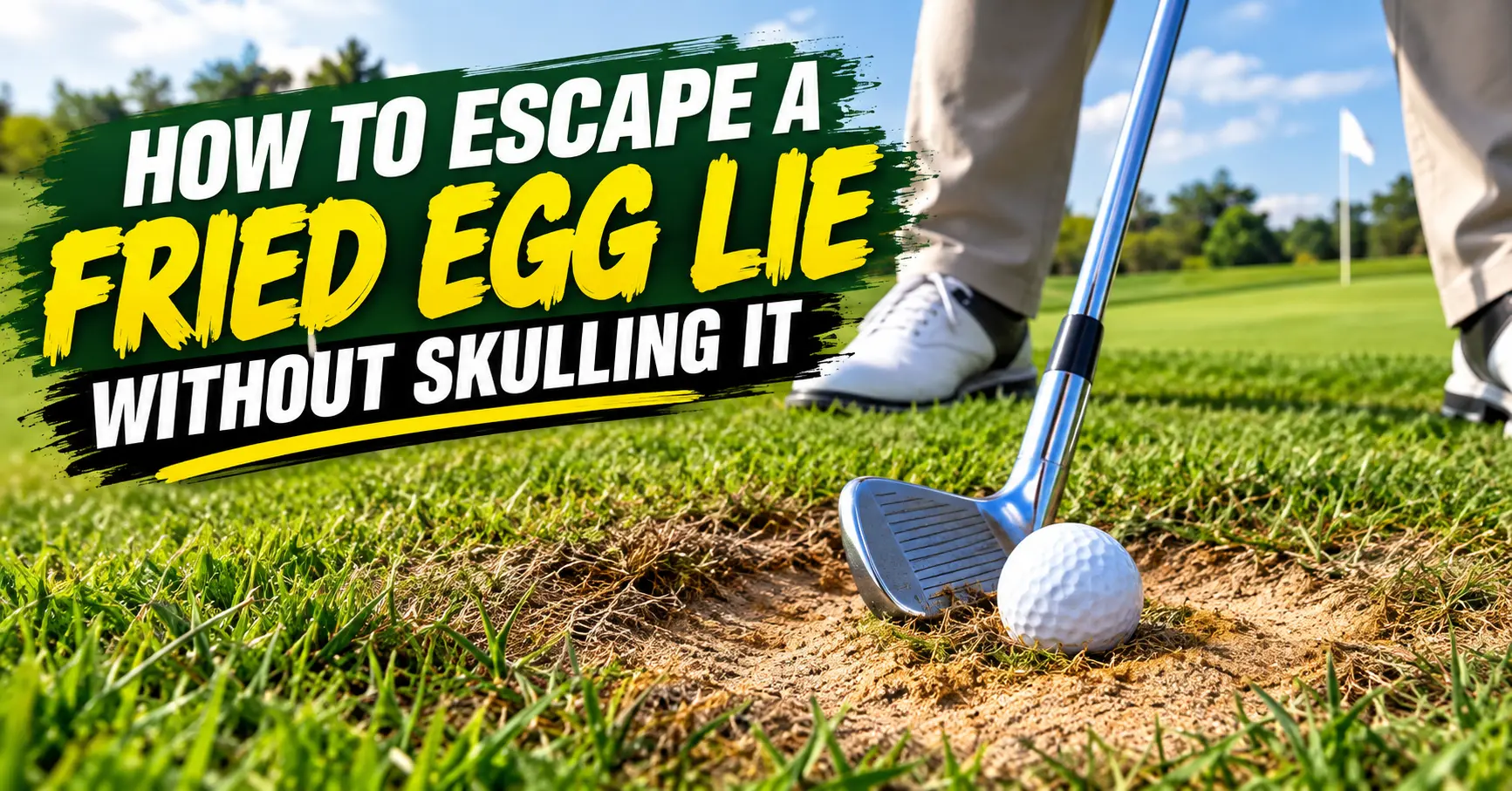
Escaping a fried egg lie comes down to one decision, and you make it before you swing. You choose which part of the wedge meets the sand. Choose wrong and the club skips off the surface, catches the top of the ball, and sends it screaming over the green.
Search this shot and you’ll find advice to open the face, square it, or shut it. All three can work. The right one depends on how steeply you can hit down and how much of the ball shows, and you’ll get the answer for your lie below. You’ll also get the rules for plugged balls, because sometimes the smartest shot is a one-stroke penalty.
Quick Answer: Square the clubface on a sand or lob wedge, set the ball one ball back of center, and put about 65 percent of your weight on your lead foot. Hit an inch behind the ball with a steep, committed swing and leave the club in the sand. Expect a low shot that runs.
Why a fried egg lie makes you skull it
Half the ball sits below the sand, and that changes the job. On a normal bunker shot the ball rests on top and your wedge slides under it. From a fried egg, the ball’s equator sits at or below the surface, so your leading edge has to get under sand level before it reaches the ball.
Two things send the shot across the green. Bounce comes first. Sand wedges commonly carry 10 to 14 degrees of it, and opening the face adds more. Swing shallow with that much sole showing and the club skips off the sand, rises, and hits the ball above its equator.
The second cause is a low point behind the ball. Most golfers arrive with their normal bunker setup of an open stance, the ball forward, and the weight centered. Then they see the plug, get nervous, and stand up. The club bottoms out early, climbs through impact, and the leading edge catches the top of the ball.
You can tell a sand skull by the sound. A click with no splash of sand means the leading edge met the ball first. Both causes have the same fix, which is to get the leading edge into the sand early and keep it moving down.
Pick the wedge with the least bounce
Sand wedge or lob wedge both work here, so let bounce decide. Check the sole, because many wedges stamp loft and bounce there, like 56-10 for a 56-degree wedge with 10 degrees of bounce. Sand wedges commonly carry 10 to 14 degrees and lob wedges 4 to 10, so the lob usually digs better. Take whichever number is lower.
Don’t buy a wedge for this shot. It’s rare enough that the lowest-bounce wedge already in your bag is the right tool.
Open, square or shut: which face works for a fried egg lie
The top results disagree. Brittany Lang, the 2016 U.S. Women’s Open champion, shuts the face and aims a little right. Rick Smith keeps the open face from a normal bunker shot, then chops down and leaves the club in the sand. Golficity’s guide squares the face so the leading edge slices through the sand.
Each one works for a reason. A steeper swing shrinks the effective bounce, so a golfer who chops almost straight down can keep the face open and still dig. Smith and Wilson staffer Brendan Steele teach it that way. Most amateurs can’t repeat that swing angle under pressure.
Skip the open face unless you can chop almost straight down. Square is the default, because it takes bounce out of the shot without demanding a perfect swing angle.
Shut the face slightly, as Lang does, when only the top of the ball shows or the sand is soft. A shut face delofts the wedge and adds dig, so the ball comes out low and hot. Right-handers should aim their body a little right, because a shut face points left. Left-handers mirror it.
Adjust the setup for how much ball shows
Match the shot to the lie in front of you. Every row assumes a right-handed golfer.
| What you see | Face | Setup | Flight | What a miss tells you |
|---|---|---|---|---|
| Half the ball shows | Square | Ball one back of center, 65 percent of weight on the lead foot | Low, then runs | Skull means the sole bounced or you stood up. Stuck in the bunker means you slowed down before impact. |
| Only the top of the ball shows | Slightly shut, body aimed a little right | Ball a little farther back, handle well ahead of the clubhead | Lower and hotter | Skull means the ball sits too far forward. Stuck in the bunker means the club dug too deep behind the ball. |
| Ball plugged in the face of the bunker | Square, shoulders tilted to match the slope | Lean into the slope and finish with the club in the sand | Higher than from flat sand, because the slope adds loft | Skull means your shoulders stayed level while the sand climbed. Stuck in the bunker means you quit before the club reached the ball. |
Sand type matters too. Fine, silty sand packs down after rain and firms up around the ball, and firm sand punishes bounce more than fluffy coarse sand does. If your course has sand like that, lean harder on the lowest-bounce wedge and the square face.
The swing, step by step
- Dig your feet in until they feel solid. Digging in your feet is legal, and a stance that shifts costs you the steep angle.
- Set the face square, or slightly shut when only the top of the ball shows, before you take your grip.
- Play the ball one ball back of center, put about 65 percent of your weight on your lead foot, and lean the handle ahead of the clubhead.
- Pick a spot about an inch behind the ball and swing to that spot.
- Make a three-quarter backswing without touching the sand, then accelerate through the sand. Sand eats speed, and a swing that slows down leaves the ball in the bunker.
- Let the clubhead stop in the sand just past where the ball sat. Don’t chase a full finish.
Advice on speed varies, so here’s how the pieces fit. Lang says keep your speed up, while GolfLink’s buried-lie guide says don’t swing hard. A smooth three-quarter swing that accelerates satisfies both, because you get the speed the sand demands without the lunge that lifts your head.
Where the ball goes once it’s out
A clean escape comes out low with little spin, and it keeps running after it lands. That changes where you aim. Land the ball two or three paces onto the green and let it release toward the pin.
Never fire at a short-sided pin from a plug. The flight is too low and the run too long, so the pin costs you more than it gives. Play to the middle of the green and count a two-putt as a good result.
No free relief from a plug, but you have four ways out
Free relief for an embedded ball applies only in the general area. A ball that plugs in bunker sand gets no free drop, so you play it as it lies or declare it unplayable. One exception matters. The grass or soil face above the sand isn’t part of the bunker, so a ball that plugs there gets free relief.
Declaring the ball unplayable gives you four options. Three cost one penalty stroke and the fourth costs two.
| Option | Penalty | Where you drop | When it fits |
|---|---|---|---|
| Stroke and distance | 1 stroke | The spot of your previous stroke | Your last shot came from outside the bunker, so the replay gets you out |
| Back on the line, inside the bunker | 1 stroke | Anywhere back on the line from the hole through the ball, inside the bunker, within one club-length | The sand behind the ball is flat and soft enough for a clean lie |
| Lateral relief, inside the bunker | 1 stroke | Within two club-lengths of the ball, no closer to the hole, inside the bunker | The ball sits against a lip and a nearby spot gives you a flat lie |
| Back on the line, outside the bunker | 2 strokes | Anywhere back on the line, outside the bunker, within one club-length | The bunker is steep or the pin is short-sided and you’d rather chip from grass |
Lateral relief is the option most golfers forget. If the ball sits against a steep lip and a spot two club-lengths away gives you a flat lie, take it. Chopping at a ball you can’t reach costs strokes, and a second failed swing costs more than the penalty.
One more rule catches players in this exact spot. Touch the sand with your club in a practice swing or a backswing and you take two penalty strokes in stroke play or lose the hole in match play. Rehearse the chop in the air. Testing the sand with your hand costs the same penalty, although digging in your feet costs nothing.
This shot isn’t for everyone
If you chunk or top regular wedge shots from the fairway, you can’t chop through a plug yet. A round isn’t the place to learn it. Take the one-stroke relief and save this shot for practice. Bury three balls in a practice bunker and chop them out until the low, running flight feels normal.
Fried egg lie FAQ
How do you hit a fried egg lie in a bunker?
Square the face of a low-bounce wedge, set the ball one ball back of center, and lean your weight forward. Hit about an inch behind the ball with a steep, accelerating swing. Stop the clubhead in the sand. The ball comes out low and runs.
What club do you use for a fried egg lie?
Sand wedge or lob wedge, whichever has less bounce. Low bounce lets the leading edge dig. Check the number on the sole, and if your lob wedge shows 4 to 10 degrees against 10 to 14 on your sand wedge, take the lob.
Should the clubface be open or closed for a fried egg lie?
Start square. Shut it slightly when only the top of the ball shows or the sand is soft, and aim your body a little right if you’re right-handed. Open it only if you can chop almost straight down, because a shallow swing with an open face bounces off the sand and skulls the ball.
What is a fried egg lie in golf?
It’s a ball that plugs in soft sand and sits about half under the surface, with a ring of displaced sand around it that looks like a sunny-side-up egg.
Do you get a free drop for a plugged ball in a bunker?
No. Embedded-ball relief applies only in the general area, so sand in a bunker gets no free drop. A ball that plugs in the grass or soil face above the sand does qualify, because that face isn’t part of the bunker.
Can you take an unplayable lie in a bunker?
Yes. You have three one-stroke options (replay from your last spot, back on the line inside the bunker, or lateral relief within two club-lengths inside the bunker) and one two-stroke option that lets you drop back on the line outside the bunker.
Before your next round
Escaping a fried egg lie starts with one habit: getting the leading edge under the ball before the sole can bounce. Build that habit in a practice bunker before the 14th hole tests it. If the ball sits under a steep lip, take the lateral drop and move on. For the bunker shots that come before the plug, start with our greenside bunker basics guide.