

Walk up to a Biarritz green and it looks like a mistake. The putting surface often runs 60 to 80 yards from front to back, and a trench cuts across the middle. Architects put the trench there on purpose. It splits the target in two and punishes any shot that finishes between the halves.
Few ideas in golf architecture start more arguments. Charles Blair Macdonald brought the Biarritz to America in the early 1900s, and his protege Seth Raynor built it again and again. A century later, golfers still love it or hate it.
Quick Answer: A Biarritz green is a long par-3 green with a deep swale that divides it into a front and back plateau. Charles Blair Macdonald copied the idea from a lost French hole, and Seth Raynor spread it across America. Land on the plateau where the pin sits, because the swale punishes everything in between.
What makes a green a Biarritz
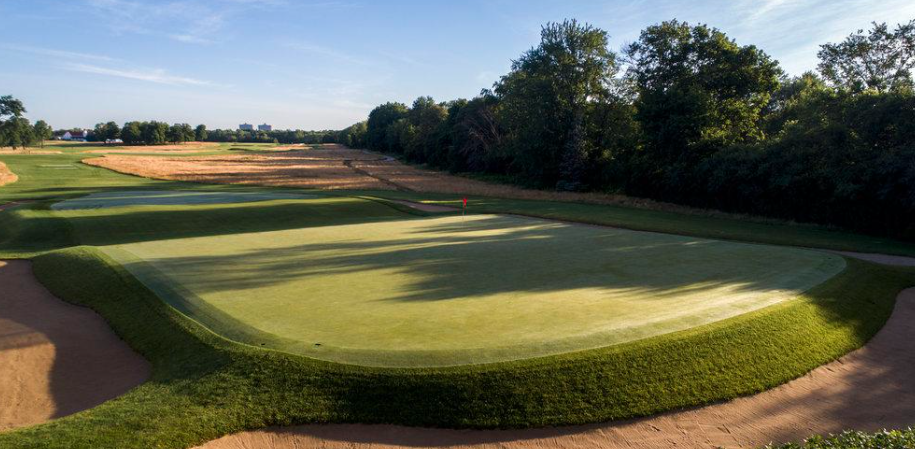
Four features define the template. First, it’s a par 3, and most traditional versions play well over 200 yards. Depth often runs 60 to 80 yards from front to back, which makes the green the biggest on almost any course that has one.
A swale cuts across the middle and splits the surface into a front plateau and a back plateau. Narrow strip bunkers run down both sides. Macdonald’s name for the raised front section was a hog’s back, and you’ll hear that term on courses that copy him.
Depth varies by course, but traditional swales drop roughly three to six feet below the plateaus. A ball that rolls in vanishes from view and reappears on the far side if it carries enough speed to climb out. Without that speed, it rolls back and leaves you putting out of a bowl.
At St Andrews, the Valley of Sin guards the front of the 18th green. The Biarritz moves that idea inside the putting surface.
Architects split hairs over the difference between a Biarritz hole and a Biarritz-style green. A Biarritz hole is the full package of long par 3, huge green, flanking bunkers, and swale. A green with a swale on a par 4, like North Berwick’s Gate hole, borrows the idea without matching the template.
The lost French hole behind the name
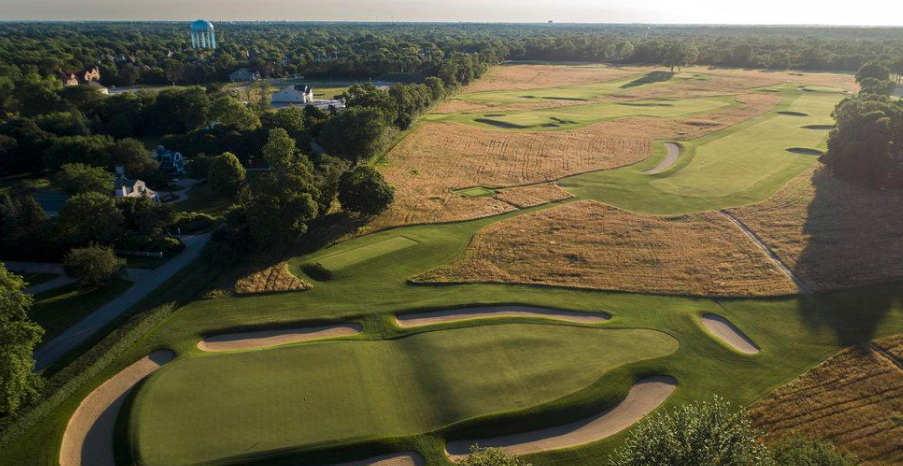
The name comes from the seaside town of Biarritz in southwest France. Willie Dunn Jr. laid out the course there in the 1880s, and its third hole, the Chasm, played across a gap between two cliffs to a long green. Nobody can measure the original now.
Macdonald saw something at Biarritz he wanted to copy, and he turned it into a template. Historians still argue over which hole there gave him the idea, because the original disappeared long ago and the surviving descriptions are thin. The Chasm gets most of the credit anyway.
Oddly, Macdonald never built a Biarritz at National Golf Links of America, the course where he built his other imports. He waited until Piping Rock on Long Island, where doubters nicknamed the result Macdonald’s Folly.
The doubters missed what the hole tests. Most par 3s ask you to hit one number. A Biarritz asks you to hit a number and then predict the roll, and that second skill gets almost no exercise on modern courses.
Seth Raynor’s recipe, and where Banks changed it
Raynor built a long list of Biarritz holes, and his versions set the pattern most golfers picture. The Course at Yale, Chicago Golf Club, Fishers Island, and Shoreacres all have one. After Raynor died in 1926, Charles Banks completed several of his projects and added his own twists.
Raynor’s recipe is easy to spot. Strip bunkers hug both sides of a long, rectangular green. The swale cuts straight across, and the two plateaus often match each other in height. Some versions press a thumbprint, a shallow round dip, into one plateau to make a pin on that half harder to get close.
Raynor’s habit of stamping out the same layout cuts both ways. You recognize a Biarritz instantly, but a Raynor version on one property looks a lot like the last, and that sameness drains some of the surprise. Tom Doak’s version at Bandon’s Old Macdonald bends the template to the dunes, and I’d take that approach over a copied blueprint every time.
Fairway height or green height in front of the swale
Clubs disagree on how to mow the front half, and the choice changes the hole more than any other setup decision. Some cut the front plateau and the swale at fairway height, so only the back plateau takes a pin. Others cut everything at green height, so either plateau takes a pin.
Purists say the original pinned only the back plateau, and nobody can prove them wrong. I side with fairway height on any Biarritz without a forced carry. A green-height front hands good players a short wedge to a front pin, and it turns a ground-game hole into a wedge contest.
A forced carry changes my answer. When water or a chasm sits in front of the green, a green-height front plateau makes the carry matter, and a front pin becomes a real test.
Check the mowing line before you play. Clubs move it, sometimes within a few years, so a hole you read about in an old article can play differently today.
The line also matters under the Rules. You can mark, lift, and clean a ball on the putting green, but in the general area you can’t do any of that for convenience unless a local rule allows it. If you can’t tell where the putting green starts, ask the starter or the committee before you tee off.
How to play a Biarritz by pin position
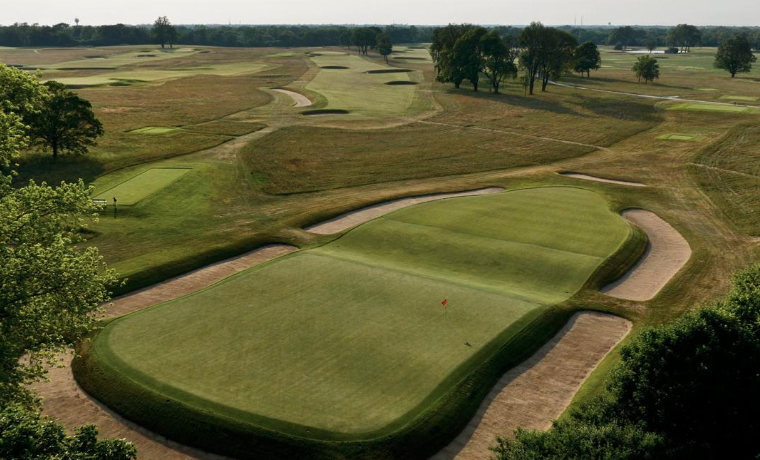
Decide the plateau first, then pick the club. The middle of a Biarritz green is the worst place to hit it, so aim at the plateau the pin sits on and treat the swale as a hazard, even though it sits inside the putting surface.
You need two numbers to do that, your carry distance and your total distance with each club. Most golfers know the second and guess at the first. On a Biarritz the carry decides everything, so learn it to within five yards on the range before you ever see the hole.
| Pin position | Where to land it | Shot to play | Biggest risk | Recovery |
|---|---|---|---|---|
| Front plateau | On the front plateau, short of the swale | High, steep ball with a club that stops quickly | Long, into the swale | Uphill putt back toward the tee |
| Back plateau, soft ground | Past the swale, on the back plateau | Carry the swale with a high ball and enough club to reach the back | Short, into the swale | Putt that must climb the far slope |
| Back plateau, firm ground | On the front edge, so the ball runs through the swale | Low runner with a 3-wood or hybrid | Thin strike that dies in the swale or drifts into a strip bunker | Putt from the bowl, or a bunker shot that has to cross the swale |
The run-in play isn’t for everyone. You need a solid 3-wood or hybrid and firm turf, and a thin strike gives you the exact outcome you wanted to avoid. If you can’t hit that club solid on demand, carry the swale and accept the back plateau.
Read the ground before you pick a plan. Check how your approach shots released on the first few greens, and look at the ball marks around the practice green. Deep marks mean the ball stops where it lands, and that kills the run-in for a back pin.
How to putt out of the swale
You’ll end up in the swale sooner or later, so learn the putt. Every swale putt climbs a slope, and the slope eats pace faster than your eyes expect.
Pick the far lip of the swale first, the point where the slope levels onto the plateau. Ask what speed gets the ball there with a little left over, then add the remaining distance to the hole. Most three-putts from a swale start with a first putt that dies halfway up the slope.
Make a longer backswing at your normal tempo. A longer stroke gives you better speed control on a big putt than a short, hard hit.
If you putt across the swale from one plateau to the other, treat it as three short putts joined together. The ball runs downhill, rolls through the flat bottom, and climbs the far slope, so pace changes twice. Read each slope separately and aim for the far lip.
Find the biggest slope on your practice green and hit putts up it until you know how much extra pace a slope takes. Ten minutes of that before a round gives you a feel for the climb.
Is the Biarritz hole obsolete?
Not while the turf stays firm. Architects can move the tee back, and a carry of 200-plus yards still demands a good strike from most golfers. A tour player can carry the swale with a short iron and hold the back plateau, but the average golfer can’t.
Soft greens do the real damage. If the ball stops where it lands, nobody uses the ground, the swale shrinks to a dip you can fly, and the hole plays like any other long par 3. Firm and fast turf keeps the run-in shot alive.
That makes the Biarritz a hole for courses that care about firm turf. A club that overwaters its greens should build something else.
Biarritz holes you can play today
Most of Raynor’s best Biarritz holes sit behind private gates, so the realistic list is short. Resort golfers can play a few. Streamsong Red in Florida has a modern version by Bill Coore and Ben Crenshaw, Old Macdonald at Bandon Dunes has Doak’s take, and Old White at The Greenbrier in West Virginia has one on a course Macdonald laid out himself.
Confirm access and mowing lines with the resort before you book, since both can change. When you get there, look for the strip bunkers first, then the ridge in front of the swale. Once you see those two, you’ll spot the rest of the template from the tee.
Biarritz green FAQ
What is a Biarritz hole in golf?
A Biarritz hole is a long par 3 with a huge green, a deep swale across the middle, and strip bunkers along both sides. Macdonald named the template after the French town where he found the idea. Most traditional examples play over 200 yards and reward golfers who control carry and roll.
Who designed the original Biarritz hole?
Willie Dunn Jr. laid out the original course at Biarritz, France, in the 1880s. Its third hole, the Chasm, gets most of the credit for the template, though historians still argue over exactly which hole inspired Macdonald.
Why is it called a Biarritz?
Macdonald named the template after the French resort town where he found the idea. Most of his other templates copy British holes, so the Biarritz stands out as the import from the Continent.
How deep is the swale on a Biarritz green?
Traditional swales drop roughly three to six feet from plateau to bottom. No governing body sets a standard, so every course differs, and some modern versions run shallower or deeper.
Is a Biarritz always a par 3?
The template is a par 3, but the swale idea shows up on longer holes. North Berwick’s Gate hole is a par 4 with a deep swale across the green, and architects still argue over whether it counts as a Biarritz or a cousin.
Where can you play a Biarritz hole?
Resort golfers can play versions at Streamsong Red, Old Macdonald, and Old White at The Greenbrier. Most of the classic Raynor examples belong to private clubs, so ask the club about guest access.
Your game plan for the next Biarritz
On any Biarritz green, pick the plateau your pin sits on, know your carry number, and keep the ball out of the middle. If the turf is firm and you strike a 3-wood solid, try the run-in once and watch the ball vanish and reappear. It’s one of the best shots in golf when it works. For more practice reading slope before your next round, read our guide to reading greens.