
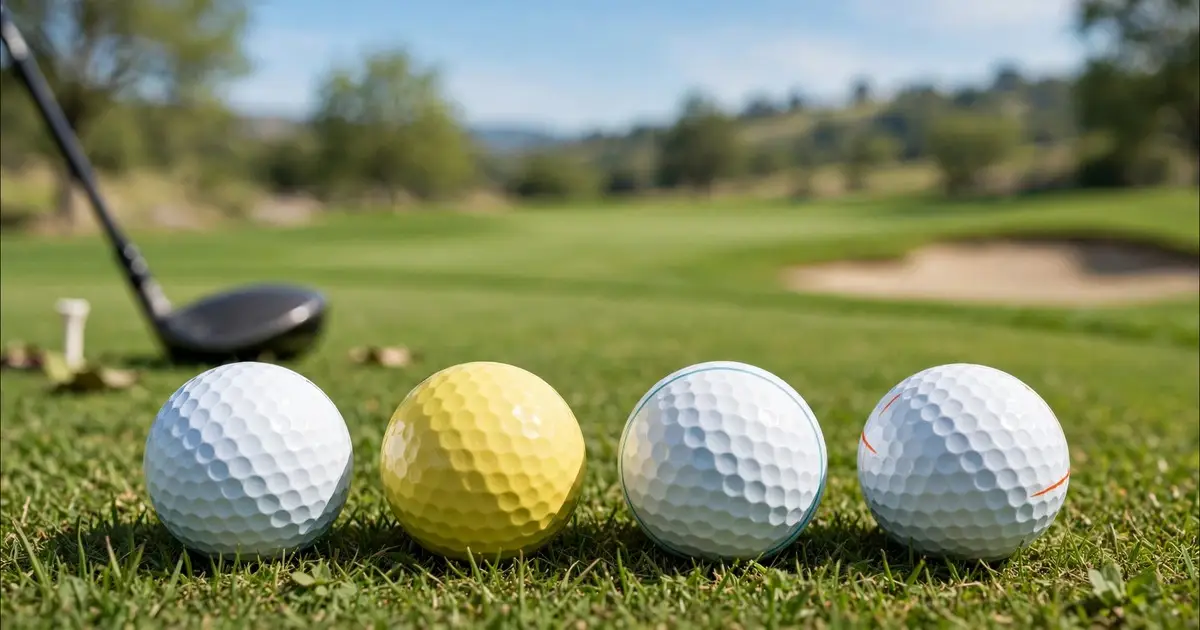
Choosing the right golf ball can be surprisingly confusing for beginners. Walk into almost any golf shop and you’ll find options promising more distance, softer feel, straighter shots and improved greenside control.
But new golfers don’t necessarily need an expensive premium ball.
For most beginners, price, consistent performance and a comfortable feel are more useful starting points than playing the same golf ball as a PGA Tour professional.
Recent golf-ball testing also shows why choosing solely by softness can be misleading. In MyGolfSpy’s 2026 robot test, which examined 48 ball models across multiple swing speeds, performance differences changed depending on the club and type of shot.
With those findings in mind, here are four golf balls worth considering in 2026, including budget-friendly options and a slightly more expensive alternative for developing players.
1. TaylorMade Noodle Long & Soft — Best Budget Starting Point
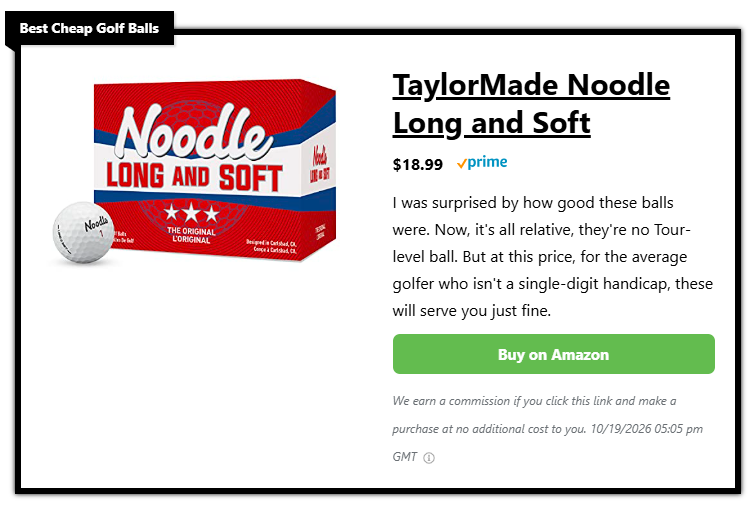
For golfers who are still learning to make consistent contact, the TaylorMade Noodle Long & Soft remains an appealing budget option.
Breaking Eighty’s August 2026 golf-ball guide also identified Noodle as its preferred beginner ball, citing its combination of practical performance and affordability.
The ball features a 34-compression core and a 342-dimple pattern designed to support distance and a soft feel.
Its biggest advantage for beginners may be financial rather than technical.
A 15-ball pack was listed at $18.99 by Academy Sports, making each ball considerably less expensive than typical premium tour models.
That matters when lost balls remain a regular part of learning the game.
However, Noodle is not designed to deliver the same greenside spin and short-game control as premium urethane-covered balls.
Best suited to: New golfers who lose several balls per round and want to keep equipment costs manageable.
Consider before buying: Check stock availability, pack size and the exact model, as TaylorMade’s own 24-ball product listing was showing as sold out during our research.
2. Callaway Supersoft — Best for Golfers Who Prefer Soft Feel
The Callaway Supersoft has long appealed to recreational golfers who want a softer sensation at impact.
Callaway’s current model uses updated core and cover construction intended to balance soft feel, distance and control.
The manufacturer’s published US price is approximately $26.99 per dozen.
For beginners who find firmer golf balls uncomfortable, Supersoft provides an accessible alternative without entering premium tour-ball pricing.
There is an important performance consideration, however.
In MyGolfSpy’s 2026 robot testing, Supersoft was among the lowest-spinning models and produced the slowest ball speed off the driver in the overall test.
That did not make it poor with every club. Its iron-distance performance was considerably more competitive under some tested conditions.
The results illustrate why golfers shouldn’t assume soft feel automatically means greater distance.
A beginner might enjoy the sensation of Supersoft while another golfer achieves better results from a firmer ball.
Best suited to: Golfers who prioritize a soft impact feel and affordable pricing.
Consider before buying: Its relatively low greenside spin may be limiting for players trying to develop more stopping power on approach and wedge shots.
3. TaylorMade SpeedSoft — A Practical Two-Piece Alternative
TaylorMade SpeedSoft is another option for beginners interested in combining a soft feel with straightforward construction.
The ball uses a two-piece design with an ionomer cover and TaylorMade’s PWRCORE technology.
The manufacturer also offers high-visibility SpeedSoft Ink designs, which could appeal to golfers who prefer a distinctive appearance.
In MyGolfSpy’s 2026 testing, SpeedSoft was selected as an ionomer option for moderate swing speeds.
The ball also produced relatively low driver spin under several testing conditions.
While lower spin can influence ball flight and distance, it does not eliminate a slice or hook caused by an incorrect clubface position or swing path.
Beginners should be careful about equipment claims suggesting a golf ball can automatically correct their swing.
The more realistic benefit is having an affordable ball with a predictable feel that they can become familiar with over several rounds.
Best suited to: Beginners seeking a soft-feeling, two-piece ball and players who want high-visibility color options.
Consider before buying: Its spin characteristics may not suit golfers looking for maximum short-game control.
4. Titleist Tour Soft — Best Step-Up Option
Not every beginner wants to purchase the least expensive golf balls available.
Some golfers progress quickly, lose relatively few balls and start paying more attention to approach-shot consistency.
For those players, the 2026 Titleist Tour Soft is worth considering.
Titleist’s updated model features a redesigned core and elastomer cover alongside a 386-dimple pattern.
The company says the ball is designed to provide distance, soft feel and improved stopping power through higher iron launch.
MyGolfSpy’s 2026 testing also identified the Tour Soft as an especially competitive ionomer-covered ball, including strong iron-spin performance relative to many alternatives.
That makes it an interesting option for developing golfers who want something beyond a basic distance ball.
However, the Tour Soft is considerably more expensive than some beginner-friendly models.
At approximately $40 per dozen, regularly losing balls can make it a costly choice.
Best suited to: Improving beginners who lose fewer balls and want to compare distance, flight and approach-shot control.
Consider before buying: Its added cost may not be justified for golfers who are still losing several balls every round.
What Should Beginners Look for in a Golf Ball?
Before choosing a specific model, new golfers should consider three important factors.
1. Price per ball
A golfer who loses several balls during every round can spend a significant amount over a season.
Buying an affordable ball makes it easier to practice and play without worrying about the cost of every mistake.
Compare prices per ball rather than per package, particularly when shopping for 12-, 15- or 24-ball packs.
2. Feel and compression
Golf balls with lower compression generally feel softer at impact, although feel also depends on the cover and overall construction.
However, the idea that every golfer with a slow swing must use the softest available ball is too simplistic.
Independent testing shows that launch conditions, spin and construction can influence performance as much as compression.
3. Greenside control
Beginners often focus on driving distance, but golf-ball choice also affects shorter shots.
A ball that produces limited greenside spin may behave differently when landing on the putting surface.
As golfers improve, evaluating wedge shots and approach performance becomes increasingly useful.
Premium urethane-covered balls generally offer greater short-game spin potential, although individual results vary.
Should Beginners Buy Expensive Golf Balls?
There is no rule preventing a beginner from playing a premium ball.
However, there is also no guarantee that spending more will lower scores.
Premium models may provide useful differences in flight and spin, but the value depends on the golfer’s needs and ability to produce repeatable shots.
A sensible approach is to start with an affordable model, become familiar with its performance and compare alternatives as ball striking improves.
Golfers should avoid constantly switching between unrelated ball models during practice if they want to develop consistent expectations for distance and short-game behavior.
Final Verdict: Which Beginner Golf Ball Makes Sense?
For a beginner who frequently loses balls, TaylorMade Noodle Long & Soft offers an economical starting point when available.
Callaway Supersoft is worth considering for golfers who particularly enjoy a soft feel.
TaylorMade SpeedSoft provides another affordable two-piece option, while Titleist Tour Soft may appeal to improving players who want to explore a different balance of flight and control.
There is no universal winner.
The most useful golf ball is one that fits the player’s budget, delivers suitable performance and can be used consistently while their game develops.
Beginners should focus on choosing a ball that suits the golf they play today—not simply the equipment used by tour professionals.